

Employment forms (3)
The paperwork of a hire
A hire produces four (4) federal records, and the employer answers for every one of them. The first is Form I-9, on which the employee attests to their citizenship or immigration status and shows a passport, a driver’s license and Social Security card, or another document from the three (3) lists, and the employer records what it examined. The second is Form W-4, the employee’s withholding certificate, which tells the employer how much federal income tax to take out of each paycheck. The third is the new-hire report to the state, and the fourth is the payroll record itself.
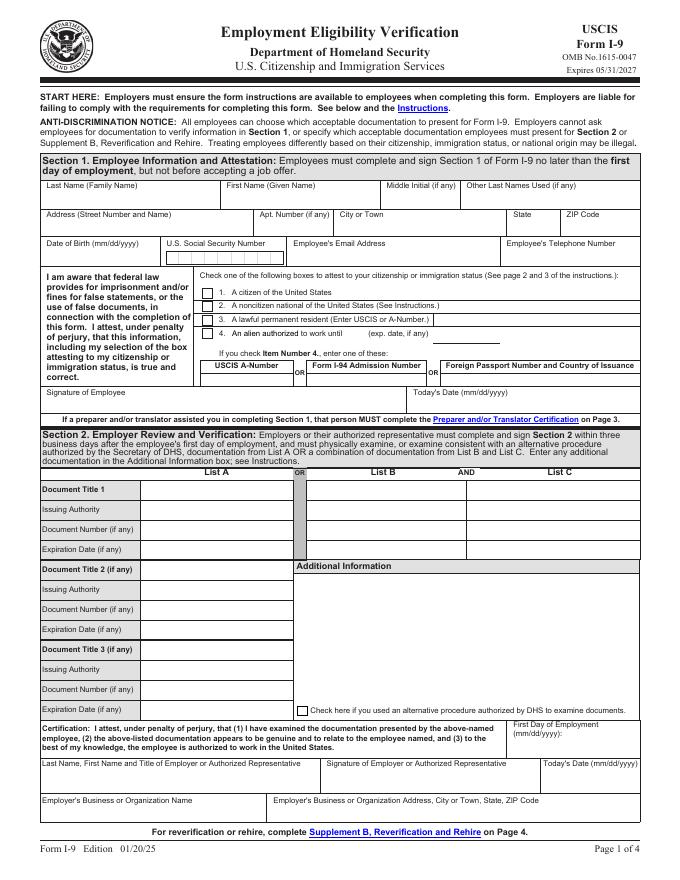
Form I-9
The employee completes Section 1 by the first day; the employer completes Section 2 within three (3) business days.
Form I-9 is a USCIS form, and the uscis.gov form page says that all U.S. employers complete one for every individual they hire for employment in the United States, and that it is not filed: the form stays in the employer’s files, never sent to USCIS or ICE. The employee’s part is due no later than the first day of employment and the employer’s part within three (3) business days of the hire, and the signed form is kept for three (3) years after the hire or one (1) year after the employment ends, whichever is later. Officers of the Department of Homeland Security, the Department of Labor and the Department of Justice may ask to inspect it. The current edition is dated 01/20/25.
Form W-4
The employee gives the signed W-4 to the employer on or before the first day of the job.
A W-4 names the employee’s filing status, dependents and any extra withholding, and the employer builds the paycheck deduction from it; under 26 U.S.C. 3402(f)(2)(A) the employee furnishes the signed certificate on or before the date employment begins. Under 26 CFR 31.6001-1(e)(2) an employer keeps its employment tax records for at least four (4) years after the due date of the tax, or the date it was paid, whichever is later, and 26 CFR 31.6001-5(a)(13) lists the withholding certificates filed by the employee among those records. Therefore a W-4 is kept at least four (4) years, counted from the due date of the tax it affected.
The new-hire report
Report the hire to the directory of the state where the employee works, within twenty (20) days.
Federal law requires each employer to report each newly hired employee to the State Directory of New Hires of the state where the employee works (42 U.S.C. 653a(b)). An employer with employees in two (2) or more states that reports electronically may send every report to one state it designates, and federal agencies report to the National Directory of New Hires (653a(b)(1)(B) and (C)). The report carries the employee’s name, address and Social Security number, the date the employee first performed services for pay, and the employer’s name, address and employer identification number, which a new business gets with Form SS-4. Each state may set the time, but the report is due no later than twenty (20) days after the hire, or, for an employer that sends reports electronically, in two (2) monthly transmissions twelve (12) to sixteen (16) days apart (653a(b)(2)). Section 653a(c) says the report is made, to the extent practicable, on a W-4 form or an equivalent, by mail or electronically. A state may set a civil penalty of up to $25 for each missed report, and $500 when the employer and employee conspired to skip it or to file a false one (653a(d)).
Payroll records
Keep a payroll record for each pay period; no particular form is prescribed.
For every employee covered by the federal minimum wage, 29 CFR 516.2(a) requires a record of the employee’s name, address and occupation, the regular hourly rate for any week with overtime due, the hours worked each workday and workweek, straight-time and overtime earnings, deductions, total wages per pay period and the date of payment. Those payroll records are preserved for at least three (3) years from the last date of entry (29 CFR 516.5). No particular order or form of records is prescribed (29 CFR 516.1(a)). The time cards and wage rate tables behind them are kept two (2) years (29 CFR 516.6).
Who completes what, and how long it is kept
| Document | Who completes it | Deadline | Kept for |
|---|---|---|---|
| Form I-9 | The employee (Section 1) and the employer (Section 2) | Section 1 by the first day of employment; Section 2 within three (3) business days of the hire | Three (3) years after the hire or one (1) year after the employment ends, whichever is later (uscis.gov form page) |
| Form W-4 | The employee | On or before the first day of the job (26 U.S.C. 3402(f)(2)(A)) | At least four (4) years after the due date or payment of the tax it affected (26 CFR 31.6001-1(e)(2), 31.6001-5(a)(13)) |
| New-hire report | The employer | No later than twenty (20) days after the hire, or two (2) monthly electronic transmissions; a state may set a shorter time (42 U.S.C. 653a(b)(2)) | No period in 653a; the state enters it in its directory within five (5) business days of receipt (653a(e)) |
| Payroll record | The employer | For each pay period (29 CFR 516.2(a)) | Three (3) years from the last entry (29 CFR 516.5); time cards and rate tables two (2) years (516.6) |
| Form W-9, for a contractor | The contractor (the payee) | Before the first payment, so that backup withholding does not apply (our W-9 page) | Four (4) years (our W-9 page) |
| Employee NDA | The employee and a representative of the company | Signed and dated by both at the hire | A copy to each party, filed (our employee NDA page) |
A contractor and a confidentiality agreement
A worker who is not an employee gives none of the four (4) records above. A business that pays an independent contractor collects a Form W-9 instead, which supplies the contractor’s taxpayer identification number for the 1099 the business files at year end. No new-hire report goes with it, because 42 U.S.C. 653a(a)(2)(A) defines the employee it covers by chapter 24 of the Internal Revenue Code, the withholding chapter, and a contractor has nothing withheld.
An employer that shares customer lists, pricing or source code with a new employee often adds an employee non-disclosure agreement to the first-day paperwork. Both sides read the agreement, the employee signs and prints their name, and a representative of the company signs with their title; each party keeps a copy. The NDA is a private contract between the two (2) of them, and no agency receives it.
Frequently asked questions
Does an employer file the I-9 and W-4 with the government?
No. Neither is filed with a government office at the hire. Form I-9 is shown to DHS, the Department of Labor or the Department of Justice when one of them asks to inspect it, and the W-4 is a record the IRS can call for under 26 CFR 31.6001-1(e)(1), which requires the records to be available for inspection by internal revenue officers at all times.
Is a new-hire report needed for a rehired employee?
Yes, when the employee has been separated from the employer for at least sixty (60) consecutive days; 42 U.S.C. 653a(a)(2)(C) treats that person as newly hired. Someone who comes back sooner is not reported again.
Which record is kept the longest?
The two run from different dates. The I-9 runs three (3) years from the hire, or one (1) year from the end of the job if that is later, so for an employee of ten (10) years it is kept eleven (11) years from the hire. The W-4 runs at least four (4) years from the due date of the tax it affected, so one that stays in force until the job ends is kept at least four (4) years after the job ends, against one (1) year for the I-9.