

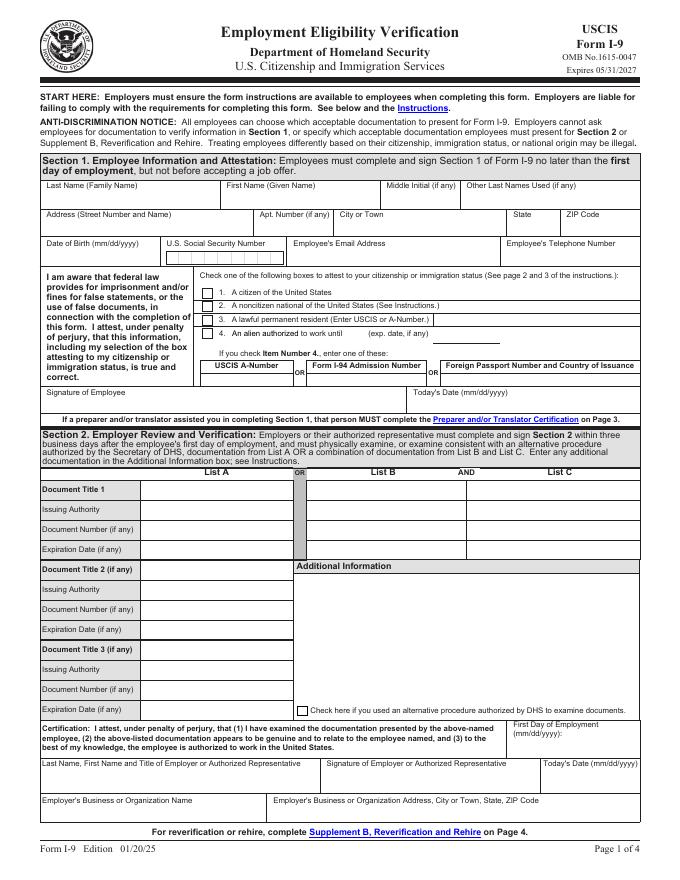
Who completes which section, and by when
Form I-9 has two (2) parties, the employee (the person hired) and the employer (the business that hires them), and page 1 gives each of them a section. The employee fills in and signs Section 1, Employee Information and Attestation, no later than the first day of employment, and may do so any time after accepting the job offer, as the Section 1 page at I-9 Central explains. The entries are the full legal name, other last names used, address, date of birth, one (1) of four (4) status boxes (U.S. citizen, noncitizen national, lawful permanent resident, or alien authorized to work) and, for the last two (2) boxes, the A-Number, Form I-94 admission number or foreign passport number that goes with the status. A Social Security number is optional on the form itself; however, an employer that uses E-Verify must have it.
The employer, or a person it appoints as its authorized representative, completes and signs Section 2, Employer Review and Verification, within three (3) business days of the date of hire, which the Section 2 page defines as the first day of work for pay. For example, an employee who starts on a Monday needs a signed Section 2 by Thursday. A job that will last under three (3) business days moves the deadline up: both sections are finished at the time of hire, and a receipt for a lost document is not accepted for a job that short (8 CFR 274a.2(b)(1)(iii)).
| Part of the form | Who completes it | Deadline |
|---|---|---|
| Section 1 | The employee | No later than the first day of employment |
| Section 2 | The employer or its authorized representative | Within three (3) business days of the first day of work for pay |
| Sections 1 and 2, job under three (3) business days | Both | At the time of hire |
| Supplement A | Each preparer or translator who helped with Section 1 | When the employee completes Section 1 |
| Supplement B, reverification | The employer | Not later than the date the employee’s work authorization expires |
| Supplement B, rehire | The employer | At a rehire within three (3) years of the original form |
Acceptable documents
The employee chooses which documents to present, and the anti-discrimination notice on page 1 bars the employer from naming one or asking for papers to prove what Section 1 says. The employer gives the employee the Lists of Acceptable Documents, on paper or as a link, before Section 1 is filled in. One (1) document from List A does the whole job; otherwise the employee presents one (1) document from List B and one (1) from List C. The acceptable documents page carries the full lists and the receipts that may stand in for a lost, stolen or damaged document. All documents containing an expiration date must be unexpired, and a document extended by its issuing authority counts as unexpired (form, page 2).
| List | Proves | Examples as the form names them |
|---|---|---|
| List A | Identity and employment authorization together | U.S. Passport or U.S. Passport Card; Permanent Resident Card (Form I-551); Employment Authorization Document with a photograph (Form I-766); foreign passport with a Form I-94 or I-94A endorsed for a specific employer |
| List B | Identity only | Driver’s license or ID card issued by a State; ID card from a federal, state or local government agency; school ID card with a photograph; voter’s registration card; U.S. Military card or draft record; U.S. Coast Guard Merchant Mariner Card; Native American tribal document; for a person under 18 with none of those, a school record, a clinic or hospital record, or a day-care record |
| List C | Employment authorization only | Social Security card that carries no work restriction; certification of report of birth from the Department of State (Forms DS-1350, FS-545, FS-240); birth certificate with an official seal from a State, county, municipal authority or territory; U.S. Citizen ID Card (Form I-197); employment authorization document issued by the Department of Homeland Security |
The employer’s task is to look at each document and decide whether it reasonably appears to be genuine and to relate to the person presenting it. Under 8 U.S.C. 1324a(b)(1)(A) an employer that examines a document meeting that test has complied, and once an acceptable set has been shown the law requires no further document; the Section 2 page says not to ask for List B or C papers when List A was presented. Documents are originals, except a certified copy of a birth certificate and the receipts the lists allow. The employer writes each document’s title, issuing authority, number and expiration date in Section 2, then hands everything back; it may copy them and keep the copies, but only for the purpose of complying with the Form I-9 rules (1324a(b)(4)).
Remote examination and authorized representatives
Check the box in Section 2 when the documents were examined remotely.
The rule is physical examination. 8 CFR 274a.2(b)(1)(ix) lets the Secretary of Homeland Security authorize an alternative procedure by notice in the Federal Register, and the Section 2 page limits that remote procedure to employers enrolled in E-Verify. An employer that used it checks the box under Additional Information that reads “Check here if you used an alternative procedure authorized by DHS to examine documents”; each row of Supplement B carries the same box.
The employer can hand Section 2 to anyone it chooses (a personnel officer, a foreman, a notary public, an agent) with no contract; however, the employer stays liable for every error that person makes. A notary who completes Section 2 is not acting as a notary and puts no seal on the form, and an employee cannot complete Section 2 of their own form.
Supplement A and Supplement B
Supplement A, preparer or translator certification
Anyone who helps the employee fill in Section 1, or translates it, completes one of the four (4) certification blocks on Supplement A (page 3) with their name and address and signs it under penalty of perjury. The employee still signs Section 1 in person, and the date beside the employee’s signature should match the date on the certification. A completed Supplement A stays with the employee’s Form I-9.
Supplement B, reverification and rehire
Use a fresh row of Supplement B for each reverification or rehire.
Supplement B (page 4) took the place of the old Section 3 and is used in three (3) cases: the employee’s work authorization is about to run out, the employee is rehired within three (3) years of the date the original form was completed, or the employee shows proof of a legal name change. When the employee’s employment authorization expires, the employer must reverify, and reverification is due not later than the date the authorization expires; the employee picks any List A or List C document to show continued authorization (8 CFR 274a.2(b)(1)(vii); form, page 4). For an Employment Authorization Document that DHS has automatically extended, reverification falls at the end of the extended period, not on the date printed on the card (8 CFR 274a.2(b)(1)(vii), 274a.13(d)). Otherwise the employee may no longer be employed. On a rehire within three (3) years, the employer may inspect the old form, confirm the person is still eligible, and enter the rehire date on Supplement B instead of starting a new Form I-9 (8 CFR 274a.2(c)(1)).
Keeping the form and inspections
Form I-9 is never filed. The uscis.gov form page says not to send it to USCIS or ICE, and the retention and storage page adds never to mail it to either. The employer keeps the signed form for three (3) years after the date of hire or one (1) year after the employment ends, whichever is later (8 U.S.C. 1324a(b)(3); 8 CFR 274a.2(b)(2)(i)(A)). What must be kept is the page where the two parties entered data, any supplement that was used and any copies of documents the employer made, on paper, microfilm, microfiche or electronically; the instructions and the Lists page are optional.
Three (3) agencies inspect: the Department of Homeland Security (through ICE’s Homeland Security Investigations), the Department of Justice’s Immigrant and Employee Rights Section, and the Department of Labor. An inspection starts with a Notice of Inspection, and the ICE fact sheet gives the employer at least three (3) business days to produce the forms (8 CFR 274a.2(b)(2)(ii)); ICE usually asks for payroll records and business licenses at the same time. A refusal or a delay counts as a retention violation under the regulation.
Penalties
The fines are set by 8 U.S.C. 1324a(e) and raised for inflation; the amounts in force, as raised by the Justice Department’s 2025 rule, sit in 28 CFR 85.5, and the column below applies to penalties assessed after July 3, 2025. The Department of Justice adjusts the figures by Federal Register notice, so check the section before relying on a figure.
| Violation | Fine |
|---|---|
| Paperwork violation, 1324a(e)(5) (a missing, late or incomplete Form I-9) | $288 to $2,861 per individual |
| Knowingly hiring or continuing to employ an unauthorized alien, first order | $716 to $5,724 per alien |
| Same, second order | $5,724 to $14,308 per alien |
| Same, third or later order | $8,586 to $28,619 per alien |
| Participating employer’s failure to notify DHS of a final nonconfirmation | $998 to $1,992 per individual |
| Requiring a bond or indemnity against liability | $2,861 per violation |
Five (5) factors are weighed for a paperwork fine (the size of the business, good faith, the seriousness of the violation, whether the individual was an unauthorized alien, and the employer’s history of violations; 1324a(e)(5)), and the ICE fact sheet shows each moving the fine up or down by 5%, to a total of 25% either way. A technical or procedural failure made in a good-faith attempt to comply is treated as compliance; however, that protection ends when the agency explains the failure and the employer does not correct it within the ten (10) business days it must be given, and it does not reach an employer with a pattern or practice of violations of the hiring and continuing-employment rules (1324a(b)(6)). A pattern or practice of hiring unauthorized aliens is a crime: a fine of up to $3,000 for each alien, up to six (6) months in prison for the entire pattern, or both (1324a(f)(1)).
Editions, signatures and the Spanish version
The current edition is dated 01/20/25 at the foot of every page and expires 05/31/2027 at the top of page 1. Of the two (2) earlier editions dated 08/01/23, the one expiring 05/31/2027 may still be used; the other ran out on 07/31/2026, which was also the day employers with electronic Form I-9 systems had to move to the newer version, according to the uscis.gov form page. Both attestations are made under penalty of perjury (8 U.S.C. 1324a(b)(1) and (2)), and the warning printed in Section 1 tells the employee that false statements and false documents can bring fines and imprisonment. The PDF can be typed into, but the signature fields cannot: the form is printed and signed by hand, because this file does not meet the DHS standards for an electronic Form I-9 system in 8 CFR 274a.2. Only an employer in Puerto Rico may complete the Spanish version instead of the English one; elsewhere the Spanish form is a translation aid and the English form is the one signed. Form I-9 is paired at hire with Form W-4, which sets federal withholding; both go to the employer, and neither is sent to a government office.
Frequently asked questions
Does a U.S. citizen have to complete Form I-9?
Yes. Every person hired for work in the United States completes Section 1, citizens included, and the employer completes Section 2 for each of them. A citizen checks box 1 and shows a document from the lists like anyone else.