

Who has to pay estimated tax
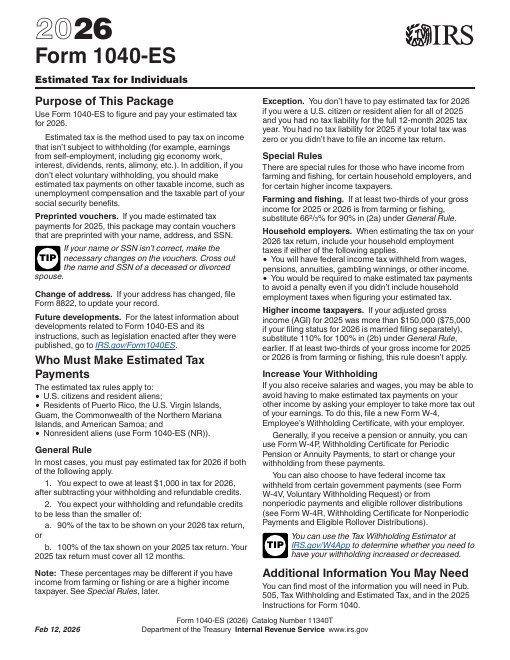
Estimated tax is how a taxpayer pays income tax on money that no employer or payer withholds from (About Form 1040-ES). Two (2) parties are involved: the taxpayer who pays and the IRS that receives each installment. It applies to U.S. citizens and resident aliens, to residents of Puerto Rico, the U.S. Virgin Islands, Guam, the Northern Mariana Islands and American Samoa, and, on the separate Form 1040-ES (NR), to nonresident aliens.
The general rule in the form’s instructions has two parts, and both must be true for 2026. The taxpayer expects to owe at least $1,000 in tax after subtracting withholding and refundable credits, and expects withholding and refundable credits to be less than the smaller of 90% of the 2026 tax or 100% of the 2025 tax. The 2025 return must cover all twelve (12) months for the 100% test to count.
However, two groups use different percentages. A taxpayer whose 2025 adjusted gross income was over $150,000 ($75,000 if married filing separately) uses 110% in place of 100%. A taxpayer with at least two-thirds of gross income from farming or fishing uses 66⅔% in place of 90%, and may instead pay everything by January 15, 2027, or file by March 1, 2027 and pay the full tax with it. A citizen or resident alien with no tax liability for the whole twelve (12) month 2025 tax year owes no estimated tax for 2026.
An employee with a side income has another choice: a new W-4 can raise the tax taken from pay, and the IRS Tax Withholding Estimator shows by how much. Publication 505 has the long-form rules.
The four due dates
Estimated tax can be paid at once by April 15, 2026, or in four equal amounts on these dates:
| Payment | Calendar-year due date |
|---|---|
| 1st | April 15, 2026 |
| 2nd | June 15, 2026 |
| 3rd | September 15, 2026 |
| 4th | January 15, 2027, but not required when the 2026 return is filed by February 1, 2027 with the full balance paid |
A mailed payment counts as paid on its postmark date, and the form warns that the USPS postmark is the date the item is processed at a facility, which may or may not be the day it is dropped off. A fiscal-year taxpayer pays on the 15th day of the 4th, 6th and 9th months of the fiscal year and the 1st month of the next one, moving to the next business day when a date falls on a Saturday, Sunday or legal holiday. More than four payments are allowed by copying an unused voucher.
A taxpayer whose income changes sharply after March 31, 2026 can use the annualized income installment method in chapter 2 of Publication 505, and then files Form 2210 with Schedule AI, even when no penalty is owed.
Before filling in the worksheet
|
Line 15 then divides the amount due, after withholding, by four for each installment, and subtracts any 2025 overpayment applied to the first one.
How to pay
| Method | Voucher | What the form says |
|---|---|---|
| Online account at IRS.gov/Account | Not required | Takes estimated tax payments and shows payment history |
| IRS Direct Pay | Not required | Transfers from a checking or savings account at no cost |
| Debit card, credit card or digital wallet | Not required | A fee is charged by the service provider |
| EFTPS | Not required | No fee, but the taxpayer must be enrolled first |
| Check or money order | Required | Payable to “United States Treasury”, with “2026 Form 1040-ES” and the SSN written on it |
Each voucher shows its due date in the upper-right corner. Spouses who file separate returns use separate vouchers, and the payment is enclosed but not stapled. Cash is not mailed.
Where the voucher is mailed
Use the address for the state of residence; the Form 1040 address is the wrong one.
| Residence | Mail the voucher and check to |
|---|---|
| Texas, Florida, California and 26 other states in the form’s first group | Internal Revenue Service, P.O. Box 1300, Charlotte, NC 28201-1300 |
| New York, Illinois, Massachusetts, the District of Columbia and 18 other states | Internal Revenue Service, P.O. Box 931100, Louisville, KY 40293-1100 |
| A foreign country, American Samoa or Puerto Rico, an APO or FPO address, or a dual-status alien | Internal Revenue Service, P.O. Box 1303, Charlotte, NC 28201-1303 |
Only the USPS delivers to P.O. boxes, so a private delivery service cannot be used. Guam and U.S. Virgin Islands bona fide residents send theirs to their own territorial tax offices. An underpayment or a late installment can bring a penalty, charged for the number of days the amount stays unpaid, and the Instructions for Form 2210 say when it is waived.
Frequently asked questions
Can a married couple pay estimated tax together?
Yes, with a joint voucher, unless one spouse is a nonresident alien, the couple is separated under a decree of divorce or separate maintenance, or the spouses have different tax years. Registered domestic partners and civil union partners cannot pay jointly.
Does the person need a Social Security number to make a payment?
The voucher asks for an SSN, or an ITIN where an SSN is requested. An ITIN that has expired does not stop a payment when the person has no SSN, and the renewal is made on a W-7.
What if the payments were made under a former name?
A statement goes on the front of the 2026 paper return, a 1040 filed in 2027. It lists every estimated payment made and the name and SSN used for each. The change of name is reported to the Social Security Administration before the return is filed.