

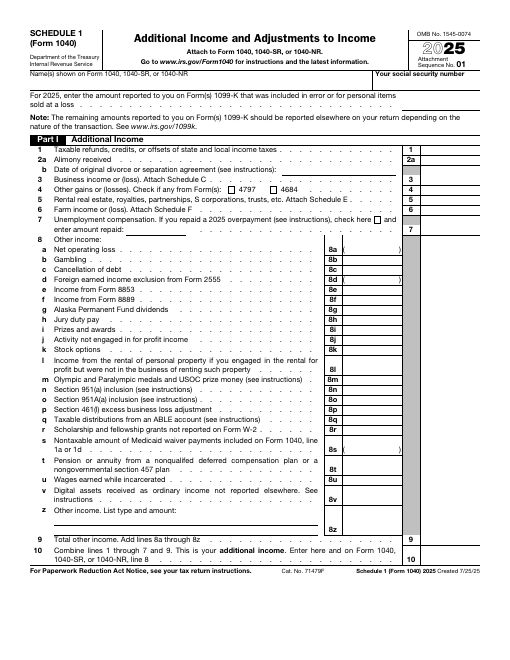
What Schedule 1 is used for
Schedule 1 carries income and adjustments that have no line of their own on the Form 1040 (About Form 1040). Two (2) parties are involved: the taxpayer and the IRS. The About page tells filers to use Part I when they have additional income, such as unemployment compensation, prize or award money or gambling winnings, and Part II when they have adjustments such as the student loan interest deduction, self-employment tax or educator expenses.
Not every return needs it. The 2025 Instructions for Forms 1040 and 1040-SR say a taxpayer may need only the Form 1040 and none of Schedules 1 through 3. Wages from a W-2 already have a line on the Form 1040, as do interest, dividends and retirement distributions.
The space above Part I takes a 1099-K entry. Amounts on a Form 1099-K that were included in error, or that came from personal items sold at a loss, are entered there. For 2025 a payment app or marketplace sends a Form 1099-K only if business transactions exceeded $20,000 and the number of transactions exceeded 200.
Part I, additional income
| Line | What goes there |
|---|---|
| 1 | A refund, credit or offset of state or local income tax, only if the tax was deducted on Schedule A in the year it was paid; a worksheet figures the taxable part |
| 2a, 2b | Alimony received under a divorce or separation agreement dated on or before December 31, 2018, plus the agreement’s date |
| 3 | Net profit or loss from Schedule C |
| 4 | Other gains or losses from Form 4797 or Form 4684 |
| 5 | Rental real estate, royalties, partnerships, S corporations and trusts, from Schedule E |
| 6 | Farm income or loss from Schedule F |
| 7 | Unemployment compensation from box 1 of Form 1099-G, reduced by an overpayment repaid in 2025 |
| 8a to 8z | Other income, listed below |
| 9, 10 | Total of lines 8a through 8z, then the total of lines 1 through 7 and 9, copied to Form 1040, line 8 |
The 2025 instructions repeat one warning for lines 8a through 8z. Income from self-employment or from fees received as a notary public goes on Schedule C, even with no expenses, and so does nonemployee compensation from a Form 1099-NEC or a Form 1099-MISC unless it is from a hobby or sporadic activity.
Line 8, other income
Each type has its own letter; line 8z is the write-in for anything else.
|
Child support, life insurance proceeds paid on a death and gifts are nontaxable and stay off line 8z.
Part II, adjustments to income
| Line | Adjustment | Figure or condition in the 2025 instructions |
|---|---|---|
| 11 | Educator expenses | $300; $600 on a joint return with two eligible educators, but never more than $300 per spouse; the educator worked at least 900 hours in a school year |
| 13 | Health savings account | Contributions, figured on Form 8889 |
| 15 | Half of self-employment tax | Line 13 of Schedule SE |
| 16 | Self-employed SEP, SIMPLE and qualified plans | Pub. 560 |
| 17 | Self-employed health insurance | The smaller of premiums paid or net profit from the business; none for months of eligibility for a subsidized employer plan |
| 18 | Early withdrawal penalty | Shown on Form 1099-INT or 1099-OID |
| 19a to 19c | Alimony paid | Same pre-2019 agreement rule as line 2a; the recipient’s SSN is required |
| 20 | IRA deduction | Worksheet; $7,000, or $8,000 at age 50 or older, before any phase-out |
| 21 | Student loan interest | Up to $2,500; modified AGI under $100,000 ($200,000 joint); not available to married filing separately |
| 23 | Archer MSA deduction | Form 8853 |
Lines 24a through 24k cover less common items, among them jury duty pay turned over to an employer, attorney fees in certain discrimination claims and contributions by certain chaplains to section 403(b) plans. Line 26 totals Part II and goes to line 10 of the Form 1040.
Signing, deadline and consequences
Schedule 1 has no signature of its own. The Form 1040 carries the taxpayer’s signature, and the schedule is stacked behind it by Attachment Sequence No., which is 01 here. It goes in the same envelope or e-file as the return, due April 15, 2026 for 2025, to the address in the 1040 instructions that matches the filer’s state.
Three line rules stand out. A married person filing separately who lived apart from the spouse all year checks the box on line 20, and without it the IRS may send a math error notice. An alimony recipient who includes the income must tell the payer a Social Security number, or a penalty may apply. A taxpayer who repaid more than $3,000 of unemployment compensation that was included in income in an earlier year is sent to Publication 525 for how to report the repayment.
Frequently asked questions
Does a return with only wages need Schedule 1?
No. The instructions note that many returns need no numbered schedule. Schedule 1 comes into play only when something on Part I or Part II applies.
Where do the two totals go?
Line 10 goes to Form 1040, line 8, and line 26 goes to Form 1040, line 10. A 1040-SR uses the same two lines.
Is gambling income reported here?
Winnings that are not from a business go on line 8b, whether the winnings come from lotteries, raffles or a lump-sum sale of future lottery payments. Losses are claimed on Schedule A.
Where do state tax refunds go?
On line 1, but only the taxable part. None of a refund is taxable if the taxpayer did not itemize in the year the tax was paid, or chose to deduct general sales taxes.