

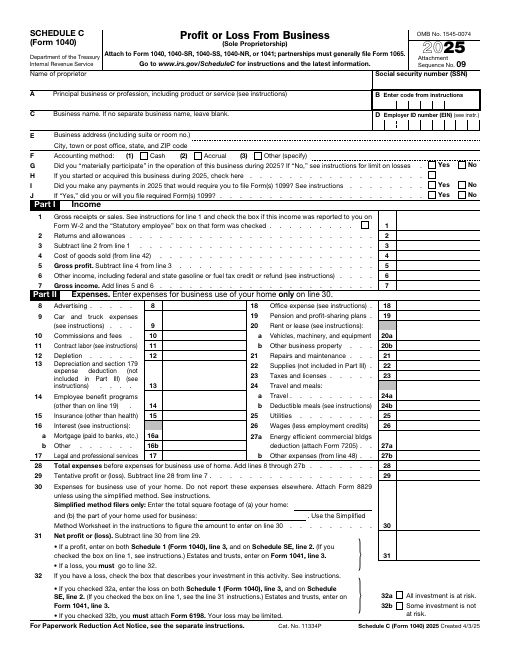
Who files Schedule C
Schedule C reports income or loss from a business run, or a profession practiced, as a sole proprietor (Instructions for Schedule C). Two (2) parties are involved: the proprietor (the owner, who is taxed on the profit) and the IRS. An activity is a business when its main purpose is income or profit and it is carried on with continuity and regularity. A sporadic activity, a not-for-profit activity or a hobby is not a business.
The schedule also takes a statutory employee’s wages and expenses, the income of a qualified joint venture, and business amounts shown on a 1099-NEC, a 1099-MISC or a Form 1099-K. The right form depends on how the business is owned.
| Owner or situation | What the instructions say |
|---|---|
| Single-member domestic LLC | Not a separate entity for federal income tax, so the owner files Schedule C (or Schedule E or F) unless the LLC elected corporate treatment on Form 8832 |
| Husband and wife who share the profits | Partners by default, so Form 1065 is the general rule; two exceptions are the qualified joint venture and a business wholly owned as community property |
| Qualified joint venture | The only two owners materially participate and file jointly; each spouse files a separate Schedule C with a share of every item, and an LLC does not qualify |
| Statutory employee | The amount in box 1 of the W-2 goes on line 1 with the box on that line checked; no self-employment tax is owed on it, because Social Security and Medicare tax were withheld |
| Estate or trust (Form 1041 filers) | The Social Security number block stays empty, the EIN goes on line D, and the result goes to Form 1041, line 3 |
A proprietor with more than one business completes a separate Schedule C for each. Someone with both self-employment income and statutory employee income files two. A single-member LLC with employees runs payroll under the LLC’s own name and EIN even though the LLC is ignored for income tax.
What each part asks for
The schedule has two pages and five parts, plus a header with lines A through J.
| Part | Lines | What goes there |
|---|---|---|
| Header | A to J | Business description and six-digit code, name, EIN, address, accounting method, material participation, new-business box, Forms 1099 questions |
| I. Income | 1 to 7 | Gross receipts, returns and allowances, cost of goods sold from line 42, gross profit, other income, and gross income on line 7 |
| II. Expenses | 8 to 32 | Expenses on lines 8 to 27b, total on 28, tentative profit on 29, home office on 30, net profit or loss on 31, loss type on 32 |
| III. Cost of goods sold | 33 to 42 | Inventory method, beginning and ending inventory, purchases, labor, materials |
| IV. Vehicle | 43 to 47b | Date placed in service and the business, commuting and other miles |
| V. Other expenses | 48 | Each expense not listed above, itemized, with the total carried to line 27b |
Line D asks for the EIN issued on Form SS-4, never a Social Security number. The instructions say an EIN is needed only for a qualified retirement plan, for employment, excise, alcohol, tobacco or firearms returns, or by a payer of gambling winnings; otherwise the line stays blank.
Line G, material participation
Check “Yes” when any one of the seven tests below is met; otherwise the activity is passive and a loss can be limited.
|
Where the profit or loss goes
Line 31 is the net figure, and where it travels depends on who files.
| Filer | Line 31 goes to |
|---|---|
| Individual | Schedule 1 (Form 1040), line 3, and Schedule SE, line 2 |
| Nonresident alien | Schedule 1, line 3; Schedule SE only if an international Social Security agreement covers the filer |
| Statutory employee | Schedule 1, line 3, but not Schedule SE, line 2 |
| Notary public | Schedule 1, line 3; Schedule SE only when there is other self-employment income |
| Estate or trust | Form 1041, line 3 |
A profit is earned income and may qualify for the earned income credit. A loss moves to line 32, where box 32a (all investment at risk) or 32b (some not at risk) must be checked. Box 32b requires Form 6198, and the instructions warn that a return with 32b checked and no Form 6198 can be delayed in processing. A passive loss needs Form 8582, and an excess business loss is figured on Form 461 and added back on Schedule 1, line 8p.
Deadlines, signing and where it is filed
Schedule C has no due date and no signature. The 2025 Form 1040 that carries it was due April 15, 2026, and a Form 4868 filed by then gave an automatic six (6) month extension to file but none to pay (Instructions for Forms 1040 and 1040-SR). The taxpayer signs the Form 1040 only. Attachments are stacked behind it by Attachment Sequence No., and Schedule C is No. 09.
| Item | Rule in the 2025 instructions |
|---|---|
| Form 4562 | Attached only for depreciation on property placed in service in 2025, depreciation on listed property, or a section 179 deduction |
| Home office, simplified method | Chosen on a timely filed original return; once made for a year it cannot be revoked |
| Forms 1099 the business must file | The e-file threshold is 10 information returns, counted across all types |
| 1099-NEC total higher than line 1 | A statement explaining the difference is attached |
Figures printed in the 2025 instructions
| Item | Amount or rule |
|---|---|
| Standard mileage rate | 70 cents per mile, plus parking fees and tolls on line 9 |
| Business meals | 50% deductible; 80% for individuals under Department of Transportation hours of service limits |
| Home office, simplified method | $5 per square foot, up to 300 square feet |
| Small business taxpayer (inventory) | Average annual gross receipts of $31 million or less for the 3 prior years |
| Section 179 | $2.5 million maximum, reduced by cost above $4 million |
| Fines and penalties paid to a government | Not deductible |
Publication 334, the Tax Guide for Small Business, covers the expense rules chapter by chapter. Late filing and late payment penalties are those of the Form 1040 the schedule rides on.
Frequently asked questions
Where does the self-employment tax get figured?
On Schedule SE, not on Schedule C. Line 31 flows to Schedule SE, and half of the resulting tax comes back as a deduction on Schedule 1, line 15.
Can a hobby be reported on Schedule C?
No. Income from a nonbusiness activity goes on Schedule 1, line 8j. The instructions give continuity, regularity and a profit motive as the test.
What address goes on line E?
The business street address, with a suite or room number if there is one, and never a box number. A business run from the home shown on page 1 of the return leaves line E blank.
Does a new business check anything special?
Yes. Line H is checked when the business was started or acquired in 2025, and also when it reopened after a temporary closing without a 2024 Schedule C.