

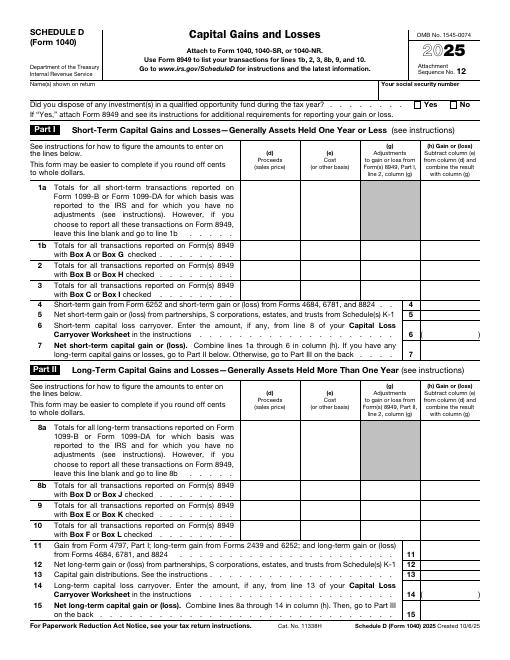
Who files Schedule D
Schedule D is the summary page for investment sales. Two (2) parties are involved: the taxpayer (the seller, who owes tax on net gain) and the IRS. The Instructions for Schedule D list what it reports: the overall result of sales listed on Form 8949, a gain from Form 2439, Form 6252 or Part I of Form 4797, gains and losses from Forms 4684, 6781 and 8824, a share of gain or loss from a partnership, S corporation, estate or trust, capital gain distributions, and a capital loss carried over from 2024.
A taxpayer with a very simple year can skip it. The Instructions for Forms 1040 and 1040-SR say no Schedule D or Form 8949 is needed when the only capital gains are capital gain distributions in box 2a of a Form 1099-DIV, there are no losses, and boxes 2b, 2c and 2d are empty. The distributions then go on line 7a and the “Schedule D not required” box on line 7b is checked.
The question at the top of the schedule asks whether any investment in a qualified opportunity fund was disposed of during the year. A “Yes” answer means Form 8949 is attached, and the instructions add Part III of Form 8997.
What each part reports
| Part | Lines | What goes there |
|---|---|---|
| I. Short-term | 1a to 7 | Sales of assets held one year or less; line 1a for broker-reported sales with basis and no adjustment, lines 1b, 2 and 3 for the Form 8949 totals by box, line 6 for a short-term carryover, line 7 for the net |
| II. Long-term | 8a to 15 | Sales of assets held more than one year; lines 8a to 10 mirror Part I, line 11 for Forms 2439, 6252, 4797 and others, line 13 for capital gain distributions, line 14 for a long-term carryover, line 15 for the net |
| III. Summary | 16 to 22 | Lines 7 and 15 combined, the gain or loss that goes to the return, and the tax worksheet choice |
Columns (d) through (h) hold proceeds, cost or other basis, adjustments from Form 8949 and the resulting gain or loss. Each column (h) is proceeds minus basis, combined with any adjustment. A holding period of more than three years applies to certain gains on partnership interests received for services.
Where line 16 goes
The instructions on the form itself send the total in one of three directions.
|
Line 18 takes the 28% rate gain worksheet (collectibles gain and a section 1202 exclusion on qualified small business stock) and line 19 the unrecaptured section 1250 gain worksheet. If lines 18 and 19 are both zero or blank and Form 4952 is not filed, the Qualified Dividends and Capital Gain Tax Worksheet in the Form 1040 instructions figures the tax. Otherwise the Schedule D Tax Worksheet does, and it applies rates of 0%, 15%, 20%, 25% and 28% to the different slices of income.
Losses, carryovers and sales that need care
A capital loss is deductible up to the amount of capital gains plus $3,000 ($1,500 if married filing separately). Line 21 enters the smaller of the line 16 loss or that limit. An unused loss becomes a carryover for the next year, figured on the Capital Loss Carryover Worksheet that feeds lines 6 and 14 the following year. If spouses once filed jointly and now file separately, a joint-return carryover is deducted only on the return of the spouse who had the loss.
| Situation | Rule in the 2025 instructions |
|---|---|
| Main home | Up to $250,000 of gain is excludable ($500,000 on a joint return) when the home was owned and used as a main home for 2 of the 5 years before sale, and no other home exclusion was used in the prior 2 years; reported on Form 8949 only if some gain is taxable or a Form 1099-S arrived (Publication 523, Selling Your Home) |
| Surviving spouse | The $500,000 limit still applies to a sale within 2 years of the spouse’s death by a filer who has not remarried, if the tests were met just before the death |
| Personal-use property | A gain is a capital gain; a loss is not deductible |
| Sale to a relative or related entity | A loss is not deductible, and Form 8949 shows it with code L |
| Wash sale | A loss is disallowed when substantially identical securities are bought within 30 days before or after the sale, including in an IRA |
| Qualified small business stock | Up to 100% of gain is excludable for stock acquired after September 27, 2010 and held over 5 years; the issuer’s gross assets must not exceed $75 million ($50 million for stock issued on or before July 4, 2025) |
| Installment sale | Reported on Form 6252 unless the seller elects out on a timely return |
A trader in securities needs a business-level pattern: profit from daily price moves, substantial activity, and continuity and regularity. Trading expenses go on a Schedule C, and securities gains are not net earnings for self-employment tax. Further detail on property sales is in Publication 544 (Sales and Other Dispositions of Assets), Publication 523 for a home sale and Publication 550 for securities, wash sales and options. The partner’s share of gain comes from the K-1 of a Form 1065, and a home or other real estate sale usually brings a Form 1099-S.
Dates, signing and the form
Schedule D has no due date and no signature of its own. The 2025 Form 1040 that carries it was due April 15, 2026, and late filing can bring interest and penalties (Instructions for Forms 1040 and 1040-SR). The taxpayer signs the Form 1040 only. Schedule D is Attachment Sequence No. 12.
The 2025 revision added Boxes G to L (called codes in the instructions) on lines 1b, 2, 3, 8b, 9 and 10 for digital asset sales, and a possible basis adjustment for a qualified opportunity fund deferral held for the 7-year period. The About page also lists a March 25, 2025 correction to line 21 of the 2018 through 2024 instructions.
Frequently asked questions
What if capital gain distributions were paid to someone else’s account?
A nominee reports on line 13 only the part that belongs to the nominee. A statement is attached showing the full amount received and the amount received as nominee.
What happens to a capital loss bigger than $3,000?
The excess is carried forward. It is figured on the Capital Loss Carryover Worksheet and enters line 6 (short-term) or line 14 (long-term) of the next year’s Schedule D.
Where does a worthless nonbusiness debt go?
A nonbusiness bad debt is treated as a short-term capital loss. It is listed in Part I of Form 8949, and Publication 550 explains which debts qualify.
Where does the gain from a K-1 go?
Line 5 takes a short-term share from partnerships, S corporations, estates and trusts, and line 12 takes the long-term share. A collectibles amount in the K-1 also feeds the 28% rate worksheet.