

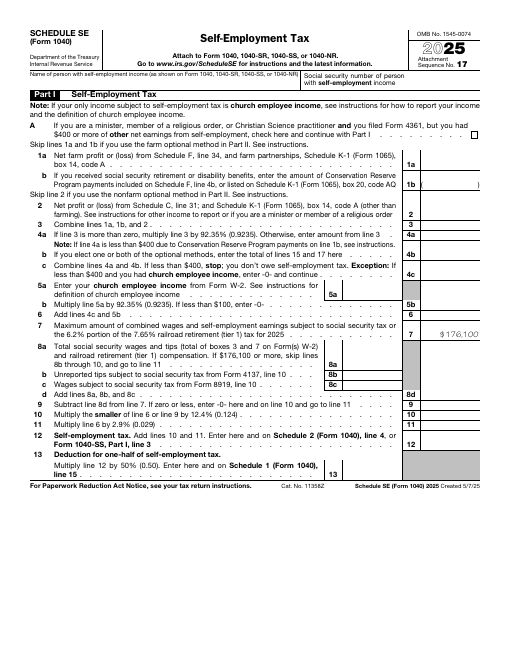
Who must file Schedule SE
Schedule SE figures the tax due on net earnings from self-employment (Instructions for Schedule SE). Two (2) parties are involved: the self-employed person (anyone in business for themselves, on a farm or off it) and the IRS. The schedule is required when line 4c is $400 or more, or when church employee income reached $108.28 or more.
The tax covers more than sole proprietors. A partner’s share of partnership income and guaranteed payments from a Form 1065 K-1 (box 14, code A) goes on the schedule, as do the earnings of a director of a corporation, a professional fiduciary and a share farmer. A person with two or more businesses combines them and figures one tax on one schedule. On a joint return the schedule carries the name of the spouse with the earnings, and each spouse with earnings files a separate one.
A few filers owe nothing or skip the schedule.
| Filer | What the instructions say |
|---|---|
| Employee with wages on a W-2 | Wages already carried Social Security and Medicare tax and are not net earnings |
| Notary public | Fees are excluded; with no other earnings, box 3 is checked on Schedule 2, line 4, with a note that the filer is exempt as a notary |
| Member of a religious sect opposed to Social Security | Exempt after IRS approval of Form 4029; box 2 is checked on Schedule 2, line 4 |
| Minister approved on Form 4361 | Exempt on that income; box 1 is checked on Schedule 2, line 4 |
| Statutory employee | The Schedule C profit stays off line 2; Social Security wages from the W-2 go on line 8a |
| Retired partner under a written lifelong retirement plan | Not net earnings, if there was no other interest and no services |
| Self-employed person abroad covered by a bilateral agreement | Attach the foreign agency’s statement and check box 3 on Schedule 2, line 4 |
How the tax is figured
Part I figures the tax on one page of lines. Net profit comes from Schedule C, line 31, or a Schedule K-1, and goes on line 2 (farm profit on line 1a).
| Line | What it does |
|---|---|
| 3 | Combines lines 1a, 1b and 2 |
| 4a | Multiplies by 92.35% (0.9235) when line 3 is above zero |
| 4c | Combines lines 4a and 4b (the optional methods); under $400, stop, because no tax is owed |
| 5a, 5b | Church employee income from the W-2, multiplied by 92.35% (nothing is carried if under $100) |
| 7 | The 2025 Social Security limit, printed as $176,100 |
| 8a to 8d | Wages and tips already taxed for Social Security: W-2 boxes 3 and 7, unreported tips from Form 4137, wages from Form 8919 |
| 10 | 12.4% of the smaller of line 6 or line 9 |
| 11 | 2.9% of line 6 |
| 12 | The tax, added from lines 10 and 11; copied to Schedule 2, line 4 |
| 13 | 50% of line 12; copied to Schedule 1, line 15 |
The IRS states the combined rate as 15.3%, made of 12.4% for Social Security and 2.9% for Medicare (self-employment tax overview). Someone with wages uses lines 8a to 9 to subtract what the employer already took. Social Security wages of $176,100 or more on line 8a skip lines 8b through 10 and go to line 11.
An extra 0.9% Additional Medicare Tax applies when line 6 across all schedules passes $250,000 for married filing jointly, $125,000 for married filing separately, or $200,000 for single, head of household and qualifying surviving spouse. The threshold drops by the amount of wages already subject to that tax, and Form 8959 figures it.
Optional methods in Part II
A filer with a loss or small profit may still file to earn Social Security credit.
Part II lets net earnings be reported at a formula amount. The maximum on line 14 is $7,240.
| Method | Conditions in the instructions | Limit on use |
|---|---|---|
| Farm | Gross farm income of $10,860 or less, or net farm profit under $7,840 | No limit on years |
| Nonfarm | Net nonfarm profit under $7,840 and under 72.189% of gross nonfarm income, and $400 of net earnings in 2 of the 3 prior years | Five (5) years, not necessarily in a row |
The farm line reports two-thirds of gross farm income, up to $7,240. Both methods used together can never produce more than $7,240. The instructions warn that the optional methods can raise the tax, and they affect the earned income credit, the child tax credits and the self-employed health insurance deduction. A method chosen on a filed return can be switched after filing with Form 1040-X.
Social Security credit, deadlines and where it goes
For 2025, one credit (quarter of coverage) was earned for each $1,810 of income subject to Social Security tax, up to four credits, so $7,240 earned all four (Publication 334). The Social Security Administration credits self-employment income only from a return filed within 3 years, 3 months and 15 days after the end of the year it was earned; a later report can lower the record but not raise it.
Schedule SE has no signature and no due date. It is attached to the Form 1040 (or 1040-SR, 1040-SS or 1040-NR) and travels with the return that was due April 15, 2026. It is mailed or e-filed together with that return, to the address in the Form 1040 instructions for the filer’s state, and a paper return stacks it by Attachment Sequence No., which is 17 here. No employer withholds the tax, and the IRS says estimated tax payments made with Form 1040-ES can be used to pay it. A taxpayer with neither a Social Security number nor an ITIN cannot pay it; the ITIN is requested on a Form W-7.
Frequently asked questions
Does the tax apply to someone already collecting Social Security?
Yes. The instructions say the tax applies at any age, and benefit receipt does not change that.
Where does the tax end up on the 1040?
Line 12 moves to Schedule 2, line 4, and from there into the total tax. The deduction on line 13 moves to Schedule 1, line 15, where it lowers adjusted gross income.
Do spouses with a joint business share a schedule?
No. When both spouses have earnings, each files their own. The same is true for a qualified joint venture, where each spouse also files a separate Schedule C.
Is a fiscal year filer treated differently?
The rate and earnings limit in effect on the day the fiscal year begins apply for the whole year, with no proration.