

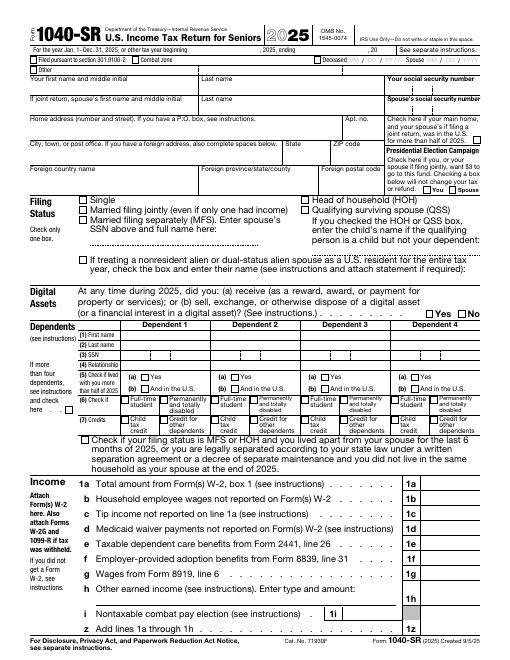
Who may file Form 1040-SR
Form 1040-SR is an optional alternative to Form 1040 for taxpayers who are 65 or older (About Form 1040). Two (2) parties are involved: the taxpayer, or a couple filing together, and the IRS. The line-by-line instructions say “everyone can file Form 1040” and that the 1040-SR is open to anyone born before January 2, 1961 (Instructions for Forms 1040 and 1040-SR).
The lines match the Form 1040 one for one, so the instructions refer to a line number on either form. Schedules 1, 2 and 3 and the lettered schedules are the same ones, and nothing about the tax changes by choosing the larger print. The 1040-SR runs four pages where the 1040 runs two.
Standard deduction chart
Add up the boxes checked on line 12d of page 2, then read the amount from the chart on page 4.
Line 12d has a box for each of these: the filer was born before January 2, 1961, the filer is blind, and the same two boxes for a spouse. The chart on the last page of the form gives the 2025 amount for the count.
| Filing status | Boxes checked | Standard deduction |
|---|---|---|
| Single | 1 | $17,750 |
| Single | 2 | $19,750 |
| Married filing jointly | 1 / 2 / 3 / 4 | $33,100 / $34,700 / $36,300 / $37,900 |
| Qualifying surviving spouse | 1 / 2 | $33,100 / $34,700 |
| Head of household | 1 / 2 | $25,625 / $27,625 |
| Married filing separately | 1 / 2 / 3 / 4 | $17,350 / $18,950 / $20,550 / $22,150 |
The chart does not apply when someone else can claim the filer (or the spouse) as a dependent, when the spouse itemizes on a separate return, or when the filer was a dual-status alien. A filer who itemizes uses Schedule A instead.
Deductions and credits for seniors
The enhanced deduction for seniors is figured in Part V of Schedule 1-A and carried to line 13b of the return. It can be taken with the standard deduction or with itemized deductions.
|
Schedule R is the separate form for the credit for the elderly or the disabled. A filer is a qualified individual at 65, or younger when retired on permanent and total disability, and a person born on January 1, 1961 counts as 65 at the end of 2025 because age 65 is reached the day before the birthday. The Schedule R instructions say the credit generally cannot be taken at these income levels.
| Filing status | Adjusted gross income of | Or nontaxable pensions and Social Security of |
|---|---|---|
| Single, head of household, qualifying surviving spouse | $17,500 or more | $5,000 or more |
| Joint, one spouse qualified | $20,000 or more | $5,000 or more |
| Joint, both spouses qualified | $25,000 or more | $7,500 or more |
| Separate, lived apart all year | $12,500 or more | $3,750 or more |
Retirement income lines
| Line | What is reported | Rule in the 2025 instructions |
|---|---|---|
| 4a, 4b | IRA distributions | A qualified charitable distribution needs the owner to be at least age 70½ and is capped at $108,000 for the year, with a one-time $54,000 limit for a split-interest entity |
| 4a, 4b | Required distributions | Must start by April 1 of the year after the year the owner reaches age 73, or an additional tax may apply |
| 5a, 5b | Pensions and annuities | Taxable part comes from the Simplified Method or General Rule when Form 1099-R shows no taxable amount |
| 6a, 6b | Social Security benefits | Form SSA-1099 box 5 goes on 6a; the worksheet starts from a $32,000 base for joint filers and $25,000 for others, and at most 85% of the benefits is taxable |
| 6c | Lump-sum election | Check the box when back benefits from an earlier year are included |
| 6d | Separate filers who lived apart | Checking it avoids a math error notice from the IRS |
A lump-sum distribution to a plan participant born before January 2, 1936 may carry less tax under Form 4972. Wages from a W-2 still go on line 1a, and retirees who owe tax on income without withholding make estimated payments with a Form 1040-ES.
Deadlines and where to mail it
The 2025 form was due April 15, 2026. Form 4868, filed by then, added an automatic six (6) months to file but nothing to pay. A citizen or resident alien who lives outside the United States and Puerto Rico, or serves in the military abroad, gets two (2) more months automatically, and four (4) more with Form 4868 filed by June 15, 2026.
A paper return goes to the address for the filer’s state, and these were the addresses for returns filed in 2026. Each one is addressed to the Internal Revenue Service, and the no-check column also starts with Department of the Treasury.
| Filer lives in | No check enclosed, or refund requested | Check or money order enclosed |
|---|---|---|
| Alabama, Florida, Georgia, Louisiana, Mississippi, North Carolina, South Carolina, Tennessee, Texas | Austin, TX 73301-0002 | P.O. Box 1214, Charlotte, NC 28201-1214 |
| Arizona, Arkansas, New Mexico, Oklahoma | Austin, TX 73301-0002 | P.O. Box 931000, Louisville, KY 40293-1000 |
| Alaska, California, Colorado, Hawaii, Idaho, Kansas, Michigan, Montana, Nebraska, Nevada, North Dakota, Ohio, Oregon, South Dakota, Utah, Washington, Wyoming | Ogden, UT 84201-0002 | P.O. Box 931000, Louisville, KY 40293-1000 |
| Connecticut, Delaware, District of Columbia, Illinois, Indiana, Iowa, Kentucky, Maine, Maryland, Massachusetts, Minnesota, Missouri, New Hampshire, New Jersey, New York, Pennsylvania, Rhode Island, Vermont, Virginia, West Virginia, Wisconsin | Kansas City, MO 64999-0002 | P.O. Box 931000, Louisville, KY 40293-1000 |
| A foreign country, U.S. territory, APO or FPO address, or a filer using Form 2555 or 4563, or a dual-status alien | Austin, TX 73301-0215 | P.O. Box 1303, Charlotte, NC 28201-1303 |
Only the U.S. Postal Service delivers to a P.O. box, so a private delivery service cannot carry a payment to one.
Signing
A joint return needs both signatures. On paper the signature is handwritten; a typed or digital one is not valid. An e-filed return is signed with a five-digit Self-Select PIN or a Practitioner PIN, and an issued Identity Protection PIN must appear in full or the return is rejected. A person who cannot sign for themselves is represented by a court-appointed conservator or guardian, who signs their name and files Form 56, or by an agent with a power of attorney attached.
Free preparation is offered to seniors by the IRS Tax Counseling for the Elderly program, which concentrates on pension and retirement questions (VITA and TCE). A paid preparer signs with a PTIN and hands back a copy.
Frequently asked questions
Does a person have to be retired to use the 1040-SR?
No. The only test in the instructions is the birth date. A filer who is still working, or whose spouse is younger, can use it.
Is the tax different on a 1040-SR?
No. The tax tables, schedules and credits are the same, and an amended 1040-SR is corrected on Form 1040-X.
Where do the senior deductions show up?
The extra standard deduction is built into line 12e through the chart, and the enhanced deduction for seniors is on line 13b from Schedule 1-A.
Can a filer born on January 1, 1961 use it?
Yes. January 1, 1961 is before January 2, 1961, so that birth date meets the 2025 test. Someone born one day later has to use the Form 1040.