

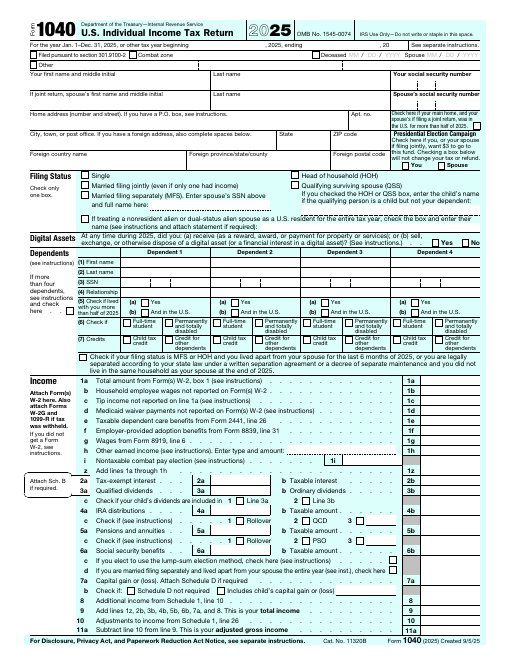
What the 1040 is for
Form 1040 is the annual income tax return for U.S. taxpayers (About Form 1040). Two (2) parties are involved: the taxpayer, or a married couple filing together, and the IRS. The first page covers filing status, dependents and income; the second covers deductions, tax, credits, payments and the refund or amount owed, and ends with the signature block.
The Instructions for Form 1040 and 1040-SR list five (5) filing statuses: single, married filing jointly, married filing separately, head of household and qualifying surviving spouse. More than one can apply, and the taxpayer picks the one with the lowest tax. Most nonresident aliens have different filing requirements and may have to file Form 1040-NR instead.
Who has to file
Chart A in the instructions sets the gross income at which a return is required for the 2025 tax year.
| Filing status | Age at the end of 2025 | File if gross income was at least |
|---|---|---|
| Single | Under 65 | $15,750 |
| Single | 65 or older | $17,750 |
| Married filing jointly | Both under 65 | $31,500 |
| Married filing jointly | One 65 or older / both 65 or older | $33,100 / $34,700 |
| Married filing separately | Any age | $5 |
| Head of household | Under 65 / 65 or older | $23,625 / $25,625 |
| Qualifying surviving spouse | Under 65 / 65 or older | $31,500 / $33,100 |
Gross income means everything received in money, goods, property and services that is not exempt from tax. A person below these figures may still file to get back withheld tax, or to claim the earned income credit, the additional child tax credit, the American opportunity credit, the premium tax credit or the refundable adoption credit. A return is required for anyone who got advance payments of the premium tax credit, with Form 8962 attached.
The schedules
The About page groups the numbered schedules by what the taxpayer has to report, and the IRS lists the lettered ones on its schedules page.
| Schedule | Use it to report |
|---|---|
| 1 | Additional income such as unemployment pay, prizes and gambling winnings, and deductions such as student loan interest and educator expenses |
| 1-A | Qualified cash tips, qualified overtime, qualified vehicle loan interest and the enhanced deduction for seniors |
| 2 | Additional taxes such as self-employment tax, household employment taxes, AMT and tax on IRAs |
| 3 | Credits not claimed on the form, such as foreign tax and education credits, and payments such as an extension payment |
| A | Itemized deductions |
| B | Interest and ordinary dividends |
| C | Profit or loss from a business run as a sole proprietor |
| D | Capital gains and losses |
| E | Rental, royalty, partnership, S corporation, estate and trust income |
| EIC | The qualifying child for the earned income credit |
| F | Farm income and expenses |
| H | Household employment taxes |
| J | Income averaging for farming or fishing |
| R | Credit for the elderly or the disabled |
| SE | Self-employment tax |
| 8812 | The child tax credit and credit for other dependents |
Wages come from the employer’s W-2, which is attached to the return, and the tax withheld goes on line 25a. A W-2G and a 1099-R are attached too when tax was withheld. Estimated tax paid during the year goes on line 26, the payments made with a 1040-ES.
Deadlines and penalties
The 2025 return was due by April 15, 2026, and the instructions say interest and penalties may follow a later filing. Form 4868 filed by that date gives an automatic six (6) month extension to file, and no extension to pay: interest runs on unpaid tax from the original date. A citizen or resident alien living outside the United States and Puerto Rico, or serving in the military outside them, gets an automatic two (2) months, and can ask for four (4) more with Form 4868 by June 15, 2026.
| Penalty | Amount in the instructions |
|---|---|
| Late filing | Usually 5% of the amount due for each month or part of a month, up to 25% |
| Late filing, over 60 days | At least $525 or the tax owed, whichever is smaller |
| Fraudulent failure to file | 15% a month, up to 75% |
| Late payment | Usually ½ of 1% of the unpaid tax for each month or part of a month, up to 25% |
| Frivolous return | $5,000 |
A refund must generally be claimed within three (3) years of the due date, extensions included.
Signing and filing
A return is not valid until it is signed; a joint return needs both spouses.
A paper return carries handwritten signatures, and digital, electronic or typed signatures are not valid on paper. An e-filed return is signed with a five-digit Self-Select PIN, any combination except five zeros, together with the prior-year adjusted gross income or prior-year PIN. A taxpayer issued an Identity Protection PIN enters all six digits, or the return is rejected. When a child cannot sign, either parent can sign the child’s name and add “parent for minor child”. A representative signs only with a power of attorney attached. A paid preparer signs with a PTIN.
The form can be e-filed with free software through the IRS Free File program, where guided software is offered at $89,000 of adjusted gross income or less and Fillable Forms at any income. A paper return is mailed to an address that depends on the state and on whether a check is enclosed. For example, a return from Texas goes to Austin, TX 73301-0002 with no payment, and to P.O. Box 1214, Charlotte, NC 28201-1214 with a check. These addresses are for returns filed in 2026, and the instructions warn that those for later years may differ.
Frequently asked questions
Which form does a taxpayer with no Social Security number use?
The same 1040, with an ITIN in place of the SSN. A first-time applicant attaches the W-7 to the front of the return and leaves the SSN space blank; the IRS assigns the number to the return.
Do the numbered schedules go in any order?
No. Schedules and forms are assembled behind the 1040 by their Attachment Sequence No. in the upper-right corner, with supporting statements last on standard size paper. Correspondence is not attached unless required.
Can a couple who file jointly change to separate returns?
Not after the due date. A couple that files jointly cannot choose separate returns for that year once the due date has passed, and each spouse is generally responsible for the whole tax and any interest or penalties.