

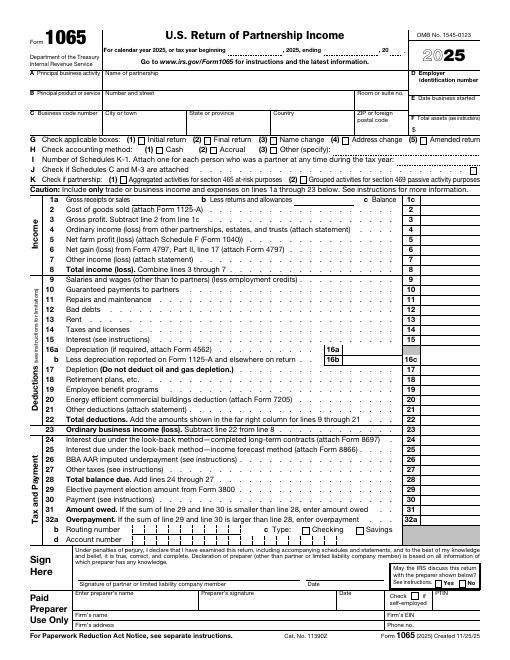
Who has to file a 1065
A partnership is two or more persons who join to carry on a trade, business, financial operation or venture, each contributing money, property, labor or skill and expecting a share of profits and losses (Instructions for Form 1065). Two (2) kinds of party appear on the return: the partnership itself and its partners, including LLC members. A written partnership agreement is not needed. Merely sharing expenses is not a partnership, and neither is co-owning rental property without providing services to the tenants.
| Situation | Files Form 1065 |
|---|---|
| Domestic partnership with income, deductions or credits | Required |
| Domestic partnership with no income and no deductions or credits | Not required |
| LLC with two or more members that never filed Form 8832 | Required |
| Spouses who are the only members and elect qualified joint venture status | Not required |
| Religious or apostolic organization exempt under section 501(d) | Required |
| Real estate mortgage investment conduit | Not required (Form 1066) |
| Publicly traded partnership taxed as a corporation | Not required (Form 1120) |
A foreign partnership with income effectively connected to a United States business, or with United States source income, files too. It is excused when it has no effectively connected income, no more than $20,000 of United States source income and less than 1% of any item allocable to direct United States partners, or when it has no effectively connected income and no United States partners, has filed its Forms 1042 and 1042-S, and has had each partner’s tax fully withheld at the source. A withholding foreign partnership gets neither exception. One filing solely to make an election gives its name, address and EIN, attaches a statement citing Regulations section 1.6031(a)-1(b)(5), and needs an EIN.
The qualified joint venture choice belongs to a married couple who file jointly, both materially participate, and hold the business in their own names and not in an LLC or other state-law entity. They make it by filing the 2025 Form 1040 jointly, each with a separate Schedule C or F (or E for rental real estate) and, where self-employment tax applies, a separate Schedule SE. It cannot be revoked without IRS consent.
Due date and extension
A domestic partnership files by the 15th day of the third month after its tax year ends, so a calendar-year partnership files by March 15. However, the instructions treat a return as timely when it is filed by the next day that is not a Saturday, Sunday or legal holiday in the District of Columbia or the state of filing. That gave March 16, 2026 for the 2025 year; March 15, 2027 falls on a Monday.
Form 7004 is filed by the regular due date and can be e-filed.
The Form 7004 instructions give the automatic extension to file as generally six (6) months, and the late-filing penalty below applies to a return not filed by the due date, extensions included.
Schedule K-1 and the partners
The partnership prepares a Schedule K-1 for every person who was a partner at any time during the year. Each partner receives it on or before the day the return is required to be filed, and the count goes in item I on page 1. A copy of every K-1 is attached to the 1065, one is kept with the partnership’s records, and when a nominee holds an interest for another person, the K-1 may have to go to the nominee. Since tax year 2024 a partnership that answered “Yes” to question 4 on Schedule B no longer files Schedules K-2 and K-3.
| Failure | Penalty in the instructions |
|---|---|
| Return late or missing required information | $255 per partner for each month or part of a month, for up to 12 months |
| Schedule K-1 late, wrong or incomplete | $340 for each K-1 |
| Yearly cap on K-1 penalties, gross receipts over $5,000,000 | $4,098,500 |
| Yearly cap on K-1 penalties, gross receipts of $5,000,000 or less | $1,366,000 |
| K-1 information intentionally disregarded | $680 or, if greater, 10% of the items, with no cap |
The partner count is everyone who held an interest during any part of the year. A penalty notice is answered with a reasonable cause explanation, and none is attached to the return itself.
The partnership representative
Unless the partnership elects out of the centralized audit regime, it names a partnership representative on each year’s 1065. The representative has sole authority to act for the partnership and must be a partner or other person with a substantial presence in the United States. An entity representative appoints an individual with the same presence, and Form 8979 changes or ends either role.
A partnership with 100 or fewer eligible partners can elect out on Schedule B-2, but only on a timely filed return, extensions included. Eligible partners are individuals, C corporations, S corporations, foreign entities that would be C corporations if domestic, and estates of deceased partners. An S corporation partner’s own shareholders count toward the 100.
E-filing and where the 1065 goes
For 2024 and later years a partnership that files ten (10) or more returns of any type in the year, with information, income tax, employment and excise returns counted together, must file the 1065 electronically. So must one with more than 100 partners, Schedules K-1 included. The IRS can waive the rule for hardship on a written request, and a partnership with a religious objection enters “Religious Exemption” at the top of page 1 of the paper return.
| Principal business, office or agency | Total assets | Send to |
|---|---|---|
| Connecticut, Delaware, District of Columbia, Georgia, Illinois, Indiana, Kentucky, Maine, Maryland, Massachusetts, Michigan, New Hampshire, New Jersey, New York, North Carolina, Ohio, Pennsylvania, Rhode Island, South Carolina, Tennessee, Vermont, Virginia, West Virginia, Wisconsin | Less than $10 million, no Schedule M-3 | Internal Revenue Service Center, Kansas City, MO 64999-0011 |
| The same states | $10 million or more, or Schedule M-3 filed | Internal Revenue Service Center, Ogden, UT 84201-0011 |
| Every other state | Any amount | Internal Revenue Service Center, Ogden, UT 84201-0011 |
| A foreign country or U.S. territory | Any amount | Internal Revenue Service, P.O. Box 409101, Ogden, UT 84409 |
A return with a Schedule M-3 must go to Ogden whatever the state.
Who signs
The 1065 is not a return until a partner or LLC member signs it. A receiver, trustee or assignee signs in that person’s place, and a trustee in bankruptcy attaches the court order. Where a partner is itself an entity, an individual authorized under state law signs for it. A paid preparer needs a PTIN, cannot write an SSN there, and gives the partnership a copy. An administrative adjustment request is signed by the partnership representative.
Frequently asked questions
Do spouses who own a business together file a 1065?
Generally yes, as partners, when they jointly own and run an unincorporated business and share its profits and losses. The qualified joint venture election above is the way out, and a business held in an LLC’s name does not qualify for it.
Can an LLC change how it is classified?
A domestic LLC with two or more members is a partnership unless it files Form 8832 to be taxed another way. A copy of that form goes with the partnership’s 1065 for the election year. An LLC that elects S corporation status reports on the 1120-S instead.
What does a foreign partnership need to file only an election?
Page 1 of the return with its name, address and EIN, plus the statement citing the regulation. A partnership without an EIN gets one first, and the SS-4 page covers that application.