

Who files a 1099-G
Form 1099-G is filed by a unit of federal, state or local government that made payments of unemployment compensation, state or local income tax refunds, credits or offsets, family leave benefits, reemployment trade adjustment assistance (RTAA) payments, taxable grants or agricultural payments (Instructions for Form 1099-G). A government unit also files it when it received payments on a Commodity Credit Corporation (CCC) loan. The payer (the government unit) is the filer, and the recipient is the person who was paid; the officer or employee in control of the payments, or one designated for the job, files it.
The instructions set a $10 floor for unemployment compensation and for tax refunds, credits and offsets. Boxes 5 and 10, and box 6 for taxable grants other than energy and tribal ones, are filed once the total paid reaches the reporting threshold in Pub. 1099 (the General Instructions). A payer must also file for any person from whom it withheld federal income tax under backup withholding, whatever the amount.
Some payments that look similar belong elsewhere. Pay for services, prizes and certain incentives go on a 1099-MISC or a 1099-NEC. Interest paid on a refund at or above the reporting threshold goes on a 1099-INT. Scholarship and fellowship grants are not reported in box 6, and a water system or state that pays for a lead service line replacement under the program in Announcement 2024-10 files nothing at all.
Revision and copies
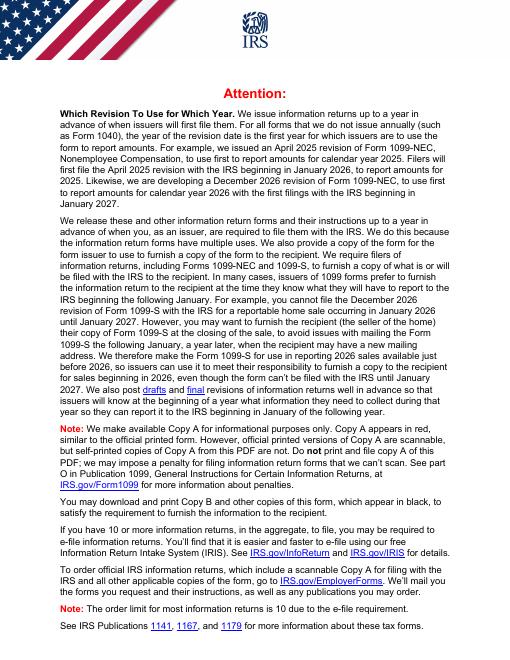
The form is the December 2026 revision, and the instructions say to use it for 2026 information filed in early 2027 and for later years until the IRS issues a replacement. A prior year needs the revision that applied to that year. The blank “For calendar year” line takes the year the payments were made.
| Copy | Goes to | Notes |
|---|---|---|
| A | The IRS | Red; sent with Form 1096 on paper; a printout from the PDF cannot be scanned, so it is not filed |
| 1 | The state tax department | Only where the state asks for a paper copy |
| B | The recipient | Black; may be printed or filled in online |
| 2 | The recipient | For the recipient’s state, city or local income tax return |
The first page of the PDF says Copy A is there for information only. Self-printed copies of it cannot be scanned, so the IRS may charge a penalty to a filer who sends one in. Copies 1, B and 2 are fillable and can be handed to recipients as they are. A filer with 10 or more information returns of any kind may be required to file them electronically, and the free IRS portal for that is IRIS. Official scannable Copy A forms are ordered from the IRS.
Boxes on the form
| Box | What it reports | What the recipient does with it |
|---|---|---|
| 1 | Unemployment compensation of $10 or more, including Railroad Retirement Board payments, before any tax was withheld | Combine all box 1 amounts and report the total on the unemployment line of the return |
| 2 | State or local income tax refunds, credits or offsets of $10 or more | May be taxable if the tax was deducted on Schedule A (Form 1040) |
| 3 | The tax year of the box 2 amount, left blank for the current year | Shows which year’s deduction the refund relates to |
| 4 | Backup withholding, or federal tax withheld at the recipient’s request | Counts as tax withheld on the return |
| 5 | RTAA payments | Other income line of Schedule 1 (Form 1040) |
| 6 | Taxable grants from a federal, state, local or tribal program | The form’s recipient instructions name no return line for it |
| 7 | USDA agricultural subsidy payments | See Pub. 225 and the Schedule F instructions |
| 8 | Checkbox: the box 2 amount is a refund of a tax that applies only to trade or business income | Reported on Schedule C or F when taxable |
| 9 | Market gain on repayment of a CCC loan | See the Schedule F instructions |
| 10 | Family leave benefits paid under a governmental paid family and medical leave program | The recipient may deduct contributions on Schedule A if itemizing |
| 11a to 12 | State, state identification number and state tax withheld, for up to two states | Not needed by the IRS |
Box 3 is written as a four-digit year, such as 2020, and refunds for more than one tax year go on separate forms. Backup withholding in box 4 applies to payments in boxes 5, 6 and 7 at a rate of 24% when the recipient gives no taxpayer identification number or the IRS sends notice CP2100 or CP2100A. Voluntary withholding is allowed on unemployment compensation, CCC loans and certain crop disaster payments but never on RTAA payments. Box 8 is checked when the box 2 refund comes from a tax that applies only to trade or business income, and the recipient then reports the taxable amount on a Schedule C or Schedule F.
Box 10 is new on this revision. It exists because Rev. Rul. 2025-4 requires states to report family leave benefits, and it moved the state boxes from 10a, 10b and 11 to 11a, 11b and 12.
Deadlines and penalties
The General Instructions for Certain Information Returns (2025 edition) put the 1099-G on the standard schedule. A due date on a Saturday, Sunday or legal holiday moves to the next business day, and a 30-day extension of the IRS filing date is available by sending Form 8809 on or before the due date.
| Step | Date | For 2026 payments |
|---|---|---|
| Statement to the recipient | January 31 | Monday, February 1, 2027 |
| Copy A to the IRS on paper | February 28 | Monday, March 1, 2027 |
| Copy A to the IRS electronically | March 31 | Wednesday, March 31, 2027 |
Part O of those instructions sets the penalty for a return due in 2026 that is filed late or with wrong information at $60 when the fix comes within thirty (30) days, $130 when it comes after that but by August 1, and $340 after August 1 or if never filed. Intentional disregard costs at least $680 per return with no cap, and reasonable cause can excuse the lower tiers. The IRS penalty table shows no amounts yet for returns due in 2027. A Form 1096 travels with every paper batch.
To correct a return already sent, the filer puts an X in the CORRECTED box, files Copy A with a new Form 1096 and gives the recipient a statement showing the change. A VOID mark does not correct anything, and an error in state or local data alone is fixed with the state tax department.
Frequently asked questions
Does a payer send a 1099-G for a state refund to someone who took the standard deduction?
The payer files with the IRS in every case. It may skip the recipient copy when it can tell the person did not itemize deductions for the year that produced the refund, except for a refund of a tax on unincorporated business income, which always gets a copy.
What should a recipient do with a 1099-G for unemployment never received?
The PDF warns that a suspected victim of identity theft should not put the box 1 amount on a return. It points to the IRS identity theft page for unemployment fraud, and the instructions point to the Department of Labor for reporting the claim.
Does the 1099-G report paid family and medical leave?
Yes, in box 10, when the total paid reaches the reporting threshold. A person who paid into the program and itemizes may treat the contributions as state or local taxes on Schedule A.
Is interest on a state refund on the 1099-G?
No. A payer that pays reportable interest on a refund files a 1099-INT for it, and the recipient reports that interest as interest income. A Form 1040 carries both lines.