

What a 1099-NEC reports
Form 1099-NEC is the information return for nonemployee compensation: money a business paid for services to someone who is not its employee (About Form 1099-NEC). Two (2) parties appear on it: the payer (the business that made the payments) and the recipient (the person or firm that did the work). The payer prepares the form, sends one copy to the IRS and another to the recipient, and the IRS compares the figure with what the recipient reports on their own return.
The Instructions for Forms 1099-MISC and 1099-NEC set four (4) conditions, and a payment that meets all of them is reported: it went to a nonemployee; it paid for services in the course of the payer’s trade or business; it went to an individual, a partnership, an estate or, in some cases, a corporation; and the payee received at least $2,000 during the year. Personal payments are not reportable. However, a nonprofit organization and a government agency both count as a trade or business here. Payments to a corporation are generally exempt, with two (2) named exceptions: attorneys’ fees, and payments by a federal executive agency to a vendor. Therefore a law firm organized as a corporation still receives the form.
The $2,000 threshold
The threshold is $2,000 for tax years beginning after 2025, and the instructions say it may be adjusted for inflation from 2027. Backup withholding overrides it: a payer that withheld federal income tax from a payee files the form whatever the amount paid.
| Payment | Form and box | Threshold |
|---|---|---|
| Services by a nonemployee, with parts and materials when supplying them was incidental to the service | 1099-NEC, box 1a | $2,000 or more |
| Fees to an attorney or law firm, corporations included | 1099-NEC, box 1a | $2,000 or more |
| Federal income tax withheld under backup withholding | 1099-NEC, box 4 | Any amount |
| Direct sales of consumer products to the recipient for resale | 1099-NEC, box 2, checkbox only | $5,000 or more |
Deadlines and where each copy goes
Section 6071(c) sets one date for the 1099-NEC: the IRS copy and the recipient’s statement are both due by January 31, on paper or electronically. When that date lands on a weekend or a legal holiday, the next business day applies. January 31, 2027 is a Sunday, so the forms for 2026 are due on Monday, February 1, 2027.
| Copy | Goes to | Deadline |
|---|---|---|
| Copy A | The IRS, with Form 1096 as the transmittal when filed on paper | January 31 |
| Copy 1 | The state tax department, when the state asks for a paper copy | Not an IRS deadline |
| Copy B | The recipient, for the federal return | January 31 |
| Copy 2 | The recipient, for the state income tax return | January 31 |
A payer with ten (10) or more information returns of all kinds in a year, W-2s and every 1099 counted together, must e-file them all, and the IRS’s own portal for that is IRIS, which costs nothing to use.
Which copies of the irs.gov PDF can be used
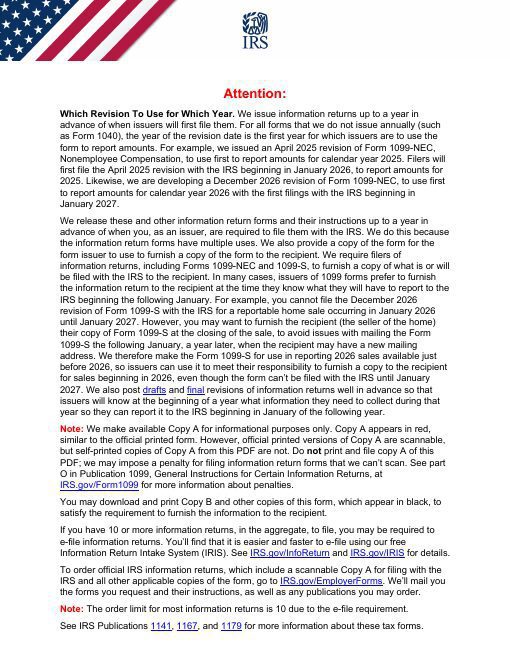
The PDF on irs.gov carries a notice on its first page: Copy A is there for information only. It prints in red like the official form, but a Copy A printed from the PDF is not scannable, and the IRS may charge a penalty for an information return it cannot scan (Form 1099-NEC PDF, page 1). The General Instructions for Certain Information Returns say the same from the other side: the IRS reads paper forms by machine, so a Copy A or a Form 1096 printed from the IRS website cannot be filed.
Copies 1, B and 2 print in black and are fillable: the payer completes them online, prints them, hands Copy B and Copy 2 to the recipient and keeps a printout for its own files (instructions, “Online fillable copies”). A scannable Copy A comes two ways: as an official printed form ordered through the IRS’s order page for information returns, or as an e-filed return through IRIS.
Before filling in the form
|
Box by box
Header and left column
Type each entry in its own box and keep the IRS’s labels in order.
The calendar year is the four (4) digits of the year the payments were made. On a paper correction the VOID box stays empty, because a checked VOID tells the scanner to skip the form. The recipient’s copies may show only the last four (4) digits of the recipient’s TIN, and the “2nd TIN not.” box gets an X only after the IRS has sent the payer two (2) incorrect-TIN notices for this payee within three (3) calendar years.
Boxes 1a through 7
Dollar entries carry cents; the state boxes are optional as far as the IRS is concerned.
| Box | IRS label | What to enter |
|---|---|---|
| 1a | Nonemployee compensation | $2,000 or more in fees, commissions, prizes and awards for services, parts and materials incidental to the service, and directors’ fees |
| 1b | Cash tips | The part of box 1a that is cash tips, paid in cash or charged |
| 1c | Treasury Tipped Occupation Code(s) | Up to two (2) three-digit codes from the IRS’s list of tipped occupations; 000 when tips came from an occupation not on the list |
| 1d | Overtime compensation | The part of box 1a above the regular rate of pay, the “half” in time-and-a-half, for overtime owed under section 7 of the Fair Labor Standards Act |
| 2 | Payer made direct sales totaling $5,000 or more | An X and no dollar amount, for consumer products sold to the recipient for resale; on this form or on the 1099-MISC, never both |
| 3 | Excess golden parachute payments | The amount above the recipient’s base amount |
| 4 | Federal income tax withheld | Backup withholding |
| 5 to 7 | State information | State tax withheld, the state abbreviation with the payer’s state number, and the state payment, with a line for each of two (2) states |
Frequently asked questions
What does the recipient do with Copy B?
The form’s own recipient instructions treat box 1a as self-employment income: a sole proprietor reports it on Schedule C or F (Form 1040) and a partnership on Form 1065 and Schedule K-1, with Schedule SE for the self-employment tax. A recipient who believes the payer treated an employee as a contractor reports the amount as wages on Form 1040 and attaches Form 8919 (Form 1099-NEC PDF, Instructions for Recipient).
Does a business that paid a contractor by card or payment app file one?
No. A payment made with a credit or payment card, or through a third-party network, is reported on Form 1099-K by the payment settlement entity, and the instructions keep those payments off the 1099-NEC and the 1099-MISC.
What happens when the contractor never gives a TIN?
The payer withholds 24% of each reportable payment until the number arrives, reports the tax in box 4 and files the form whatever the total paid. The sixty (60) day grace period for a payee who has applied for a number covers interest and dividends only; nonemployee compensation is withheld on at once (General Instructions, part N).