

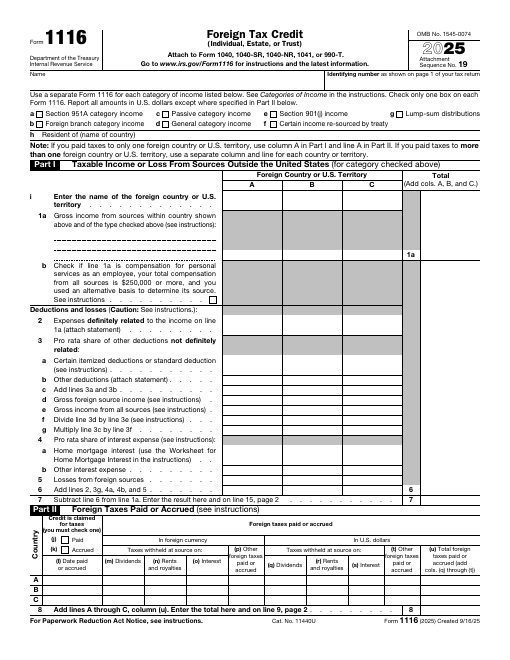
Who files Form 1116
Form 1116 is filed by an individual, estate or trust that paid or accrued foreign income tax to a foreign country or U.S. territory and wants the credit instead of a deduction (About Form 1116). A nonresident alien generally cannot take the credit, with two exceptions: residence in Puerto Rico for the whole year, or foreign tax on income effectively connected with a U.S. trade or business. Taxes paid to the U.S. Virgin Islands go on Form 8689 and not on this form (Instructions for Form 1116).
Skipping the form
Enter the smaller of the foreign tax or the regular tax on the credit line of the return.
A taxpayer can claim the credit without Form 1116 when all three conditions hold. All foreign source gross income was passive category income, such as most interest and dividends. All of that income and the foreign tax on it were reported on a qualified payee statement, for example Form 1099-DIV, Form 1099-INT or a Schedule K-1. Creditable foreign tax is not more than $300 ($600 married filing jointly). Estates and trusts cannot use this election, and the foreign tax carryovers do not apply to the years it covers.
Credit or deduction
A taxpayer can deduct foreign income tax on Schedule A instead of taking the credit, but generally cannot do both for the same year. The choice can be made or changed from deduction to credit at any time before the end of a special 10-year period (section 6511(d)(3)), and from credit to deduction within the standard 3-year period (section 6511(a)).
| Foreign tax | Credit allowed |
|---|---|
| Income, war profits and excess profits tax paid or accrued to a foreign country or U.S. territory, or a city, state or province there | Allowed |
| Tax paid in lieu of such a tax | Allowed |
| Tax the taxpayer does not legally owe, including amounts refundable by the foreign country | Not allowed |
| Tax imposed only because the U.S. credit could be claimed against it | Not allowed |
| Tax paid to a country the Secretary of State has designated as supporting international terrorism, or with which the United States has no diplomatic relations | Not allowed |
| Withholding on a dividend when the stock was held fewer than 16 days in the 31-day period that begins 15 days before the ex-dividend date | Not allowed |
| Interest or penalties the taxpayer must pay | Not allowed |
Some tax that cannot be credited can still be deducted, such as tax denied because of boycott rules or the holding-period rules.
Categories of income
A separate form is completed for each category, and only one box above Part I is checked per form.
| Box | Category | What it holds |
|---|---|---|
| a | Section 951A | Amounts included under section 951A (GILTI) by shareholders of controlled foreign corporations |
| b | Foreign branch | Business profits attributable to qualified business units in foreign countries |
| c | Passive | Dividends, interest, royalties, rents, annuities and related gains |
| d | General | Wages, salary and overseas allowances as an employee, and active business income |
| e | Section 901(j) | Income from sanctioned countries; the form is generally completed only through line 17 |
| f | Re-sourced by treaty | U.S. source income a treaty treats as foreign, when the treaty is elected |
| g | Lump-sum distributions | Foreign source lump sums when Form 4972 is elected |
Box h asks for the country of residence.
Parts of the form
Part I – Taxable income from foreign sources
Use column A for one country, and a separate column for each additional country or territory.
Line i names each country. Line 1a is gross income from that country of the category checked, and line 1b is checked for employee pay of $250,000 or more sourced on an alternative basis. Line 2 lists expenses definitely related to that income, line 3 the share of other deductions not definitely related (itemized or standard deduction, other deductions, the ratio of foreign to total gross income), line 4 the share of interest expense and line 5 losses from foreign sources. Line 6 adds them and line 7 subtracts the total from line 1a.
Part II – Foreign taxes paid or accrued
Check Paid or Accrued, then list each country on its own line.
Each row gives the date paid or accrued and the tax in the foreign currency and in U.S. dollars, split into dividends, rents and royalties, interest and other taxes (columns (l) to (u)). A taxpayer who reports on the cash basis can choose accrual by checking Accrued on a timely original return, and must then use accrual every later year. Tax reported in dollars on a Form 1099-DIV or 1099-INT is entered with “1099 taxes” in column (l). Line 8 adds column (u).
Part III – Figuring the credit
Complete lines 9 to 24 once for each category.
Line 9 carries line 8, line 10 adds carryovers (Schedule B, Form 1116) and carrybacks, and line 12 subtracts reductions such as those listed below. Line 15 is the foreign taxable income from line 7, line 17 is the net foreign source taxable income after adjustments, and line 18 is worldwide taxable income: Form 1040, 1040-SR or 1040-NR line 11b less line 14, plus Schedule 1-A line 37. Line 19 divides line 17 by line 18, line 20 is the tax from the return (Form 1040 line 16 plus Schedule 2 line 1z), and line 21 is line 20 times line 19, the maximum credit. Line 24 takes the smaller of line 14 or line 23.
Part IV – Summary of separate credits
Fill in even when only one Form 1116 is filed (new for 2025).
Lines 25 to 31 carry the line 24 amount for each category, line 32 adds them and line 33 takes the smaller of line 20 or line 32. Line 34 subtracts the reduction for international boycott operations, and line 35 is the foreign tax credit. It goes to Schedule 3 (Form 1040), line 1; Form 1041, Schedule G, line 2a; or Form 990-T, Part III, line 1a.
Reductions and penalties
Foreign tax is cut by 10% of all foreign taxes otherwise creditable when a U.S. shareholder who controls a foreign corporation fails to file Form 5471 on time, or a U.S. partner who controls a foreign partnership fails to file Form 8865; further reductions may apply if the failure continues. A dollar penalty under section 6038(b) reduces that cut. A taxpayer who does not tell the IRS about a foreign tax refund or a change in the foreign tax paid owes a penalty unless the failure is due to reasonable cause and not willful neglect. The instructions state no dollar amount for that penalty.
Deadline and where to file
Attach Form 1116 to the return; it has no separate due date or address.
The form rides with the return it supports, so the return’s due date and filing address apply. A refund of foreign tax received after filing, or another foreign tax redetermination, is generally reported on Form 1040-X with a revised Form 1116 and, for the later year, Schedule C (Form 1116). The form has no signature line of its own, and no user fee is stated. Returns that carry it include the Form 1040, Form 1040-SR and Form 1041.
Frequently asked questions
What converts foreign tax into dollars?
Tax paid is converted at the exchange rate on the day it was paid or withheld. A refund is converted at the rate in effect when the tax was paid. An accrual-basis taxpayer generally uses the average rate for the tax year to which the tax relates.
Can a taxpayer carry unused foreign tax to another year?
Yes, back one (1) year and then forward ten (10) years, for tax in a separate category that exceeds the limit. Section 951A category income has no carryovers, and line 10 stays blank on that form. Publication 514 covers the rules in more detail.
Is the credit available against the alternative minimum tax?
A foreign tax credit may be allowed in figuring that tax. The Instructions for Form 6251 and for Schedule I (Form 1041) explain how.