

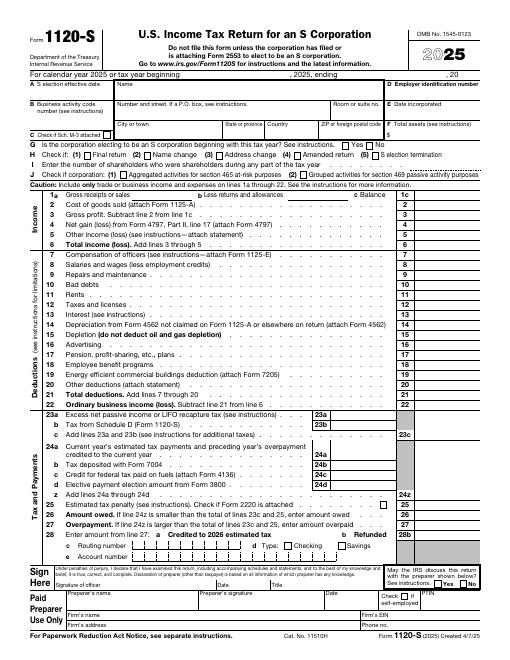
Who files a 1120-S
Form 1120-S reports the income, gains, losses, deductions and credits of a domestic corporation or other entity for any year covered by an S election (About Form 1120-S). Three (3) things must be true: the corporation elected S status on Form 2553, the IRS accepted the election, and it is still in effect (Instructions for Form 1120-S). The form says in its own heading not to file it unless Form 2553 has been filed or is attached, and no 1120-S is filed for a year before the election takes effect.
The parties are the corporation and its shareholders (the owners who receive Schedule K-1). The corporation itself can owe tax on built-in gains, excess net passive income and recaptured investment credit. Shareholders owe tax on their shares whether or not cash was distributed, and the instructions say that, unlike most partnership income, S corporation income is not self-employment income.
| How the election ends | What the instructions say |
|---|---|
| The corporation stops being a small business corporation | It ends the day the test fails; a statement goes with the final-year 1120-S |
| Three straight years of accumulated earnings and more than 25% passive gross receipts | It ends on the first day of the year after the third |
| Revocation | Shareholders holding more than 50% of the stock consent; a revocation with no date takes effect at the start of that year if made by the 15th day of its third month |
Due date and extension
Calendar-year corporations count from December 31.
The return is due by the 15th day of the third month after the tax year ends. When that day is a Saturday, Sunday or legal holiday, the corporation files on the next day that is none of those. A corporation that has dissolved counts from the date it dissolved.
| Tax year | Due date | With Form 7004 |
|---|---|---|
| Calendar year 2025 | March 16, 2026 (March 15 was a Sunday) | Generally six (6) months more |
| Calendar year 2026 | March 15, 2027 | Generally six (6) months more |
| Fiscal year | The 15th day of the third month after the year ends | Generally six (6) months more |
Form 7004 is filed by the regular due date and can be e-filed, and the Form 7004 instructions add that the extension does not extend the time to pay. Tax due is paid by the due date of the return, extensions excluded, and interest runs on late tax even with an extension. Estimated tax is due in four installments once built-in gains tax, excess net passive income tax and investment credit recapture tax together reach $500; for a calendar-year corporation the 2026 dates are April 15, June 15, September 15 and December 15.
Schedule K-1 and the shareholders
The corporation prepares a Schedule K-1 for every person who was a shareholder at any time in the year. Each is given to that shareholder on or before the day the 1120-S is required to be filed. A copy of every K-1 is attached to the return, one stays in the corporation’s records, and an amended K-1 goes with an amended return. The IRS copy carries the full taxpayer number, while the shareholder’s copy may truncate it.
Schedules K-2 and K-3 cover international items. From tax year 2024, an S corporation that answered “yes” to question 11 on Schedule B is not required to file them. Attachments go behind page 5 in the order the instructions give, starting with Form 8825, then Form 1125-A and Schedule D.
Where the return goes
An S corporation that files ten (10) or more returns of any type in a calendar year (income, employment, excise and information returns counted together) must e-file its 1120-S. The IRS can waive that for hardship on a written request, and a corporation with a religious objection writes “Religious Exemption” at the top of page 1. Otherwise the address follows the state and the size of the corporation.
| Principal business, office or agency | Total assets | Mail to |
|---|---|---|
| Connecticut, Delaware, District of Columbia, Georgia, Illinois, Indiana, Kentucky, Maine, Maryland, Massachusetts, Michigan, New Hampshire, New Jersey, New York, North Carolina, Ohio, Pennsylvania, Rhode Island, South Carolina, Tennessee, Vermont, Virginia, West Virginia, Wisconsin | Under $10 million and no Schedule M-3 | Kansas City, MO 64999-0013 |
| The same states | $10 million or more, or Schedule M-3 filed | Ogden, UT 84201-0013 |
| The other twenty-seven (27) states | Any amount | Ogden, UT 84201-0013 |
| A foreign country or U.S. territory | Any amount | P.O. Box 409101, Ogden, UT 84409 |
Each address begins “Department of the Treasury, Internal Revenue Service” except the last, which begins “Internal Revenue Service”. Private delivery services cannot deliver to the P.O. box. A corporation with a short year in 2026 that begins and ends in that year may use the 2025 form when the 2026 form is not out, showing its 2026 tax year at the top.
Who signs
The return is signed and dated by the president, vice president, treasurer, assistant treasurer, chief accounting officer or another authorized corporate officer. A receiver, trustee or assignee signs in place of the officer, and a trustee in bankruptcy attaches the court order that allows it. A paid preparer also signs, adds a PTIN, and gives the corporation a copy; an employee who completes the form leaves that section empty.
Penalties and interest
Each penalty below has a reasonable cause exception. A penalty notice is answered with a written explanation, which is never attached to the return.
| Failure | Penalty in the instructions |
|---|---|
| Late return, no tax due | $255 per shareholder for each month or part of a month, up to 12 months |
| Late return, tax due | The $255 amount plus 5% of the unpaid tax a month, up to 25% |
| Return more than 60 days late | At least the smaller of the tax due or $525, for returns required in 2026 |
| Tax paid late | ½ of 1% of the unpaid tax a month, up to 25% |
| Schedule K-1 late, wrong or incomplete | $340 each; $680 or 10% of the items, if greater, when disregard is intentional |
For example, an S corporation with four shareholders that files a no-tax return three months late owes $255 times four times three, or $3,060. The shareholder count includes everyone who held stock during any part of the year.
Frequently asked questions
Does an S corporation file a 1120-S in the year it elects?
Yes, from the year the election takes effect. A Form 2553 attached to the first 1120-S is generally a late election, and item G on page 1 asks whether the corporation is electing with this return.
Where do the corporation’s payroll taxes go?
On a separate return. The IRS page for S corporations sends employment taxes to Form 941 (Form 943 for farm employees) and Form 940, and the 941 page covers the quarterly return.
How does a partnership return differ?
A partnership files the 1065 and needs no election; an S corporation must file Form 2553 first. Both returns attach a Schedule K-1 for each owner and hand each owner a copy by the return’s due date.