

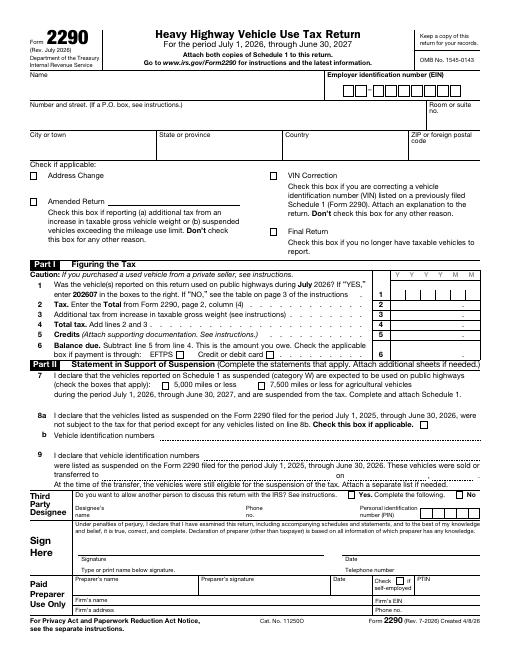
Who must file Form 2290
The Instructions for Form 2290 require a return for any taxable highway motor vehicle that is registered, or required to be registered, in the filer’s name at its first use during the tax period. The two (2) parties are the filer (the person in whose name the vehicle is registered) and the IRS.
A taxable vehicle is a self-propelled highway motor vehicle with a taxable gross weight of 55,000 pounds or more, such as a truck, truck tractor or bus. Use means driving on a U.S. public highway under the vehicle’s own power, so the drive home from the dealership is first use. A vehicle used under a dealer’s tag is treated as registered to the dealer. When a vehicle is registered in two names, the owner owes the tax, leased or not.
An EIN is required, applied for online or on Form SS-4 by fax or mail. A qualified subchapter S subsidiary or eligible single-owner disregarded entity files under its own EIN and not the owner’s.
Vehicles that need no Form 2290
|
Tax table for 2026–2027
Column (1) applies to vehicles used in July; later months use the partial-period tables in the instructions.
The tax depends on the taxable gross weight category. The table shows four of the categories A to V, with the amounts printed on page 2 of the form.
| Category | Taxable gross weight (pounds) | Annual tax | Logging vehicles |
|---|---|---|---|
| A | 55,000 | $100.00 | $75.00 |
| B | 55,001 – 56,000 | $122.00 | $91.50 |
| U | 74,001 – 75,000 | $540.00 | $405.00 |
| V | over 75,000 | $550.00 | $412.50 |
Category W holds vehicles with the tax suspended. Taxable gross weight adds the unloaded weight of the vehicle fully equipped for service, the same for any trailers customarily used with it, and the maximum load customarily carried. A bus adds 150 pounds per seat for passengers and driver. The weight declared at state registration can affect it. A weight increase into a higher category brings added tax on line 3.
Due dates
Form 2290 is due by the last day of the month after the month the vehicle is first used on a public highway in the period. It does not follow the registration renewal date. A filer who first uses vehicles in two different months files a separate return for each month, and the month goes in line 1 as year and month, for example 202607.
| First used in | File and pay by |
|---|---|
| July 2026 | August 31, 2026 |
| August 2026 | September 30, 2026 |
| September 2026 | November 2, 2026 |
| October 2026 | November 30, 2026 |
| November 2026 | December 31, 2026 |
| December 2026 | February 1, 2027 |
| January 2027 | March 1, 2027 |
| February 2027 | March 31, 2027 |
| March 2027 | April 30, 2027 |
| April 2027 | June 1, 2027 |
| May 2027 | June 30, 2027 |
| June 2027 | August 2, 2027 |
When a due date lands on a Saturday, Sunday or legal holiday, the next business day applies, which is why the September 2026 row reads November 2. A letter to the IRS in Florence, Kentucky, sent before the due date and explaining the delay, can request up to 6 months to file (the 6-month limit does not apply to taxpayers abroad). It does not extend the time to pay.
How and where to file
Returns for 25 or more taxable vehicles must be e-filed.
E-filing goes through a provider in the IRS e-file program for excise taxes, and the stamped Schedule 1 can be ready within minutes. Suspended vehicles do not count toward the 25.
A paper return goes with both copies of Schedule 1 to the address that fits the payment.
| Paper return | Mail to |
|---|---|
| Full payment by check or money order | Internal Revenue Service, P.O. Box 932500, Louisville, KY 40293-2500 |
| No payment due, or paid by EFTPS or card | Department of the Treasury, Internal Revenue Service, Ogden, UT 84201-0031 |
| Check or money order from an international financial institution | Internal Revenue Service, International Accounts, 1973 Rulon White Blvd., Ogden, UT 84201-0038 |
The tax is paid in full with the return: direct debit with an e-filed return, EFTPS (submitted by 8:00 p.m. Eastern the day before the due date), card (with a convenience fee), or a check or money order with the Form 2290-V voucher.
Suspension, credits and Schedule 1
A vehicle expected to be used on public highways 5,000 miles or less during the period (7,500 for agricultural vehicles) is suspended from the tax. It goes in category W, with the Part II statement completed. If it later passes the limit, the tax is paid on an amended return.
A credit goes on line 5 for tax already paid on a vehicle that was destroyed, stolen or sold before June 1 and not used for the rest of the period, or used 5,000 miles or less in the prior period (7,500 for agricultural vehicles). A credit above the tax is claimed as a refund on Form 8849.
The stamped Schedule 1 is the proof of payment that states generally require before they register the vehicle, and U.S. Customs and Border Protection asks for it for a Canadian or Mexican vehicle entering the country. The filer signs the return; an unsigned return is not considered filed. A paid preparer who is not an employee of the filer also signs and lists a PTIN.
Frequently asked questions
What if the truck is bought used from a private seller?
When the seller has paid the tax for the current period, the due date does not change, and the buyer enters the month after the sale on line 1 when the first use was the drive home in the month of sale. The seller can claim a credit or refund for the remaining months, and the claim includes the buyer’s name and address.
What if a penalty notice arrives for a late return?
The instructions say to send the IRS a letter explaining the reasonable cause, or to follow the relief steps on the notice. Nothing is attached to the return itself.