

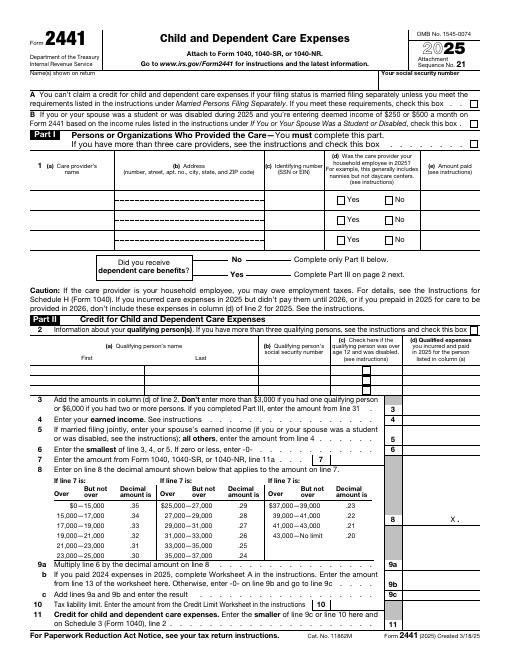
Who files Form 2441
Form 2441 is filed by a taxpayer who paid for care of a qualifying person so that the taxpayer, and a spouse on a joint return, could work or look for work, or who received dependent care benefits from an employer (About Form 2441). Two (2) parties are involved: the taxpayer and the care provider, whose name, address and taxpayer identification number are listed on the form. The form is attached to the return.
The taxpayer, and the spouse if filing jointly, must have earned income to take the credit or leave benefits out of income. A full-time student or a disabled spouse (or taxpayer) is treated as having earned income of at least $250 for each such month, or $500 with two or more qualifying persons.
All five of these conditions must be met:
|
Qualifying persons
A qualifying person is one of three people. The first is a child under age 13 whom the taxpayer can claim as a dependent (a child who turns 13 during the year counts for the part of the year before the birthday). The second is a spouse who could not care for himself or herself and lived with the taxpayer for over half the year. The third is another person who could not care for himself or herself, lived with the taxpayer for over half the year, and is a dependent or would be but for a gross income of $5,200 or more, a joint return, or the taxpayer (or the spouse on a joint return) being claimable as a dependent on another taxpayer’s 2025 return.
A person who cannot dress, clean or feed himself or herself because of a physical or mental disability, or who needs constant attention to prevent self-injury or injury to others, cannot care for himself or herself. For divorced or separated parents, the custodial parent is generally the one the child lived with for more nights in 2025, or the parent with the higher adjusted gross income if the nights were equal. The noncustodial parent generally cannot treat the child as a qualifying person.
Married filing separately
Check the box on line A only when all three conditions are met.
A married person filing separately is treated as unmarried for the credit if the person lived apart from the spouse for the last six (6) months of 2025, the home was the qualifying person’s main home for more than half of the year, and the person paid more than half the cost of keeping up that home. A person who does not meet all three generally cannot take the credit, though the exclusion for employer benefits can generally still apply.
What counts as a qualified expense
Qualified expenses are amounts paid for household services and for care of the qualifying person while the taxpayer worked or looked for work. Household services include a cook, maid, babysitter, housekeeper or cleaning person where the work is partly care of the person, and not a chauffeur, bartender or gardener. The taxpayer’s share of employment taxes paid on wages for the care services can be included.
| Expense | Qualifies |
|---|---|
| Day camp, even one built around computers or soccer | Counts |
| Care outside the home at a dependent care center that meets state and local rules, for a dependent under age 13 or a qualifying person who regularly spends at least 8 hours a day in the taxpayer’s home | Counts |
| Overnight camp, summer school or tutoring program | Does not count |
| Food, lodging, education, clothing or entertainment | Does not count, unless incidental to the care and inseparable from its cost |
| Schooling for a child in kindergarten or above | Does not count |
| Child support payments, or costs a state social service agency reimbursed | Does not count |
Only expenses incurred and paid in 2025 go in column (d) of line 2. Expenses incurred in 2025 but paid in 2026 may be usable for the 2026 credit, and care prepaid in 2025 for 2026 can only be used to figure the 2026 credit. Expenses of 2024 paid in 2025 can be figured on Worksheet A, with the result entered on line 9b.
Parts of the form
Part I – Persons or organizations who provided the care
List each provider on line 1; use a statement if there are more than three.
Each line has the provider’s name and address, an identifying number (SSN, ITIN or EIN, or “Tax-Exempt”), whether the provider was a household employee, and the amount paid in 2025. A taxpayer living abroad whose provider has no U.S. number enters “LAFCP”. A provider who is a nanny is generally a household employee, and a daycare center is not, which can mean a Schedule H and employment taxes. When the employer ran the care, the employer’s name goes in column (a), “See W-2” in column (b), and -0- in column (e).
The taxpayer can show due diligence by getting and keeping the provider’s completed Form W-10 (or another source listed in its instructions). If the provider does not give the information, the line is filled in as far as possible with “See Attached Statement” and a note explaining. Without correct or complete information the credit may be disallowed unless due diligence is shown.
Part II – Credit for child and dependent care expenses
| Line | What it holds |
|---|---|
| 2 | Each qualifying person’s name, SSN, a check box for a person over age 12 who is disabled, and expenses |
| 3 | Total of line 2 column (d), capped at $3,000 for one person and $6,000 for two or more, or the line 31 amount if Part III was completed |
| 4 and 5 | Earned income of the taxpayer and of the spouse (a spouse who is a full-time student or disabled uses the $250 or $500 monthly rule) |
| 6 | Smallest of lines 3, 4 and 5 |
| 7 and 8 | Adjusted gross income from Form 1040 line 11a, and the decimal rate from the table on the form |
| 9a to 9c | Line 6 times the rate, plus any credit on 2024 expenses from Worksheet A |
| 10 and 11 | Tax liability limit from the Credit Limit Worksheet, and the smaller of 9c or 10, carried to Schedule 3 (Form 1040), line 2 |
The rate on line 8 is .35 when line 7 is $15,000 or less, drops by .01 for each additional $2,000 of income, and stays at .20 above $43,000. The $6,000 cap applies to two or more qualifying persons even when the taxpayer spent on only one of them. Earned income generally starts with line 1z of the Form 1040, adds net earnings from Schedule SE less the Schedule 1 deduction for the deductible part of self-employment tax, and drops by any self-employment loss. Nontaxable combat pay can be elected in.
Part III – Dependent care benefits
Complete lines 12 to 26 first when an employer provided benefits.
Benefits include an employer’s direct payments to the taxpayer or provider, the value of employer-sponsored daycare, and pre-tax dependent care flexible spending account contributions. Employee benefits appear in box 10 of Form W-2; a partner finds them in box 13, code O, of Schedule K-1 (Form 1065). The most that can be excluded is $5,000 ($2,500 if married filing separately and required to enter the spouse’s earned income on line 19), or less if the employer’s plan caps it lower.
Line 26 shows taxable benefits, which go to line 1e of the Form 1040. Lines 27 to 31 let a taxpayer with benefits also claim the credit: the $3,000 or $6,000 limit is reduced by the benefits excluded or deducted (line 28), and those benefits are left out of column (d) of line 2. Line B is checked whenever deemed income of $250 or $500 a month is entered on lines 4, 5, 18 or 19.
Frequently asked questions
Can a taxpayer claim both the credit and the exclusion?
Yes. Part III reduces the $3,000 or $6,000 limit by the benefits excluded, and lines 27 to 31 carry what is left to line 3.
Can a relative be the care provider?
Yes, unless the person is the taxpayer’s spouse, the child’s parent or the taxpayer’s dependent. A child of the taxpayer must also be 19 or older by the end of the year.