

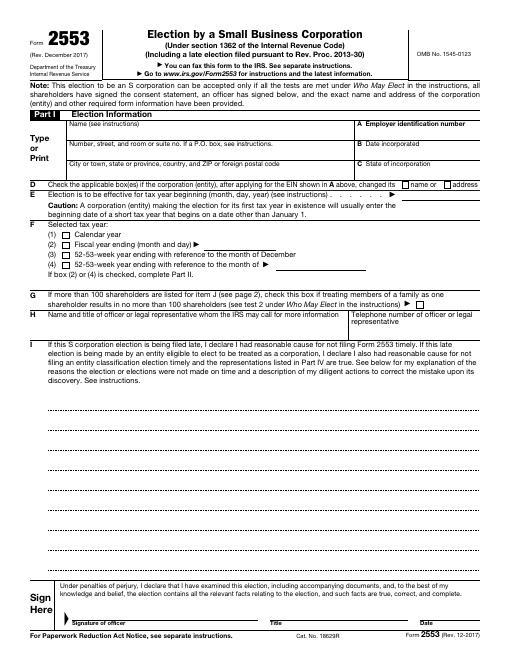
What Form 2553 does
Form 2553 is the election a corporation, or an entity that can be treated as a corporation, makes under section 1362(a) to become an S corporation (About Form 2553). Two (2) parties are involved: the corporation (the entity electing) and the IRS, which accepts or rejects the election and notifies the corporation. An S corporation’s income is generally taxed to its shareholders, although the corporation can still owe tax on some income (Instructions for Form 2553).
An entity such as an LLC that meets every test below is treated as a corporation from the election date and does not also file Form 8832. A new entity still waiting for its EIN writes “Applied For” and the date it applied in the EIN space, and the SS-4 is the paper application for the number.
Who may elect
The instructions set out the tests, all of which must be met, and the IRS page for S corporations repeats the core ones.
| Test | Rule in the instructions |
|---|---|
| Entity | A domestic corporation, or a domestic entity eligible to elect corporate treatment |
| Number of shareholders | No more than one hundred (100); an individual and spouse, or the members of one family, with their estates, count as one |
| Type of shareholder | Individuals, estates, exempt organizations under section 401(a) or 501(c)(3), and certain trusts; no nonresident alien, except as a potential current beneficiary of an electing small business trust |
| Stock | One class, ignoring differences in voting rights |
| Excluded | A bank or thrift using the reserve method for bad debts, an insurance company under subchapter L, and a DISC or former DISC |
| Tax year | December 31, a natural business year, an ownership tax year, a section 444 year or another year with a business purpose |
| Consent | Every required shareholder consents (column K) |
Deadline: two months and fifteen days
The filing window opens at any time during the tax year before the one the election covers and closes two (2) months and fifteen (15) days into the year it takes effect. The two months run from the day of the month the year begins to the close of the day before the matching day two months later, and the fifteen days follow.
| Tax year begins | Two-month period ends | Last day to file |
|---|---|---|
| January 1 | February 28 (29 in a leap year) | March 15 |
| April 1 | May 31 | June 15 |
| August 20 | October 19 | November 3 |
However, a corporation with no earlier tax year cannot file before its first year begins, because an election made earlier is not valid.
Late election relief
Write “FILED PURSUANT TO REV. PROC. 2013-30” in the top margin of page 1.
A late election generally takes effect for the following tax year. Relief is available when the corporation shows reasonable cause and diligence, explained on line I or an attached statement, and all of these are true:
|
The election can go with the current Form 1120-S when every earlier 1120-S is filed, and that return then carries “INCLUDES LATE ELECTION(S) FILED PURSUANT TO REV. PROC. 2013-30” in its top margin. A corporation that meets the first three requirements in the instructions (intent, solely late, reasonable cause) but misses the three (3) years and seventy-five (75) days limit can still ask when at least six (6) months have passed since it filed its return for the first S corporation year, it and every shareholder reported income as an S corporation, and the IRS raised no problem with the status within those six (6) months. When neither set of requirements is met, the route is a private letter ruling and a user fee.
Who signs
An officer signs and dates for the corporation: the president, vice president, treasurer, assistant treasurer, chief accounting officer or another authorized corporate officer. Each shareholder signs and dates column K or a separate consent statement, and the form says that consent is binding and cannot be withdrawn after a valid election. Timing decides who counts: for a filing before the effective date only the people holding stock that day sign, and for a filing on or after it, everyone who held stock from the effective date through the filing day signs, former shareholders included.
| Shareholder | Who consents |
|---|---|
| Spouses with a community interest in the stock or its income | Both |
| Tenants in common, joint tenants, tenants by the entirety | Each one |
| Minor | The minor, a legal representative, or a parent if none is appointed |
| Estate | The executor or administrator |
| Electing small business trust | The trustee, and the deemed owner of a grantor trust |
| Qualified subchapter S trust | The trust’s deemed owner |
Where it goes
Send the original or fax it; a photocopy is not accepted by mail.
The place follows the state of the corporation’s principal business, office or agency, as the IRS page on where to file Form 2553 shows.
| State of the business | Mail to | Fax |
|---|---|---|
| Connecticut, Delaware, District of Columbia, Georgia, Illinois, Indiana, Kentucky, Maine, Maryland, Massachusetts, Michigan, New Hampshire, New Jersey, New York, North Carolina, Ohio, Pennsylvania, Rhode Island, South Carolina, Tennessee, Vermont, Virginia, West Virginia, Wisconsin | Department of the Treasury, Internal Revenue Service Center, Kansas City, MO 64999 | 855-887-7734 |
| The other twenty-seven (27) states | Department of the Treasury, Internal Revenue Service Center, Ogden, UT 84201 | 855-214-7520 |
A corporation that faxes keeps the original with its permanent records. The IRS notice of acceptance or rejection generally arrives within sixty (60) days; when none has come after two (2) months, the instructions give 800-829-4933 for follow-up.
Proof of filing is a timely postmarked certified or registered mail receipt, a form stamped accepted or received, or an IRS letter of acceptance.
Fiscal year fee, then the 1120-S
A corporation that asks for a fiscal year on a business purpose checks box Q1 and is billed a $6,200 user fee later (subject to change); it does not pay with the form, and the answer takes about ninety (90) days longer. Until the election takes effect, the corporation keeps filing Form 1120 or its other usual return, since the instructions bar a Form 1120-S for any earlier year.
Ending the election
The election lasts until it is terminated or revoked. To revoke, the corporation sends a statement to the service center where it files its annual return, signed by shareholders holding more than 50% of the stock, voting or not. A revocation that starts on the first day of the tax year is due by the 15th day of the third month of that year, and one starting on any other day must reach the IRS by the requested effective date, as the IRS page on revoking a Subchapter S election explains. Another election before the fifth tax year after a termination or revocation generally needs IRS consent.
Frequently asked questions
Does an LLC have to file Form 8832 before Form 2553?
No. An eligible entity that files Form 2553 on time and meets the other tests is treated as having elected corporate status as of the effective date. For a missed deadline on both elections, relief for both is requested on Form 2553 within the same three (3) years and seventy-five (75) days.
Can the election be sent with the first 1120-S?
Yes, but a 2553 that arrives with a Form 1120-S is generally a late election. The corporation then uses the reasonable cause statement in item I.
What if a shareholder’s consent is missing?
When the election was timely but a consent was not, the instructions point to Regulations section 1.1362-6(b)(3)(iii). A spouse who holds stock only through a community property law falls under Rev. Proc. 2004-35.