

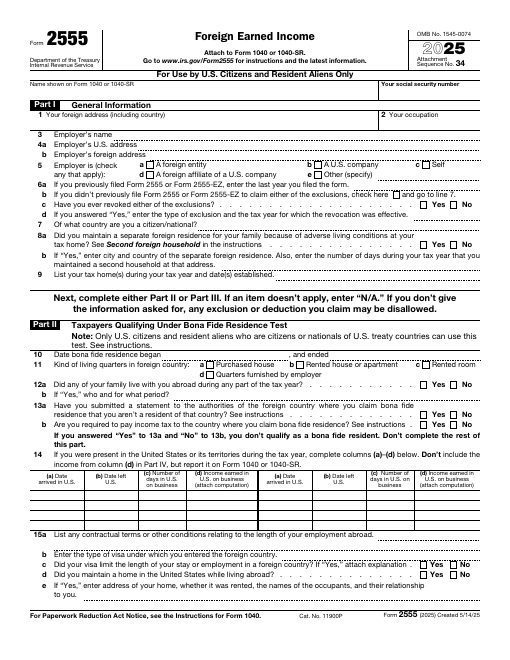
Who files Form 2555
Form 2555 is filed by a citizen or resident alien of the United States (the taxpayer) who lives and works in a foreign country and wants the foreign earned income exclusion, the housing exclusion or the housing deduction (About Form 2555). A taxpayer abroad pays tax under the same laws as one living at home, so the exclusion is a choice made on the return.
Two conditions must both be met. The first is the tax home test: the tax home (the regular or principal place of business, employment or post of duty) must be in a foreign country throughout the period of residence or presence. A taxpayer whose abode is in the United States does not meet it, with one exception for service in a combat zone. The second is either the bona fide residence test or the physical presence test. Pay from working abroad as an employee of the U.S. Government does not qualify, and no Form 2555 is filed for it (Instructions for Form 2555).
| Test | What it requires | Form part |
|---|---|---|
| Bona fide residence | Bona fide resident of a foreign country for an uninterrupted period that includes an entire tax year (January 1 to December 31 on a calendar-year return) | Part II |
| Physical presence | Present in a foreign country at least 330 full days in any 12 consecutive months | Part III |
A resident alien can use the residence test only as a citizen or national of a treaty country; the physical presence test is open to every citizen and resident alien. A full day is the 24 hours that start at midnight, and travel over international waters can interrupt the 330 days.
What counts as foreign earned income
Foreign earned income is wages, salaries, professional fees and other pay for personal services performed in a foreign country while the taxpayer meets the tax home test and one of the two tests. Noncash pay (a home or a car), allowances and reimbursements count too.
|
When personal services and capital both produce a business’s income, a reasonable amount for the services counts as earned income, capped at 30% of the taxpayer’s share of the net profit after the deduction for the employer-equivalent part of self-employment tax.
Parts of the form
Part I – General information
Complete lines 1 to 9, then either Part II or Part III.
Line 1 takes the foreign address and line 2 the occupation. Lines 3 to 5 name the employer and its type: foreign entity, U.S. company, self, foreign affiliate or other. Line 6 asks when Form 2555 or 2555-EZ was last filed and whether an exclusion was ever revoked. Line 7 is the country of citizenship, line 8 asks about a second foreign household kept because of adverse living conditions, and line 9 lists the tax homes with their dates. The form warns that missing information can lead to the exclusion or deduction being disallowed.
Parts II and III – the two tests
Fill in the part for the test that applies; write “N/A” on items that do not.
Part II (lines 10 to 15) gives the dates residence began and ended (“Continues” is written if it has not ended), the kind of living quarters, family who lived abroad, whether a statement of nonresidence was submitted, and any time spent in the United States. A Yes on line 13a with a No on line 13b means the taxpayer does not qualify as a bona fide resident. Part III (lines 16 to 18) gives the 12-month period, which must contain 365 days (366 in a leap year) with part of it in 2025, the principal country of employment and each trip abroad.
Parts IV and V – the income
Report each amount in U.S. dollars.
Part IV adds up wages (line 19), business and partnership shares (lines 20a and 20b), noncash income (lines 21a to 21d), allowances (lines 22a to 22g) and other income (line 23). Line 25 subtracts excludable meals and lodging, which must have been provided for the employer’s convenience and on its business premises (lodging also had to be a condition of the job). Line 26 is the 2025 foreign earned income, and Part V repeats it on line 27 with a question on the housing exclusion or deduction.
Part VI – housing
Complete only when claiming the housing exclusion or deduction.
Line 28 lists reasonable housing expenses, which include rent, utilities other than telephone, insurance, furniture rental, residential parking and repairs, and exclude mortgage principal, the cost of buying a house, and domestic labor. Line 29b caps them: for most locations $39,000 (30% of $130,000) for a full 365 days, or $106.85 per day for a shorter qualifying period, with a different limit for locations listed in Notice 2025-16. Line 32 figures the base amount, $56.99 times the days on line 31 or $20,800 for 365 days, and line 33 subtracts it from the smaller of the expenses and the limit. The housing exclusion is figured on lines 34 to 36. A taxpayer whose income is all self-employment skips lines 34 and 35, enters zero on line 36 and uses Part IX.
Parts VII to IX – the exclusion and the deduction
Line 37 prints the $130,000 maximum, which is prorated by the days of the qualifying period that fall in the year (lines 38 to 40). Line 42 takes the smaller of that figure and the earned income left after the housing exclusion. Line 43 adds the two exclusions, line 44 subtracts deductions allocable to the excluded income, and line 45 goes to Schedule 1 (Form 1040), line 8d. Part IX figures the housing deduction, including a one-year carryover, and line 50 goes to Schedule 1, line 24j.
Deadline and where to file
Attach Form 2555 to Form 1040 or 1040-SR and mail the return to the special address.
A calendar-year 2025 return was generally due April 15, 2026. A taxpayer who lives outside the United States and Puerto Rico, with a tax home outside them, gets an automatic two (2) month extension to June 15, 2026, which also applies to paying the tax, though interest runs from the regular due date. A statement saying the two conditions are met is attached to the return. A taxpayer who has not yet met either test by the due date can apply for a special extension on Form 2350, or file without the exclusion and amend with Form 1040-X later.
Returns with Form 2555 do not go to the address for the state of residence. The instructions send them to a special international address, listed on the IRS international filing addresses page (where to file Form 1040 from abroad). The form has no signature line of its own.
What the choice costs
The choice is usually made on a timely return and then applies to that year and every later one. To revoke it, a statement goes with the return for the first year the exclusion is not wanted. A taxpayer who claims either exclusion or the housing deduction cannot take the additional child tax credit or the earned income credit, and cannot take a credit or deduction for foreign income tax on the excluded income. Deductions, credits and exclusions definitely related to the excluded income are also disallowed, prorated when only part of the income is excluded. The Form 1040 and Schedule 1 carry the results.
Frequently asked questions
Can a taxpayer who left a country because of war still claim the exclusion?
Yes, in some cases. The minimum time requirements can be waived when a taxpayer had to leave because of war, civil unrest or similar conditions and could reasonably have expected to meet them. “Claiming Waiver” is written in the top margin of page 1, and a statement is attached.
Does a person serving in a combat zone have a foreign tax home?
Service in an area the President designated a combat zone in support of the U.S. Armed Forces can qualify as a tax home in that foreign country, even with an abode in the United States. The IRS lists the recognized zones on its combat zones page.
Where are the tests explained with examples?
Publication 54 works through both tests and both exclusions.