

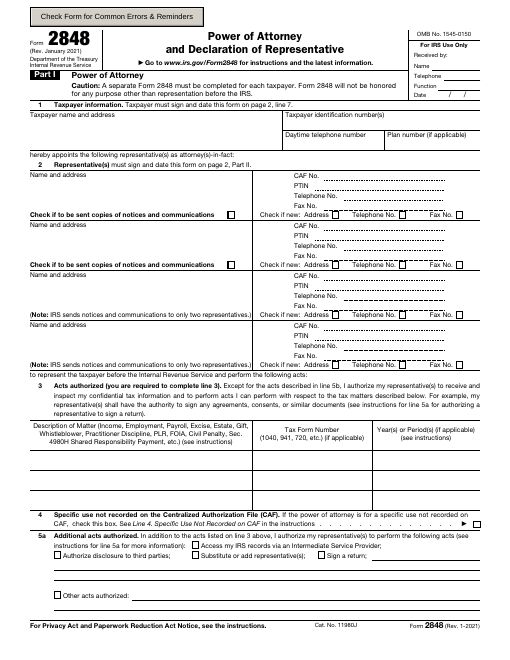
What Form 2848 does
Form 2848 authorizes an individual to represent a taxpayer before the IRS (About Form 2848). Two (2) people sign it: the taxpayer and the representative (the attorney-in-fact). It also lets the representative receive and inspect confidential tax information. A separate Form 2848 is completed for each taxpayer, and naming a representative does not relieve the taxpayer of any tax obligation.
A representative can perform every act the taxpayer could perform on the listed matters, including signing agreements, consents and waivers. Four things are held back unless the taxpayer adds them on line 5a: naming another representative, signing certain returns, consenting to disclosure of returns to a third party, and using an Intermediate Service Provider to pull records. A representative can never endorse or negotiate a government check for a federal tax liability, and signing Form 907 (an agreement extending the time to sue) needs its own wording on line 5a.
Who can be named
Only an individual who is eligible to practice before the IRS qualifies. Part II lists the designations, and each representative enters the matching detail in the “licensing jurisdiction” and “number” columns.
| Letter | Designation | What the representative enters |
|---|---|---|
| a | Attorney | State of admission and bar number, if any |
| b | Certified public accountant | State of license and license number, if any |
| c | Enrolled agent | Enrollment card number |
| d | Officer | Title, such as President or Secretary |
| e | Full-time employee | Title or position |
| f | Family member | The relationship: spouse, parent, child, brother, sister, grandparent, grandchild, step-parent, step-child, step-brother or step-sister |
| g | Enrolled actuary | Enrollment card number (authority is limited) |
| h | Unenrolled return preparer | PTIN (authority is limited) |
| k | Qualifying student or law graduate in a low income or student tax clinic | “LITC” or “STCP” |
| r | Enrolled retirement plan agent | Enrollment card number |
An unenrolled return preparer can appear only before revenue agents, customer service representatives and similar IRS staff, and only in an examination of the period covered by the return the preparer prepared and signed. Appeals officers, revenue officers and Office of Chief Counsel attorneys are out of reach, and the preparer cannot sign closing agreements, waivers or refund claims. A preparer who does not meet the requirements can be named on a Form 8821 instead, which allows access to information but not representation. Publication 947 covers who may represent a taxpayer.
Filling in the lines
Line 1 names the taxpayer; lines 2 to 6 name the representatives and their powers.
| Line | What it asks | Rules from the instructions |
|---|---|---|
| 1 | Taxpayer name, address, SSN, ITIN or EIN, telephone | A sole proprietor with a Schedule C business enters both the SSN (or ITIN) and the EIN to cover income and employment tax. Spouses with a joint return each file their own form |
| 2 | Up to four representatives | Each gets a nine-digit CAF number (“None” if unassigned) and a PTIN where one applies. A box sends copies of notices, but only two representatives can receive them |
| 3 | Matter, form number, years | An individual’s income tax matter uses Form 1040. Examples: “Income, 1040” for “2019”, or “Excise, 720” for “2019”, which covers all four quarters. Future years are recorded only up to three (3) years past December 31 of the year the IRS receives the form. A matter with no form or period gets “Not Applicable” |
| 4 | Specific use not on the CAF | Checked for one-time uses such as a private letter ruling request or an EIN application; the form is then mailed or faxed to the office handling the matter |
| 5a and 5b | Added powers and withheld powers | Details are written in the space provided |
| 6 | Earlier powers of attorney | Filing revokes earlier ones for the same matter unless the box is checked and a copy attached. A Form 8821 in effect is not revoked |
Penalties and some payments tied to a return are covered by the return’s own entry. A penalty with no return behind it, such as the trust fund recovery penalty, has to be described on line 3, for example as “Civil Penalty”. Innocent spouse relief must be named too, for example by entering “Innocent Spouse Relief” or the form number 8857. A parent corporation with a consolidated return lists only Form 1120 and its own information; a subsidiary needs its own Form 2848 for returns filed separately, such as a Form 941.
Signing
The taxpayer signs and dates line 7; an unsigned, undated or incomplete form is returned. The representative then signs Part II in the order listed on line 2. If the taxpayer signs first, the representative has 45 days from the taxpayer’s date (60 for a taxpayer living abroad); a representative who signs first leaves the taxpayer with no time limit.
| Taxpayer | Who signs line 7 |
|---|---|
| Individual | The taxpayer; for a person under 18, a parent or court-appointed guardian with court documents |
| Corporation or association | An officer with legal authority to bind it, with the exact title |
| Partnership | All partners, or one authorized partner with a copy of the authorization attached |
| Partnership under the centralized audit regime | The partnership representative, or the designated individual of an entity representative |
| Estate | One co-executor who can bind the estate |
| Employee plan | A duly authorized individual, or a trustee with the title of trustee |
A form mailed or faxed needs a handwritten signature; typed names and digital images are not valid on paper. An electronic signature (a typed name, a scanned image, a pad or stylus signature, or third-party software) is accepted only when the form is submitted online.
Where Form 2848 goes
The IRS takes the form online with a Secure Access account, by fax or by mail, unless line 4 is checked; then it goes to the office handling the matter. Tax Pro Account handles requests for individuals in real time, and POA requests there are limited to attorneys, CPAs, enrolled agents, enrolled actuaries and enrolled retirement plan agents (Tax Pro Account). Only one form is submitted at a time, even for spouses filing jointly.
| Taxpayer lives in | Mail to | Fax |
|---|---|---|
| Alabama, Arkansas, Connecticut, Delaware, District of Columbia, Florida, Georgia, Illinois, Indiana, Kentucky, Louisiana, Maine, Maryland, Massachusetts, Michigan, Mississippi, New Hampshire, New Jersey, New York, North Carolina, Ohio, Pennsylvania, Rhode Island, South Carolina, Tennessee, Vermont, Virginia, West Virginia | Internal Revenue Service, 5333 Getwell Road, Stop 8423, Memphis, TN 38118 | 855-214-7519 |
| Alaska, Arizona, California, Colorado, Hawaii, Idaho, Iowa, Kansas, Minnesota, Missouri, Montana, Nebraska, Nevada, New Mexico, North Dakota, Oklahoma, Oregon, South Dakota, Texas, Utah, Washington, Wisconsin, Wyoming | Internal Revenue Service, 1973 Rulon White Blvd., MS 6737, Ogden, UT 84201 | 855-214-7522 |
| APO and FPO addresses, American Samoa, the Northern Mariana Islands, Guam, the U.S. Virgin Islands, Puerto Rico, a foreign country | Internal Revenue Service, International CAF Team, 2970 Market Street, MS: 4-H14.123, Philadelphia, PA 19104 | 855-772-3156; 304-707-9785 outside the United States |
The IRS says the fax numbers may change without notice.
Revoking, withdrawing and other changes
To revoke a power of attorney without naming a new representative, the taxpayer writes REVOKE across the top of the first page, signs and dates beneath it, and sends a copy to the IRS. A taxpayer with no copy sends a signed statement listing the matters, the years or periods, and the name and address of each representative. A representative who wants out writes WITHDRAW on the first page, signs and dates it, and sends it the same way. A new address for the representative needs only a signed letter to the office that received the form. No fee is named anywhere in the instructions.
Frequently asked questions
Can a representative sign the taxpayer’s return?
Only in limited cases. Treasury Regulations section 1.6012-1(a)(5) allows it for disease or injury, for continuous absence from the United States for at least sixty (60) days before the filing date, or with IRS permission for good cause. The taxpayer checks “Sign a return” on line 5a and gives the reason.
Are spouses covered by one form?
No. Each spouse who filed a joint return completes a separate Form 2848, even when both name the same representative.
How is a representative’s CAF number obtained?
The IRS assigns it when the first form is filed, so a representative without one writes “None”. A representative who has forgotten a number can call the Practitioner Priority Service at 866-860-4259.