

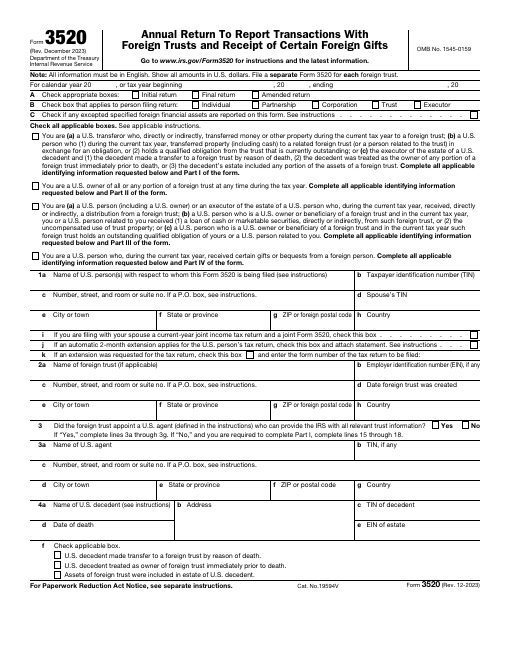
Who must file Form 3520
The About Form 3520 page says that a United States person, or the executor of the estate of a United States decedent, files the form to report certain transactions with foreign trusts, ownership of foreign trusts under sections 671 through 679 of the Internal Revenue Code, and receipt of certain large gifts or bequests from foreign persons. The Instructions for Form 3520 turn this into four filers, and each one completes its own part.
|
Spouses who file a joint income tax return and are both transferors, grantors or beneficiaries of the same foreign trust can file a joint Form 3520 and check the box on line 1i. A person may also have to file FinCEN Form 114 (the FBAR) or Form 8938. Item C on page 1 is for a filer who also files Form 8938 and counts this form in Part IV of that return.
Transactions that need no Form 3520
Check the exceptions before filing; the instructions list more than these.
The instructions exempt transfers to funded nonqualified deferred compensation arrangements and to a foreign trust with a current IRS determination letter under section 501(c)(3). Most transfers at fair market value are exempt too, except for some such as transfers in exchange for qualified obligations. Transfers to, ownership of and distributions from a Canadian RRSP, a Canadian RRIF or another Canadian retirement plan are exempt, and so are certain tax-favored foreign retirement and savings trusts described in Rev. Proc. 2020-17. A distribution that is taxed as pay for services is exempt when the recipient reports it as compensation income.
What each part reports
| Part | Lines | What it holds |
|---|---|---|
| Page 1 | 1 to 4 | The filer, the foreign trust (name, EIN, creation date), the trust’s U.S. agent if any, and a decedent when an executor files |
| I | 5 to 19 | Who created the trust, its governing law, any foreign owners and beneficiaries, and Schedules A (obligations of a related trust), B (gratuitous transfers) and C (qualified obligations) |
| II | 20 to 23 | Each owner and the Code section that makes the person an owner, whether the trust filed Form 3520-A, and the gross value of the portion owned |
| III | 24 to 53 | Each distribution, loans and use of trust property, then a default calculation (31 to 38), an actual calculation (39 to 47) and the interest charge (48 to 53) |
| IV | 54 to 56 | Gifts and bequests from foreign individuals, estates, corporations and partnerships, and a question about nominees |
Line 3 asks whether the foreign trust appointed a United States agent who can give the IRS all relevant trust information. A “No” answer, for a filer completing Part I, requires lines 15 through 18 and copies of the trust documents. A foreign trust without an EIN, or its U.S. owner, can apply online, and a trust whose principal place of business is outside the United States and its territories can apply by phone at 267-941-1099. The paper application is Form SS-4.
Foreign gifts and bequests
Complete Part IV only after the amounts below are passed.
A gift does not include qualified tuition or medical payments made for the person. Amounts from related donors are added together for the $100,000 test. On line 54, each gift or bequest above $5,000 is listed with its date, description and fair market value; if none exceeds $5,000, the filer writes “No gifts or bequests exceed $5,000” in column (b). The IRS page on gifts from foreign persons gives the corporation and partnership amount as $20,116 for 2025. A distribution from a foreign trust goes in Part III and not in Part IV.
Deadlines
| Filer | Due date |
|---|---|
| Individual, calendar year | April 15, the 15th day of the 4th month after the tax year ends |
| Individual living and working outside the United States and Puerto Rico, or in military service abroad | June 15, the 15th day of the 6th month, with a statement attached |
| Any filer with an extension for the income tax return | No later than the 15th day of the 10th month (October 15 for a calendar year) |
| Estate of a decedent | 15th day of the 4th month after the estate’s year ends, or the 10th month with an extension |
The due date is not tied to the income tax return, and an extension to file Form 3520 cannot run past the 10th month. A filer who asked for an income tax extension, for example on Form 4868, checks box 1k and writes the number of the return, such as 1040. Box 1j is for the automatic two-month extension. When the date lands on a weekend or legal holiday, the next business day is the deadline. Only a complete return is timely, and complete means that every required attachment is included.
Where to file
Mail the return to the Ogden service center.
Send Form 3520 to Internal Revenue Service Center, P.O. Box 409101, Ogden, UT 84409. The form is filed apart from the income tax return, with all information in English and all amounts in U.S. dollars.
Signing and attachments
Who signs
Sign and date the form, and give the signer’s title.
An individual or fiduciary signs for themselves, a partner or LLC member signs for a partnership, and an authorized corporate officer signs for a corporation. A receiver or trustee in bankruptcy attaches the court order that authorizes the signing. E-signatures are accepted. A paid preparer fills in the preparer block at the bottom of page 6, including a PTIN, and gives the filer a copy.
What goes with the return
Attach what the lines you completed call for.
An owner of a foreign trust attaches the Foreign Grantor Trust Owner Statement when the trust filed Form 3520-A, and otherwise attaches a substitute Form 3520-A completed as well as possible; that substitute is due on the same day as Form 3520. Other attachments are the trust documents on line 18, loan and sale documents on lines 11 and 14, a Foreign Grantor Trust or Nongrantor Trust Beneficiary Statement on lines 29 and 30, and Form 4970 on line 49. A filer whose items differ from the trust’s return files Form 8082.
Penalties
| Failure | Initial penalty, generally |
|---|---|
| No report of a transfer to a foreign trust (Part I) | Greater of $10,000 or 35% of the gross value of the property transferred |
| No report of a distribution (Part III) | Greater of $10,000 or 35% of the gross value of the distributions |
| Foreign trust with a U.S. owner fails to file Form 3520-A or gives incomplete information | Greater of $10,000 or 5% of the gross value of the portion treated as owned |
| Failure continues more than 90 days after an IRS notice | Additional penalties |
| Foreign gifts not reported in time | 5% of the gift for each month of failure, up to 25%, and the IRS may determine the tax consequences |
The first three come from section 6677 of the Internal Revenue Code, as the Instructions for Form 3520 state them, and only a complete return counts as timely. A foreign country’s penalty for disclosing the information is not reasonable cause, and neither is a trust document that bars disclosure. No penalty applies when the filer shows reasonable cause and not willful neglect. Section 6662(j) can raise a 20% underpayment penalty to 40% for an owner of a foreign trust when the underpayment comes from a transaction involving an asset that Form 3520-A should have covered. If a complete return is not filed on time, the time to assess tax tied to Parts I through III stays open until three (3) years after the information is reported.
Frequently asked questions
Does a gift from a relative abroad need Form 3520?
Only when the total from nonresident alien individuals or a foreign estate passes $100,000 in the year, with related donors counted together. A smaller total is not reported.
Can the form be filed for a trust with no activity?
Yes, for an owner. A person treated as the owner of a foreign trust completes Part II every year, even when nothing happened with the trust.
Is the form filed with the tax return?
No. It goes to the Ogden address on its own, and its due date can be different from the income tax due date.