

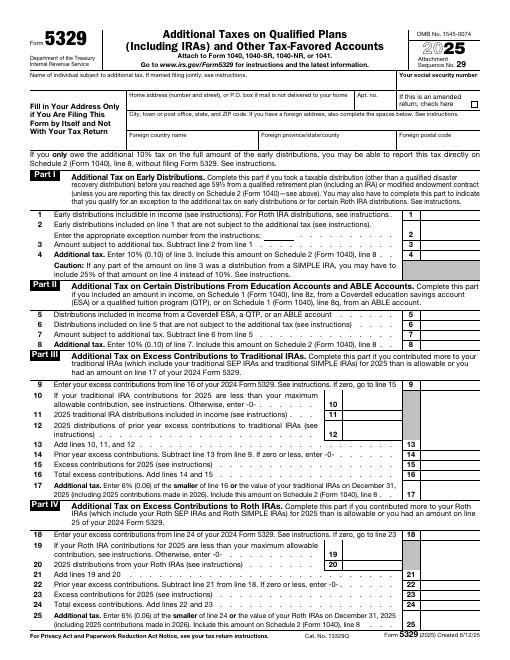
Who must file Form 5329
Form 5329 reports the additional taxes on early withdrawals, excess contributions and missed required distributions. The taxpayer (the account owner) reports it, and the IRS collects it through the income tax return. The Instructions for Form 5329 name six situations that require the form.
|
One common case needs no form. When code 1 is correctly shown in box 7 of every Form 1099-R and the 10% tax applies to the full amount on each, the tax goes straight to Schedule 2 (Form 1040), line 8. On a joint return, each spouse who must file completes a separate Form 5329.
When and where to file
Attach the form to the return; mail it alone only when there is no return.
Form 5329 goes in with the 2025 Form 1040, Form 1040-SR, Form 1040-NR or Form 1041, by the due date of that return including extensions. Extra time for the return is requested on Form 4868. The instructions give no separate date for Form 5329 and state no weekend rule.
A taxpayer with no 2025 return to file completes the form by itself, at the time and place a Form 1040, 1040-SR or 1040-NR would be due. The home address goes on page 1, and the signature and date on page 3. A form filed this way cannot be e-filed.
For an earlier year, the version for that year is used. With no other changes and no return filed for that year, it is sent alone; with other changes, it goes with an amended return on Form 1040-X.
The parts of the form
| Part | Tax it reports | Rate |
|---|---|---|
| I | Early distributions from a qualified plan, IRA or modified endowment contract | 10%, or 25% for a SIMPLE IRA in its first 2 years |
| II | Taxable distributions from a Coverdell ESA, QTP or ABLE account | 10% |
| III to VIII | Excess contributions to a traditional IRA, Roth IRA, Coverdell ESA, Archer MSA, HSA or ABLE account | 6% a year |
| IX | A missed required minimum distribution | 25%, or 10% if corrected |
The 6% applies to the smaller of the total excess or the account’s value on December 31, 2025. Because the excess carries forward, each part asks for the prior year’s amount.
Exception numbers for early distributions
Line 2 takes the part of a Part I distribution that escapes the 10% tax, with the matching number from the instructions.
| No. | Exception |
|---|---|
| 01 | Plan distribution after leaving the job in or after the year of age 55 (age 50 for public safety employees), or after 25 years of service; not for IRAs |
| 02 | Series of substantially equal periodic payments |
| 03 | Total and permanent disability |
| 04 | Death |
| 05 | Unreimbursed medical expenses above 7.5% of adjusted gross income |
| 09 | IRA distribution for a first home, up to $10,000 |
| 19 | Birth or adoption, up to $5,000 within one year of the event |
| 99 | More than one exception applies |
Numbers 06 to 08, 10 to 18 and 20 to 23 cover other cases, among them a domestic relations order, higher education costs, an IRS levy and eligible emergency expenses. A birth or adoption claim carries an attached statement with the child’s name, age and taxpayer identification number.
Excess contributions and missed distributions
The 2025 traditional IRA limit for a taxpayer who is not married filing jointly is the smaller of taxable compensation or $7,000 ($8,000 at age 50 or older). The Roth IRA limit shrinks when modified AGI passes $236,000 for joint filers or $150,000 for single filers. The Coverdell limit is $2,000 and the ABLE limit is $19,000 (higher for an employed designated beneficiary).
The tax is avoided when the excess comes back out with its earnings by the return’s due date including extensions. For a Coverdell ESA the date is before June 1, 2026. Apart from a Coverdell ESA and an ABLE account, a return already filed can still be fixed within 6 months after its original due date, on an amended return marked “Filed pursuant to section 301.9100-2”.
Part IX applies to an IRA other than a Roth, an employer plan or an eligible section 457 plan. For an IRA, distributions must start by April 1 of the year after the owner turns 73; an employer plan allows the later of that age or retirement, unless the owner holds more than 5% of the employer. A shortfall costs 25%, reduced to 10% when the missing amount is taken out and a return showing the tax is filed inside the correction window. For reasonable error, the IRS may waive it: attach a statement, write “RC” and the amount beside line 54a or 54b, and pay the tax on line 55.
Frequently asked questions
Is Form 5329 needed for every early withdrawal?
No. With code 1 correctly shown in box 7 of every Form 1099-R and the 10% tax due on all of it, the tax is entered on Schedule 2, line 8. The form is for exceptions and for the other taxes in Parts II to IX.
Where does the tax from Form 5329 go?
Parts I to VIII carry their additional tax to Schedule 2 (Form 1040), line 8. Part IX ends on line 55, which goes to the same line, or to Schedule G, line 8, of Form 1041 for a trust or estate.
How are Roth IRA withdrawals reported?
The taxable part of an early Roth IRA distribution comes from line 25c of Form 8606 and goes on line 1. A first-time homebuyer amount from line 20 of Form 8606 also goes on line 2 with exception 09.