

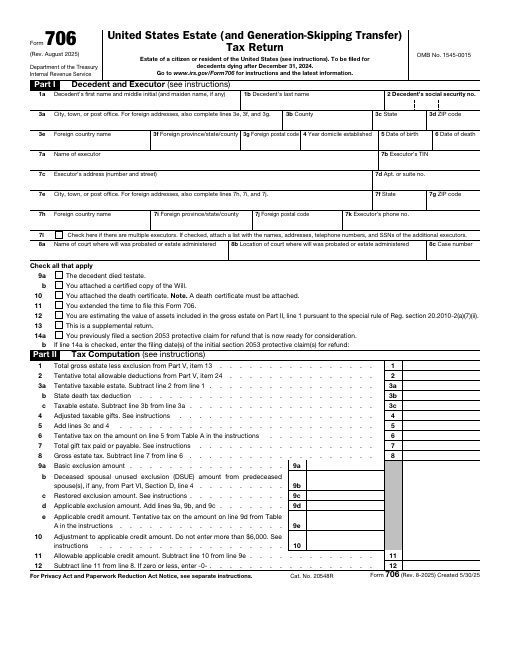
Who must file Form 706
The executor of the estate of a U.S. citizen or resident files Form 706 in two (2) cases. For a decedent who died in 2026, the first case is a gross estate, plus adjusted taxable gifts and specific exemption, of more than $15,000,000. The second is an election to transfer the DSUE amount to the surviving spouse, which requires a return whatever the size of the estate. The Instructions for Form 706 call the 2026 basic exclusion amount $15,000,000 and the basic credit amount $5,945,800.
To test the first case, the instructions add three amounts: adjusted taxable gifts made after December 31, 1976, the specific exemption allowed under section 2521 for gifts made after September 8, 1976, and the gross estate at its date-of-death value.
The gross estate includes all property in which the decedent had an interest, including property outside the United States. It also takes in annuities, the includible part of joint estates with right of survivorship and tenancies by the entirety, certain life insurance proceeds even when payable to people other than the estate, digital assets and community property to the extent of the decedent’s interest.
Residents and the executor
A decedent who was neither a citizen nor a resident files a different return.
For estate tax a resident is a person with a domicile in the United States at death. Estates of nonresidents who were not citizens use Form 706-NA. The executor is the executor, personal representative or administrator; with none appointed, qualified and acting in the United States, every person in actual or constructive possession of any of the decedent’s property is considered an executor and must file. An executor must provide documentation of status, which may include a certified copy of the will or a court order naming the executor; a statement by the executor is insufficient.
When the return is due
File within 9 months of the date of death; request the extension before that day.
Form 706 is due 9 months after the date of death, and the estate and generation-skipping transfer taxes are due on the same day. Form 4768 requests an automatic 6-month extension of time to file. The IRS page on estate and gift tax returns adds that the extension must be requested before the due date, and that the estimated correct amount of tax must be paid before that date.
An estate that is only electing portability has more room. Executors who had no filing requirement under section 6018(a) but did not file in time to elect portability may file on or before the fifth anniversary of the death under Rev. Proc. 2022-32, and must write “Filed Pursuant to Rev. Proc. 2022-32 to Elect Portability under section 2010(c)(5)(A)” at the top of the return. An estate that misses even that deadline may seek relief under Regulations section 301.9100-3.
Portability needs nothing beyond a complete, timely return; Section A of Part VI is checked only by an estate that opts out, and Section C figures the DSUE amount.
Where to file
Mail the return to Kansas City; a supplemental return goes to Florence.
| Return | Mailing address |
|---|---|
| Form 706 by U.S. mail | Department of the Treasury, Internal Revenue Service, Kansas City, MO 64999 |
| Form 706 by private delivery service | Internal Revenue Submission Processing Center, 333 W. Pershing Road, Kansas City, MO 64108 |
| Supplemental Form 706 (mail or private delivery service) | Internal Revenue Service Center, Attn: E&G, Stop 824G, 7940 Kentucky Drive, Florence, KY 41042-2915 |
The IRS filing page for estate and gift tax returns gives the same Kansas City, MO 64999 address for Form 706 and the Florence address for a supplemental return, and sends private delivery service users to the Submission Processing Center street address.
The six parts of the form
| Part | What it covers |
|---|---|
| I | The decedent, the executor and the court |
| II | Tax computation and the executor’s signature |
| III | Elections: alternate valuation, special-use valuation, sections 6166 and 6163 |
| IV | General information in seventeen numbered lines: marital history, beneficiaries receiving $5,000 or more, and yes or no questions |
| V | Recapitulation of the schedules, items 1 through 24 |
| VI | Portability of the DSUE amount |
The form is five pages and the schedules are separate files. Schedules A through I report the gross estate. Schedules J through M and O report the deductions, Schedules P and Q the credits, and Schedules R and R-1 the generation-skipping transfer tax. A return filed without an entry in each field is not processed, and a zero item in the Recapitulation needs no schedule except Schedule F.
Table A in the instructions sets the rate: 18% on the first $10,000, rising to 40% on amounts over $1,000,000.
Paying the tax
Payment options named in the instructions are EFTPS, a same-day wire, a check payable to “United States Treasury” and cash at participating retail stores. The check carries the decedent’s name, SSN or TIN and “Form 706”. Payments must be in U.S. dollars, and digital assets are not accepted. An estate electing installments under section 6166 or postponement under section 6163 checks “Yes” on Part III, line 3 or 4 and attaches the required statements.
Estate tax closing letter
Request it on Pay.gov at least 9 months after filing.
An estate tax closing letter is issued only on request through Pay.gov, for a user fee. The IRS FAQ on the closing letter gives the fee as $56 for requests made on or after May 21, 2025. The About Form 706 page announces that the fee rises to $76 after October 26, 2026. The instructions add that an account transcript, requested through the Transcript Delivery System or on Form 4506-T, may be used instead of the letter.
Signing and attachments
The executor signs the declaration under penalties of perjury. With several executors all are liable for penalties, but one co-executor’s signature is enough. Generally, a paid preparer signs and gives the executor a copy. To let someone act before the IRS, the executor uses Form 2848, or Form 8821 for someone who only receives confidential information.
|
The instructions say that processing is delayed when the supplemental documents are not filed with the return.
Penalties
Section 6651 penalizes both late filing and late payment unless reasonable cause is shown. A reasonable-cause explanation does not go with the return; it is sent after a penalty notice arrives. Section 6662 adds a 20% penalty on an underpayment caused by negligence, intentional disregard of the rules or a substantial valuation understatement, which means a reported value of 65% or less of the true value. For a gross valuation understatement, a reported value of 40% or less, the penalty is 40%, and none applies when the underpayment from either valuation cause is $5,000 or less.
Certain estates must also report each asset’s estate tax value to the IRS and the recipient on Form 8971. It is filed separately from Form 706 within 30 days of the return’s due date (including extensions), or of the filing date if the return is filed late, and failing to file it when required is subject to the information return penalties of sections 6721 and 6722.
Frequently asked questions
Does an estate below $15,000,000 need to file Form 706?
Not by the gross estate alone, because adjusted taxable gifts and the specific exemption are added to it before it is compared with the $15,000,000 limit for a 2026 death. The executor of a smaller estate files anyway to elect portability, and the instructions apply that election to estates of any size.
Which revision of Form 706 applies?
The August 2025 revision is for decedents dying after December 31, 2024. A decedent who died after December 31, 2018 and before January 1, 2025 used the August 2019 revision, according to the table in the instructions.
Is there a guide for executors?
Publication 559, Survivors, Executors and Administrators, is the publication the instructions say may assist in learning about and preparing Form 706.