

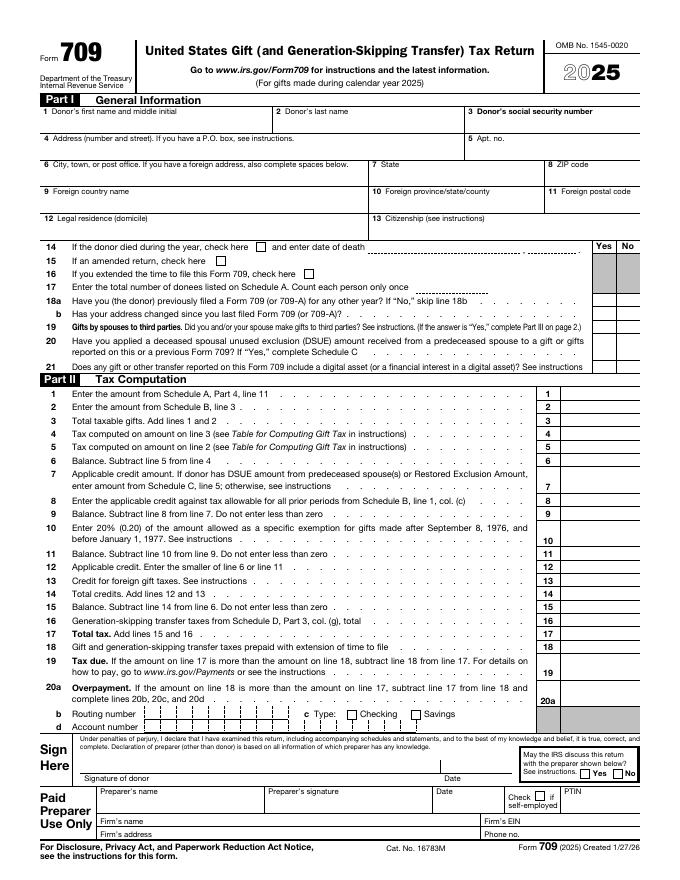
Who must file Form 709
Form 709 is filed by the donor (the person who makes the gift). A citizen or resident of the United States must file in situations that include the following four, according to the Instructions for Form 709. The first is gifts to any one person in 2025 that total more than $19,000, other than gifts to a spouse. The second is a gift of a future interest, which gets no annual exclusion and must be reported even when it is under $19,000. The third is spouses who want to split gifts, which takes a return whatever the amounts. The fourth is a gift of community property, which counts as made one-half by each spouse, or of property held by spouses as joint tenants or tenants by the entirety; in both cases each spouse files.
Only individuals file. If a trust, estate, partnership or corporation makes a gift, the individual beneficiaries, partners or stockholders are the donors. If a donor dies before filing, the executor files the return. The donor owes the gift tax, and a donee may have to pay it when the donor does not.
A donor does not need to file when all three are true: no gifts went to a spouse, no donee received more than $19,000, and every gift was a present interest. A donor whose only gifts are to qualifying charities, of the donor’s entire interest in the property, also skips the return. Four transfers are not gifts for the form: payments to political organizations, transfers to certain 501(c)(4), (5) and (6) organizations, tuition paid straight to a school, and medical bills paid straight to the care provider. Contributions to a qualified tuition program do not count as tuition.
A donor who is a nonresident not a citizen of the United States, meaning neither domiciled in nor a citizen of the United States when the gift is made, and who gave real or other tangible property situated in the United States files Form 709-NA instead of Form 709. The Instructions for Form 709 call for it when a future interest was given, present interests to a donee other than a spouse total more than $19,000, or outright gifts to a spouse who is not a U.S. citizen total more than $190,000 (IRS gift tax page).
Revision and amounts
The form is the 2025 revision and reports gifts made from January 1 to December 31, 2025. A gift in another year goes on the form for that year. In the 2025 instructions the spouse questions sit in a new Part III on page 2, Part II has direct deposit lines for a refund, and Schedule A has new boxes (k), (l) and (m) for a charitable gift, a deductible gift to a spouse and a section 2652(a)(3) election. A consenting spouse no longer signs the return itself.
| Item | Amount for gifts made in 2025 |
|---|---|
| Annual exclusion per donee (present interests) | $19,000 |
| Most one spouse can give a donee when gifts are split and only that spouse files | $38,000 |
| Gifts of present interests to a spouse who is not a U.S. citizen, before reporting is needed | $190,000 |
| Largest 529 plan contribution spread over 5 years | $95,000 |
| Basic exclusion amount | $13,990,000 |
| Basic credit amount | $5,541,800 |
| Top rate on gifts and GST transfers | 40% |
The IRS gift tax FAQ shows the same $19,000 annual exclusion for 2026 and says a 2025 law raised the basic exclusion amount to $15,000,000 for gifts made in 2026.
What each part covers
| Part | Page | What it does |
|---|---|---|
| Part I | 1 | Donor’s name, address, domicile, citizenship; boxes for a death, an amended return and an extension; prior filings; spouse gifts; deceased spousal unused exclusion (DSUE); digital assets |
| Part II | 1 | Tax computation, lines 1 to 20, with tax due, overpayment and direct deposit |
| Part III | 2 | Spouse’s consent to split gifts made to third parties |
| Schedule A | 3 to 6 | Each gift: Part 1 gift tax only, Part 2 direct skips, Part 3 indirect skips and trusts, Part 4 taxable gifts |
| Schedule B | 7 | Gifts from prior periods and the credit already used |
| Schedule C | 8 | DSUE amount from a deceased spouse and the restored exclusion amount |
| Schedule D | 9 and 10 | GST tax, the GST exemption and the inclusion ratio |
Schedule A lists each donee’s name and address, relationship, the gift, the donor’s basis, the date and the value on that date. For a split gift, column (h) shows one-half of the value, and the spouse’s own gifts, if any, go in the “Gifts made by spouse” area of each part. Direct skips and trusts also go on Schedule D. Part II then subtracts the applicable credit, which comes from the exclusion amount, so tax is owed only on what the credit does not cover. A donor who used a DSUE amount from a spouse who died after 2010 attaches the first four pages of that spouse’s Form 706 with the portability election.
Deadlines, signing and where to file
The return covers one calendar year, and only one Form 709 may be filed for the same year.
| Step | Rule | Dates |
|---|---|---|
| Return due | April 15 of the year after the gift; the next business day when April 15 is a weekend or holiday | Wednesday, April 15, 2026 for 2025 gifts; Thursday, April 15, 2027 for 2026 gifts |
| Extension through the income tax return | An extension of time to file the income tax return, made on Form 4868 or Form 2350, also extends the gift tax return; those forms may be used for this only when the income tax extension is requested too | Same length as the income tax extension |
| Extension without an income tax request | Form 8892 gives an automatic six (6) month extension | Six (6) months |
| Donor died during the year | The executor files by the earlier of the estate tax return due date (with extensions) or April 15 of the next year or its extended date | Varies |
| Consent to split gifts | Not after April 15 following the gift year; if no return is filed by then, on the first return filed | April 15 |
Neither extension gives more time to pay the tax. A separate request is needed for that under Regulations section 25.6161-1.
Where it goes. The mailing address is Department of the Treasury, Internal Revenue Service Center, Kansas City, MO 64999. A private delivery service uses Internal Revenue Service, 333 W. Pershing Road, Kansas City, MO 64108. Form 709 can also be e-filed through Modernized e-File, and the e-help Desk answers at 866-255-0654. An amended or supplemental Form 709 is a new Form 709 with the amended box checked on line 15, a statement of the change and a copy of the original, mailed to Internal Revenue Service Center, Attn: E&G, Stop 824G, 7940 Kentucky Drive, Florence, KY 41042-2915.
Signing. The donor signs and dates the return. A paid preparer also signs and adds a PTIN. A spouse who consents to split gifts signs a Notice of Consent, attached to the return, with a statement that the spouse elects to treat all gifts made to third parties as made one-half by each spouse. Spouses who split gifts should file both returns together, and the form asks for both to be mailed in the same envelope when the spouse’s return is also filed.
Paying. Tax due on line 19 can be paid through EFTPS, same-day wire from a bank, a check payable to “United States Treasury” with the donor’s TIN and “Form 709” written on it, or, where available, cash at participating retail stores.
Penalties and adequate disclosure
Section 6651 sets penalties for late filing and for late payment, unless there is reasonable cause. A written explanation of the delay is not attached to the return; the donor sends it only if a penalty notice comes. Willful failure to file on time, willful evasion of tax and valuation understatements are also penalized. A substantial understatement is a reported value of 65% or less of the true value, and a gross understatement is 40% or less.
A gift tax return preparer whose return understates the tax through an unreasonable position is subject to a penalty equal to the greater of $1,000 or 50% of the income earned for preparing the return. Willful or reckless conduct can be penalized $5,000 or 75% of the income derived. A preparer who fails to furnish a copy, sign the return or provide a PTIN is subject to a $50 penalty, unless the failure is due to reasonable cause and not willful neglect.
The statute of limitations on a gift starts to run only when the gift is adequately disclosed. In general that takes a full Form 709, a description of the property and what the donor got back, the donor and donee names and their relationship, the trust’s EIN and terms for a gift in trust, and either a qualified appraisal or a detailed description of how the value was found (Regulations sections 301.6501(c)-1(e) and (f)).
Frequently asked questions
Can spouses file a joint Form 709?
No. Each spouse who has to file uses an individual return. When spouses split gifts, only one of them has to file if only that spouse made gifts, the gifts to each donee total no more than $38,000 and every gift was a present interest (Exception 1 in the instructions; Exception 2 covers a few other cases). Spouses who both file and split gifts each list the other’s gifts in the “Gifts made by spouse” area of Schedule A, and the consent makes each spouse liable for the whole gift tax jointly and severally.
Does a gift under $19,000 need a Form 709?
Not if it is a present interest, nothing else was given to that person that year, and no gift went to a spouse. A gift to a spouse who is a U.S. citizen needs no report unless it is a terminable interest that does not meet the life estate with power of appointment exception, or the donor makes the QTIP election, which also takes a return.
Is a Form 709 needed for a gift of cryptocurrency?
Yes, when the gift is reportable. The gift tax covers digital assets, including NFTs and virtual currencies, and line 21 asks whether any gift on the return involves one.