

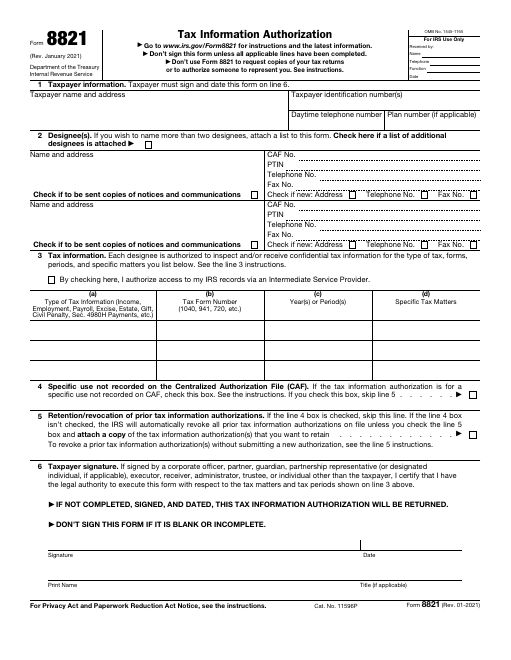
What Form 8821 allows
Form 8821 lets a taxpayer authorize any individual, corporation, firm, organization or partnership to inspect and receive confidential tax information, verbally or in writing (About Form 8821). One party, the taxpayer, signs it. The form is also the way to delete or revoke an earlier authorization. A taxpayer may write a tax information authorization without the form, but it must carry everything the form asks for.
The designee cannot speak for the taxpayer, ask the IRS to disclose records to anyone else, argue the taxpayer’s position on federal tax law, sign waivers, consents or closing agreements, or represent the taxpayer in any other way. A designee also cannot hand the job to another party, and can never endorse or negotiate a refund check or receive a refund by direct deposit. Once a properly completed form is on file, the designee can also get tax information online through IRS e-Services.
Form 8821 next to Form 2848
| Question | Form 8821 | Form 2848 |
|---|---|---|
| What the named person can do | Inspect and receive tax information | Represent the taxpayer, receive information and sign agreements on the listed matters |
| Who can be named | Any individual, corporation, firm, organization or partnership | Only an individual eligible to practice before the IRS |
| How many fit on the form | Two designees; a box on line 2 shows that a list of more is attached | Four representatives |
| Who signs | The taxpayer only | The taxpayer, then each representative |
| Copies of IRS notices | At most two designees | At most two representatives |
For mortgage, student loan and small business loan applications, an IRS transcript is often used in place of a copy of the return to confirm income and filing status (Get your tax records and transcripts). The form warns that it cannot be used to ask for copies of tax returns.
Filling in the lines
| Line | What it asks | Rules from the instructions |
|---|---|---|
| 1 | Taxpayer name, address, TIN, telephone, plan number | An individual enters name, TIN and street address and leaves the designee’s details out. On a joint return the designee is authorized only for the signer; a spouse or former spouse files a separate form. A trust gives the trustee’s name, title and address plus the trust’s name and EIN |
| 2 | Designees | Full name and mailing address, a nine-digit CAF number (or “NONE” if the IRS has not assigned one) and a PTIN where one applies. A box sends the designee copies of notices; no more than two designees may receive them for the same matter |
| 3 | Type of tax information, form number, years, specific matters | “Income, 1040” for “2018” or “Excise, 720” for “2018”; ranges such as “2017 thru 2019”; fiscal years by ending year and month. General entries such as “All years” bring the form back. Column (d) takes “not applicable” if the designee’s access is not limited |
| 3 box | Intermediate Service Provider | Checked only if the designee may use a private company’s software to pull records; otherwise the designee uses the IRS e-Services transcript tool |
| 4 | Specific use not recorded on the CAF | Checked for uses the IRS does not record, so the designee mails or faxes the form to the office handling the matter and line 5 is skipped |
| 5 | Retention or revocation | Without a check and attached copies, all prior authorizations are revoked |
| 6 | Taxpayer signature | See the signing table |
The IRS records no future year that falls more than three (3) years past the end of the year it receives the form. A penalty entry is made as “civil penalty” in column (a) with “N/A” in column (b). Listing a return such as Form 1040 also covers notices about return-related penalties, like the failure-to-pay penalty, but a payment not tied to a return, such as the section 4980H employer shared responsibility payment, is covered only if column (a) names it.
Uses that go on the line 4 list include requests from loan companies and educational institutions, federal or state background-check investigators, and requests about the SS-4, the Form W-2 series, Form W-4, Form W-7, Form 843, Form 1096, Form 1098, the 1099 series, Form 1128, Form 2553 and Form 4361.
Signing and time limits
The form says not to sign it when it is blank or incomplete, and an unsigned or undated form is returned. A mailed or faxed form needs a handwritten signature; typed or digital ones are valid only online.
| Taxpayer | Who may sign line 6 |
|---|---|
| Individual | The taxpayer; a spouse on a joint return signs a separate form |
| Corporation | An officer with authority under state law, a person the governing body designates, an officer or employee named in a principal officer’s written request attested by another officer, or anyone else allowed access under section 6103(e)(1)(D) other than a 1% record shareholder |
| Partnership | Any person who was a member during any part of the period covered, and for a multi-year form, a member in each year or period |
| Employee plan | A duly authorized individual with authority to bind it, with the exact title |
| Trust | A trustee with authority to bind the trust, with the title of trustee; a Form 56 identifies the current trustee if none was filed |
| Estate | An executor with authority to bind the estate; one co-executor is enough |
The 120-day limit applies when the form authorizes disclosure for a purpose other than resolving a tax matter with the IRS. It does not apply to a form that supports help with a tax matter.
Where Form 8821 goes
The form can be submitted online with a Secure Access account, faxed or mailed; online, a list of extra designees travels in the same file as the form. The same three IRS offices and fax numbers take Form 2848.
- Memphis (fax 855-214-7519): Internal Revenue Service, 5333 Getwell Road, Stop 8423, Memphis, TN 38118. It serves the District of Columbia and the 27 states of Alabama, Arkansas, Connecticut, Delaware, Florida, Georgia, Illinois, Indiana, Kentucky, Louisiana, Maine, Maryland, Massachusetts, Michigan, Mississippi, New Hampshire, New Jersey, New York, North Carolina, Ohio, Pennsylvania, Rhode Island, South Carolina, Tennessee, Vermont, Virginia and West Virginia.
- Ogden (fax 855-214-7522): Internal Revenue Service, 1973 Rulon White Blvd., MS 6737, Ogden, UT 84201. It serves the other 23 states: Alaska, Arizona, California, Colorado, Hawaii, Idaho, Iowa, Kansas, Minnesota, Missouri, Montana, Nebraska, Nevada, New Mexico, North Dakota, Oklahoma, Oregon, South Dakota, Texas, Utah, Washington, Wisconsin and Wyoming.
- Philadelphia (fax 855-772-3156, or 304-707-9785 from outside the United States): Internal Revenue Service, International CAF Team, 2970 Market Street, MS 4-H14.123, Philadelphia, PA 19104. It serves APO and FPO addresses, American Samoa, the Northern Mariana Islands, Guam, the Virgin Islands, Puerto Rico and foreign addresses.
Revoking and changing an authorization
To end an authorization without a new one, the taxpayer writes REVOKE across the top of the old form and signs and dates beneath the original signature. A taxpayer without a copy sends the IRS a signed notice that states the designee’s authority is revoked, with each designee’s name and address and the tax matters and periods; “revoke all years/periods” ends everything. A specific-use authorization is revoked at the office handling the case. A designee’s new address needs only a signed and dated notice to the office that took the form.
Frequently asked questions
Can a designee receive a taxpayer’s refund?
No. The instructions say a designee is never allowed to endorse or negotiate a refund check or to receive a refund by direct deposit.
Is a separate form needed for each spouse?
Yes. On a joint return the designee named by one spouse is authorized only for that spouse, so the other spouse or former spouse submits a separate Form 8821.
What limits what the designee may do with the information?
Section 6103(c) limits use and disclosure of return information received under the taxpayer’s consent. The designee is subject to penalties for unauthorized access, other use or redisclosure without the taxpayer’s express permission.
Does a copy of a tax return come with this form?
No. The form says not to use it to request copies of tax returns. A transcript is ordered through an online account, by mail or by phone at 800-908-9946, and a photocopy of a return costs a fee for each return and is requested on Form 4506.