

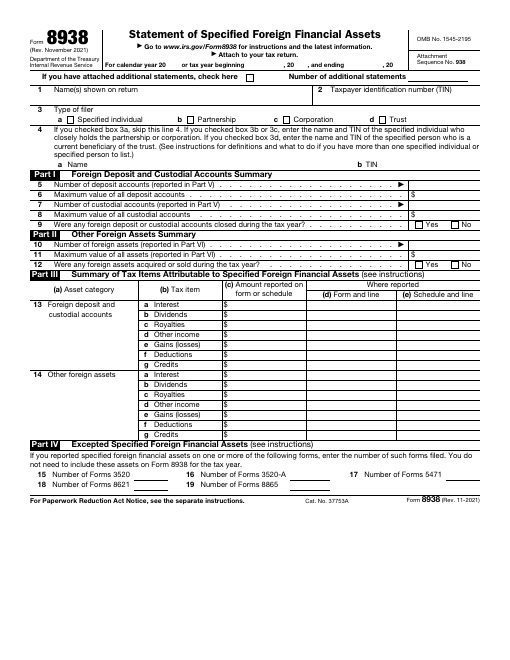
Who must file Form 8938
Form 8938 is filed by a “specified person” (the filer) that holds an interest in specified foreign financial assets worth more than the threshold that applies to it, unless an exception applies (About Form 8938). There are two kinds of specified person: a specified individual and a specified domestic entity. A person who has no income tax return to file for the year does not file Form 8938, whatever the assets are worth.
A specified individual is a U.S. citizen, a resident alien for any part of the tax year, a nonresident alien who elects to be treated as a resident for a joint return, or a nonresident alien who is a bona fide resident of American Samoa or Puerto Rico. A specified domestic entity is a domestic trust with a specified person as a current beneficiary, or a closely held domestic corporation or partnership with at least 50% of its gross income from passive income or at least 50% of its assets producing or held to produce passive income. Certain excepted entities are not specified domestic entities; a domestic trust, for example, is excepted when its trustee is a regulated bank (or another listed institution) that has supervisory authority or fiduciary duties over the foreign assets and files the trust’s returns on time. “Closely held” means that on the last day of the entity’s tax year a specified individual directly, indirectly or constructively owns at least 80% of the voting power or value of the corporation, or of the capital or profits interest in the partnership (Instructions for Form 8938).
Reporting thresholds
The test uses the total value of all specified foreign financial assets, and it is met only when the total is more than the figure shown. Joint assets of spouses who file a joint return are counted once, in full. Spouses who are both specified individuals and file separately each count half of a jointly owned asset; any other joint owner counts the entire value.
| Filer | Last day of tax year | At any time in the year |
|---|---|---|
| Unmarried, living in the United States | $50,000 | $75,000 |
| Married filing jointly, living in the United States | $100,000 | $150,000 |
| Married filing separately, living in the United States | $50,000 | $75,000 |
| Unmarried, living abroad | $200,000 | $300,000 |
| Married filing jointly, living abroad | $400,000 | $600,000 |
| Married filing separately, living abroad | $200,000 | $300,000 |
| Specified domestic entity | $50,000 | $75,000 |
A filer counts as living abroad when the tax home is in a foreign country and one presence test is met: a U.S. citizen who was a bona fide resident of a foreign country for a period that includes the whole tax year, or a citizen or resident present abroad at least 330 full days in any 12 consecutive months ending in the tax year. Assets are valued at fair market value, converted to dollars at the year-end rate (generally the Treasury Bureau of the Fiscal Service rate), even when the asset was sold earlier in the year.
What is reported and what is not
A specified foreign financial asset is a financial account held at a foreign financial institution, or, if held for investment outside an account, foreign stock or securities, any interest in a foreign entity, or a financial contract with a foreign issuer or counterparty. A safe deposit box is not a financial account, and the contents of an account are not listed separately (Basic questions and answers on Form 8938).
|
Real estate held through a foreign company is different: the interest in the company is a specified foreign financial asset (reported when the total passes the threshold), though the building is not listed on its own.
Parts of the form
Identifying information
Fill the tax year at the top, then lines 1 to 4.
Line 1 takes the names shown on the return and line 2 the first taxpayer identification number (SSN or ITIN) on it; an entity uses its EIN. Line 3 checks one filer type: specified individual (3a), partnership (3b), corporation (3c) or trust (3d). Line 4 is skipped by an individual and otherwise names the specified individual who closely holds the entity, or the current beneficiary of the trust.
Parts I to IV – the summaries
Add up Part V and Part VI first, then complete these.
Part I counts deposit accounts (line 5) and custodial accounts (line 7) with the maximum value of each group (lines 6 and 8), and line 9 asks whether any account was closed. Part II counts the other foreign assets (line 10), gives their maximum value (line 11), and line 12 asks whether any was acquired or sold. Part III lists, for deposit and custodial accounts (line 13) and other assets (line 14), the interest, dividends, royalties, other income, gains or losses, deductions and credits, each with the form and the schedule where it was reported. Part IV gives the number of Forms 3520, 3520-A, 5471, 8621 and 8865 filed (lines 15 to 19).
Parts V and VI – one block per account or asset
Copy page 2 for each extra account or asset.
Part V covers each deposit or custodial account: the type, account number, whether it was opened, closed, joint with a spouse or had no tax item, the maximum value, any exchange rate, and the name and address of the institution, with an optional Global Intermediary Identification Number (GIIN). Part VI covers every other asset: a description, an identifying number, acquisition and disposal dates (“Various” for several), and a value box (up to $50,000, $50,001 to $100,000, $100,001 to $150,000, $150,001 to $200,000, or the exact figure above that). Lines 35 and 36 describe the foreign entity or the issuer or counterparty.
Deadline and where to file
Attach Form 8938 to the annual return and send both together.
The form is due on the date of the return it is attached to, extensions included. The instructions name the returns it can ride with: Forms 1040, 1040-NR, 1040-SR, 1041, 1041-N, 1065 and 1120. A Form 8938 is not sent to the IRS unless it is attached to an annual or amended return, and no separate address or fee is stated for it.
Penalties
A person required to file who does not file a complete and correct form by the due date (extensions included) may be subject to a penalty of $10,000. If the form is still not filed 90 days after the IRS mails a notice, a further $10,000 may apply for each 30-day period (or part of one), up to $50,000 more. Spouses on a joint return are treated as one person for these penalties and are jointly and severally liable. An underpayment tied to an undisclosed foreign asset may bring a penalty of 40% of the underpayment, and an underpayment due to fraud a penalty of 75%. No penalty is imposed when the failure is due to reasonable cause and not willful neglect, if the filer shows the facts that support it, and a foreign law that penalizes disclosure is not reasonable cause.
Form 8938 and the FBAR
The FBAR (FinCEN Form 114) is a separate report of foreign accounts, filed electronically with the Financial Crimes Enforcement Network and not with a tax return. Its test is an aggregate balance above $10,000 at any time in the calendar year, and it can reach accounts over which a person has only signature authority, subject to exceptions (Comparison of Form 8938 and FBAR requirements). A person can owe one filing, both or neither.
Frequently asked questions
Does a person with no taxable foreign income still file?
Yes, when the assets pass the threshold. The instructions require the assets to be reported even if none of them affects the tax for the year. A person with no income tax return to file for the year does not file Form 8938 at all.
How is a foreign currency account converted to dollars?
The account is valued in its own currency, then converted at the rate on the last day of the tax year, even if the account closed earlier; the rate on an annual account statement from the institution may be relied on. Lines 25 and 34 record the currency, the rate and, if the Bureau of the Fiscal Service did not provide a rate, the source of the rate used.