

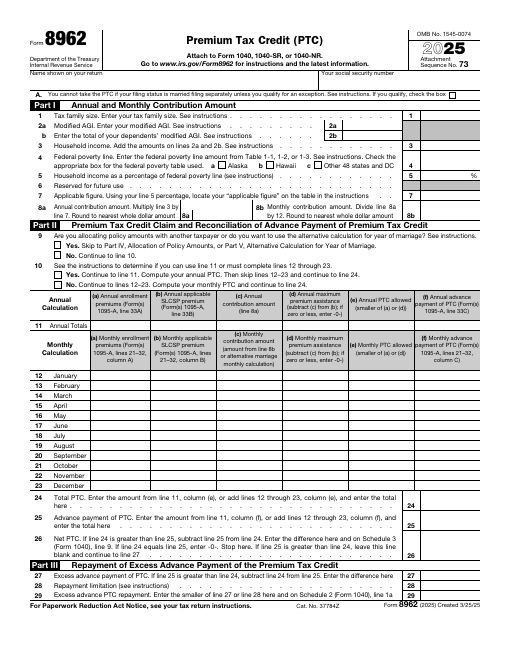
What Form 8962 figures out
Form 8962 works out the premium tax credit (PTC) and reconciles it with the advance payment of the premium tax credit (APTC) (About Form 8962). Two (2) amounts are compared: the credit the taxpayer qualifies for on the year’s return, and the advance payments the Marketplace made to the insurer during the year. When the advance payments are larger, the difference is excess APTC and is repaid, within limits. When the credit is larger, the difference lowers the tax owed or raises the refund.
Only a qualified health plan bought through a Marketplace at the bronze, silver, gold or platinum level counts. Catastrophic plans, stand-alone dental plans and anything bought through SHOP do not qualify for the credit.
Who attaches it
The instructions require Form 8962 with the return in three cases.
|
In every case the return must be filed with the form attached, even when the taxpayer is not otherwise required to file, and it must be a Form 1040, 1040-SR or 1040-NR; Form 1040-SS cannot be used. A person claimed as a dependent on another return does not file Form 8962, because the person claiming the dependent does. The IRS adds that a return filed without reconciling the advance payments delays the refund and can affect eligibility for advance payments later (The Premium Tax Credit: The basics).
Form 1095-A supplies the numbers
The monthly premiums, the second lowest cost silver plan (SLCSP) premiums and the advance payments on lines 11 to 23 are copied from Form 1095-A. A Marketplace must provide it by January 31, 2026 for 2025 coverage, and the instructions say to contact the Marketplace when it has not arrived by early February. A form marked “CORRECTED” replaces the original, and a form marked “VOID” is not used. Dollars only: cents on the 1095-A are rounded to whole dollars. HealthCare.gov shows where to download a copy.
When no advance payments were made, the SLCSP column of the 1095-A can be wrong, blank or -0-, and the correct premium is found in Publication 974 (About Publication 974) or, for the federally facilitated Marketplace, the HealthCare.gov tax tool.
What each part asks for
| Part | Lines | What it asks | Where the result goes |
|---|---|---|---|
| Box A | A | Married filing separately and a victim of domestic abuse or spousal abandonment | Records are kept, not attached |
| I | 1 to 8b | Tax family size, modified AGI, household income, poverty line, income as a percentage of it, applicable figure, contribution amounts | Feeds Part II |
| II | 9 to 26 | Whether policy amounts are shared, then the credit by year (line 11) or by month (lines 12 to 23), advance payments and net credit | Line 26 to Schedule 3 (Form 1040), line 9 |
| III | 27 to 29 | Excess advance payment, repayment limit and amount repaid | Line 29 to Schedule 2 (Form 1040), line 1a |
| IV | 30 to 34 | Up to four allocations of a policy that covered two tax families, as after a divorce | Back to lines 12 to 23 |
| V | 35 and 36 | Alternative calculation for the year of marriage | Worksheets in Publication 974 |
Line 11 (the annual calculation) is used only when every policy ran all twelve (12) months with the same enrollment premium and the same SLCSP premium each month. In any other case, lines 12 to 23 are completed month by month. On line 5, a household income above 400% of the poverty line is entered as 401. The applicable figure on line 7 runs from 0.0000 at 150 or less to 0.0850 at 400 or more.
For 2025 returns the instructions use the 2024 federal poverty lines.
| Family size | 48 states and DC | Alaska | Hawaii |
|---|---|---|---|
| 1 | $15,060 | $18,810 | $17,310 |
| 2 | $20,440 | $25,540 | $23,500 |
| 3 | $25,820 | $32,270 | $29,690 |
| 4 | $31,200 | $39,000 | $35,880 |
| 5 | $36,580 | $45,730 | $42,070 |
| 6 | $41,960 | $52,460 | $48,260 |
| 7 | $47,340 | $59,190 | $54,450 |
| 8 | $52,720 | $65,920 | $60,640 |
| Each person over 8 | $5,380 | $6,730 | $6,190 |
Repaying excess advance payments
Line 28 limits the repayment by the household income percentage on line 5.
| Line 5 percentage | Single | Any other filing status |
|---|---|---|
| Under 200 | $375 | $750 |
| 200 to under 300 | $975 | $1,950 |
| 300 to under 400 | $1,625 | $3,250 |
| 400 or more | No limit | No limit |
A spouse who files separately gets these limits separately, based on the income on that return. A self-employed filer who takes the self-employed health insurance deduction uses Publication 974 for line 28, and no limit applies to advance payments made for a person not lawfully present in the United States.
Married filing separately and other eligibility rules
A married couple generally files jointly to take the credit. A filer who is separated by a decree or divorced is not treated as married. Two exceptions let a married person take the credit: a separate return filed as head of household (or as single on Form 1040-NR) by a spouse who lives apart and meets the rules in the return’s instructions, and a return filed as married filing separately by a victim of domestic abuse or spousal abandonment who checks box A. The second exception is limited to three (3) consecutive years.
A separate filer without an exception cannot take the credit and generally repays all the APTC for a plan that covered only that tax family, or half when the plan also covered someone in the spouse’s tax family. The IRS reduces any line 24 amount above -0- on those returns to -0-.
Employer coverage is affordable for 2025 when the employee’s share is no more than 9.02% of household income. Household income under 100% of the poverty line can still qualify when the Marketplace estimated at least 100% at enrollment and advance payments were made, or for a lawfully present person who is not eligible for Medicaid because of immigration status. A month generally earns a credit only if the filer’s share of the premium was paid by the return’s due date, not counting extensions.
Signing, deadline, fee and where it goes
Form 8962 has no signature line and the instructions name no fee. It is filed with the return, so the deadline is the return’s deadline: April 15, 2026 for most 2025 calendar-year returns, the date given in the Form 4868 instructions. The return that carries it is signed under the rules for Form 1040.
The form goes behind the return, either in the e-file or in the paper envelope to the address in the return’s instructions. Free File is among the e-file routes the IRS lists.
Frequently asked questions
Is the form needed when no advance payments were made?
Yes, if the credit is being taken. The instructions require Form 8962 from any filer who wants the PTC, whether or not APTC was paid.
What changes should be reported to the Marketplace during the year?
The instructions list changes in household income, a move to a new address, gaining or losing other coverage, a job change, a birth or adoption, a marriage or divorce, and other changes to the tax family. Reporting them lets the Marketplace adjust the advance payments.
Where does a QSEHRA show up?
An unaffordable qualified small employer HRA reduces the monthly credit by its monthly permitted benefit, and “QSEHRA” is written in the top margin of page 1. An affordable QSEHRA means no credit for that month.
Does the person claimed as a dependent file the form?
No. The person who claims the dependent files it and repays any excess advance payments for that dependent’s coverage.