

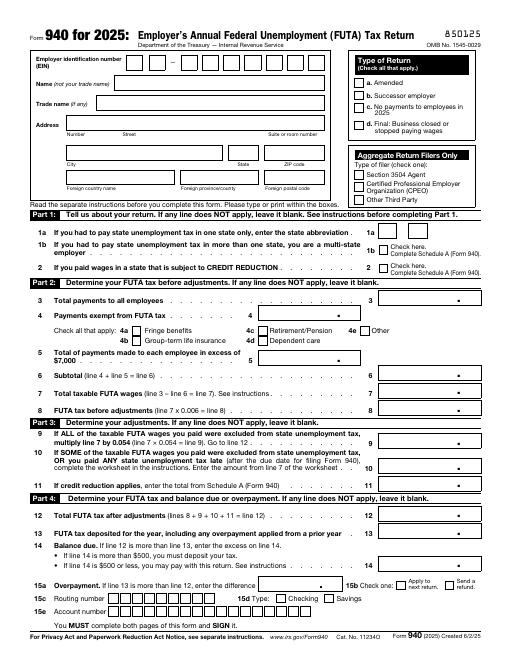
What a 940 reports
Form 940 reports the annual Federal Unemployment Tax Act (FUTA) tax of an employer (About Form 940). Two (2) parties are involved: the employer, who files and pays, and the IRS. An employer does not collect FUTA tax from employees and does not take it out of their wages.
The tax is figured on the first $7,000 paid to each employee in a calendar year. The statutory rate is 6.0%, and most employers receive a credit of up to 5.4% for state unemployment tax paid on time, which leaves the 0.6% that line 8 of the form multiplies by the taxable wages (Instructions for Form 940).
Who files a 940
An employer files a 940 when either of two tests was met in 2024 or 2025: wages of $1,500 or more paid in any one calendar quarter, or at least one employee on some part of a day in 20 or more different weeks of a year. A partnership does not count its partners in the second test.
| Type of employer | Rule in the instructions |
|---|---|
| Household employer | FUTA applies only after $1,000 or more of cash wages in a quarter; Schedule H (Form 1040) is usually filed instead of a 940 |
| Agricultural employer | A 940 is due after $20,000 or more of cash wages to farmworkers in a quarter, or 10 or more farmworkers in 20 or more different weeks |
| Section 501(c)(3) organization | Generally not subject to FUTA tax; it is subject when it pays wages on behalf of an organization that is not a 501(c)(3) |
| Indian tribal government, state or local government | Exempt; a tribe must have taken part in the state unemployment system for the full year |
An employer that also employs household workers can include their FUTA tax on its 940 and report their Social Security and Medicare tax on Form 941, 943 or 944.
Due date
The 2025 return is filed by the date below; the weekend rule is in the instructions.
| Situation | 2025 Form 940 due |
|---|---|
| Standard due date | February 2, 2026 |
| Every FUTA deposit was made when due | February 10, 2026 |
A due date on a Saturday, Sunday or legal holiday moves to the next business day. A paper return is on time when its envelope is postmarked by the U.S. Postal Service, or handed to an IRS-designated private delivery service, by the due date. The state unemployment credit requires the state tax to be paid by that same date.
Deposits during the year
A FUTA tax of more than $500 for the year requires at least one quarterly deposit before the return is filed. The test is run each quarter: tax of $500 or less is carried to the next quarter until the running total passes $500, and that quarter’s amount is deposited.
| Quarter ends | Deposit due |
|---|---|
| March 31 | April 30 |
| June 30 | July 31 |
| September 30 | October 31 |
| December 31 | January 31 (for the 2025 year, February 2, 2026) |
The quarterly liability is the first $7,000 of each employee’s annual wages paid in that quarter, multiplied by 0.006. For example, $13,000 of wages in the first quarter gives $78, which is carried forward.
Deposits are made by electronic funds transfer through the free EFTPS, IRS Direct Pay or the employer’s business tax account; a payroll service or bank can send them (see the IRS e-file page for employment taxes). Credit reduction amounts are included in the fourth-quarter deposit.
Where the 940 goes
The IRS encourages e-filing through approved software or a tax professional, and an amended 940 can also be e-filed. A paper return is mailed to one of the addresses below, which depend on the employer’s state, and the Louisville address is for a return that has a payment inside.
| Employer’s location | Mail a return without a payment to |
|---|---|
| CT, DE, DC, GA, IL, IN, KY, ME, MD, MA, MI, NH, NJ, NY, NC, OH, PA, RI, SC, TN, VT, VA, WV or WI | Department of the Treasury, Internal Revenue Service, Kansas City, MO 64999-0046 |
| Any other state | Department of the Treasury, Internal Revenue Service, Ogden, UT 84201-0046 |
| Puerto Rico, the U.S. Virgin Islands, or a location not listed | Internal Revenue Service, P.O. Box 409101, Ogden, UT 84409 |
| Tax-exempt organization or government (federal, state, local, Indian tribal), anywhere | Ogden, UT 84201-0046 |
A return with a payment goes to Internal Revenue Service, P.O. Box 932000, Louisville, KY 40293-2000, for every location. A P.O. box cannot take a private delivery service package. A check or money order is payable to “United States Treasury” with the EIN, “Form 940” and “2025” written on it and Form 940-V attached. A balance paid by transfer or card is not accompanied by a voucher, and that return is mailed to the without-a-payment address.
Parts of the form
The return has seven parts, and a line that does not apply is left blank. Part 1 names the state (line 1a) or marks a multi-state employer that attaches Schedule A (line 1b), and Part 2 builds the taxable wages (lines 3 to 7) and the tax before adjustments (line 8). Part 3 adjusts for wages the state excluded, late state payments and credit reduction. Part 4 gives the total tax (line 12), deposits (line 13), the balance due (line 14) or the overpayment (line 15a), and Part 5 lists the liability for each quarter when line 12 is more than $500.
A balance of $1 or more on line 14 is paid; under $1 need not be. An overpayment is applied to the next return or refunded by direct deposit, and a box left unchecked generally sends it to the next return. Parts 6 and 7 hold the third-party designee, who needs a five-digit PIN, and the signature on page 2.
Who signs
| Business type | Who signs |
|---|---|
| Sole proprietorship | The individual who owns the business |
| Corporation, or an LLC taxed as one | The president, vice president or another principal officer authorized to sign |
| Partnership, or an LLC taxed as one | A responsible partner, member or officer who knows its affairs |
| Single-member LLC disregarded for income tax | The owner or an authorized principal officer |
| Trust or estate | The fiduciary |
An agent signs only with a valid power of attorney or a reporting agent authorization (Form 8655) on file. A paid preparer who is not an employee of the filer signs paper returns by hand and gives the employer a copy.
Penalties and interest
The instructions point to sections 11 and 12 of Publication 15 for rates. Neither penalty applies when the failure was for reasonable cause.
| Problem | Penalty in Publication 15 (2026) |
|---|---|
| Return filed late | 5% of the unpaid tax for each whole or part month, generally up to 25% |
| Tax paid late | 0.5% of the tax for each whole or part month, up to 25% |
Interest runs on any unpaid balance. A deposit that was required but paid with the return instead can bring a penalty. A notice about a penalty is answered with an explanation, never with a statement attached to the return, and abatement is requested on Form 843.
Frequently asked questions
Is a 940 filed when no wages were paid in 2025?
Yes, for an employer that is otherwise required to file, with box c checked at the top of page 1 and a signature in Part 7. A business that closed checks box d instead.
How is a filed 940 corrected?
The 2025 form is used again with box a (Amended) checked, every amount that belonged on the original is filled in, and an explanation of the reason is attached. It can be e-filed or mailed to the without-a-payment address even when money is enclosed.
What does an employer need before starting?
A nine-digit EIN, never a Social Security number, plus the state unemployment account information; the SS-4 page explains how an EIN is obtained. The other IRS employer forms, such as W-3, are in the IRS forms section.