

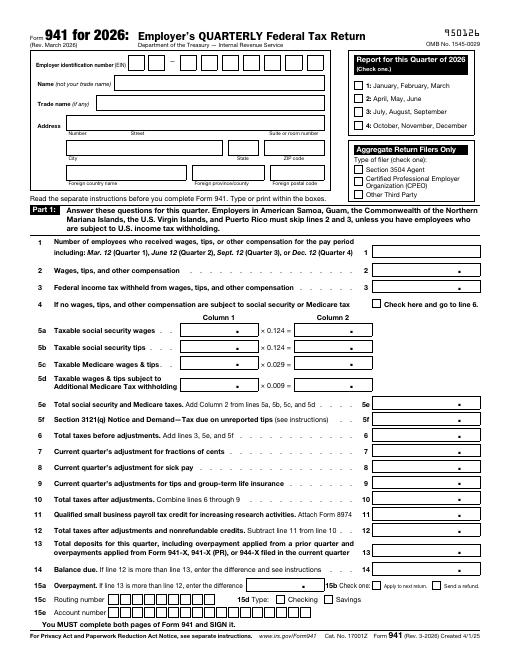
What a 941 reports
Form 941 reports the wages an employer paid, the tips employees told it about, the federal income tax it withheld, and the employer and employee shares of Social Security and Medicare tax (About Form 941). Two (2) parties stand behind it: the employer (the business paying wages) and the IRS. For 2026 the Social Security rate is 6.2% each for employer and employee on wages up to $184,500, and the Medicare rate is 1.45% each with no wage limit (Instructions for Form 941).
After the first 941, a return is due for every quarter, even a quarter with no tax to report, unless the employer filed a final return or one of these exceptions applies.
| Situation | Form used |
|---|---|
| The IRS sent notice to file Form 944 | The annual Form 944, not the 941 |
| Seasonal employer with no wages in a quarter | A 941 only for quarters with liability; line 18 is checked on each one filed |
| Household employees | Usually Schedule H (Form 1040) |
| Farm labor | Form 943 |
| Backup withholding, pensions, annuities, gambling winnings | Form 945 |
| Federal unemployment (FUTA) tax | Form 940 |
Due dates for each quarter
A 941 is due by the last day of the month after the quarter closes. An employer that made every deposit on time and in full may instead file by the 10th day of the second month after the quarter ends.
| Quarter | Months covered | Quarter ends | 941 due | Due with all deposits made on time |
|---|---|---|---|---|
| 1 | January to March | March 31 | April 30 | May 10 |
| 2 | April to June | June 30 | July 31 | August 10 |
| 3 | July to September | September 30 | October 31 | November 10 |
| 4 | October to December | December 31 | January 31 | February 10 |
When a due date falls on a Saturday, Sunday or legal holiday, the return can be filed on the next business day. For example, October 31, 2026 is a Saturday, so the third-quarter 2026 return is timely on Monday, November 2, 2026, and January 31, 2027 is a Sunday, which moves the fourth-quarter return to Monday, February 1, 2027. A paper return is timely when postmarked by the due date.
Deposits are separate from the return
Federal tax deposits go by electronic funds transfer through the free EFTPS, IRS Direct Pay or the employer’s business tax account. A tax professional, bank or payroll service can make them for the employer. A credit or debit card is never used for deposits, and a check or money order is limited to a balance due when no deposit was required or when a monthly depositor makes an accuracy-of-deposits payment.
| Depositor | How the IRS sorts it | When deposits are due |
|---|---|---|
| Monthly | $50,000 or less of tax in the lookback period | By the 15th of the month after the payday |
| Semiweekly | More than $50,000 in the lookback period; Schedule B (Form 941) is attached | Wednesday, Thursday or Friday paydays by the next Wednesday; Saturday through Tuesday paydays by the next Friday |
| Next-day | $100,000 of liability on any one day | By the next business day; a monthly depositor becomes semiweekly for at least the rest of that year and all of the next |
| None needed | Line 12 under $2,500 for the current or the prior quarter, and no $100,000 day | Pay the balance with the return by its due date |
The lookback period is the four quarters from July 1 of the second preceding year to June 30 of the preceding year; for 2026 it began July 1, 2024 and ended June 30, 2025. The schedules come from section 11 of Publication 15, the Employer’s Tax Guide.
Where the 941 goes
The IRS encourages e-filing, done through approved software or a tax professional (see the IRS e-file page for employment taxes). A paper return goes to an address that depends on the state and on whether a payment is enclosed.
| Employer’s location | Return without a payment | Return with a payment |
|---|---|---|
| Connecticut, Delaware, District of Columbia, Georgia, Illinois, Indiana, Kentucky, Maine, Maryland, Massachusetts, Michigan, New Hampshire, New Jersey, New York, North Carolina, Ohio, Pennsylvania, Rhode Island, South Carolina, Tennessee, Vermont, Virginia, West Virginia, Wisconsin | Internal Revenue Service, Kansas City, MO 64999-0005 | Internal Revenue Service, P.O. Box 932100, Louisville, KY 40293-2100 |
| Any other state | Internal Revenue Service, Ogden, UT 84201-0005 | Internal Revenue Service, P.O. Box 932100, Louisville, KY 40293-2100 |
| No legal residence in any state, including the territories | Internal Revenue Service, P.O. Box 409101, Ogden, UT 84409 | Internal Revenue Service, P.O. Box 932100, Louisville, KY 40293-2100 |
A balance paid by transfer or card uses the no-payment address and no voucher. A check or money order is payable to “United States Treasury”, shows the EIN, “Form 941” and the quarter, and travels with Form 941-V. Private delivery services cannot deliver to a P.O. box. Neither the return nor a payment goes to the Social Security Administration. Exempt organizations and governmental entities send a return without a payment to the Ogden address, whatever their location.
Who signs
Both pages are completed and the signature goes on page 2.
| Business type | Who signs |
|---|---|
| Sole proprietorship | The owner |
| Corporation, or an LLC taxed as one | The president, a vice president or another authorized principal officer |
| Partnership, or an LLC taxed as one | A responsible and authorized partner, member or officer who knows its affairs |
| Single-member LLC disregarded for income tax | The owner or an authorized principal officer |
| Trust or estate | The fiduciary |
An agent can sign with a valid power of attorney on file. A corporate officer or agent may use a rubber stamp, mechanical device or software under Rev. Proc. 2005-39. A paid preparer who is not an employee of the filer signs by hand on paper, adds a PTIN, and gives the employer a copy.
Penalties and interest
The rates below come from Publication 15; they do not apply to a deposit missed for reasonable cause.
| Problem | Penalty |
|---|---|
| Deposit 1 to 5 days late | 2% of the amount |
| Deposit 6 to 15 days late | 5% |
| Deposit 16 or more days late, but less than 10 days after the first IRS notice | 10% |
| Still unpaid more than 10 days after the first IRS notice | 15% |
| Return filed late | 5% of the unpaid tax for each month or part, up to 25% |
| Tax paid late | ½ of 1% a month, up to 25% |
| Withheld tax not paid over | 100% of the unpaid trust fund tax, on each person who was responsible and acted willfully |
Interest runs from the due date on any unpaid balance. A penalty notice is answered with an explanation of the reasonable cause, never with a statement attached to the return, and abatement is requested on Form 843.
Frequently asked questions
Does an employer with no payroll in a quarter still file?
Yes, once it has filed a first 941, unless it filed a final return or one of the exceptions above applies. A business that stopped paying wages checks line 17 and gives the last date wages were paid.
How is a filed 941 corrected?
On Form 941-X, which is filed separately and can be e-filed. The IRS also matches the four quarterly returns against the year’s Form W-3, which totals the W-2 amounts.
What goes in the EIN space for a new business?
The nine-digit EIN, never a Social Security number. A business whose number has not arrived writes “Applied For” and the date on a paper return, while an e-filed return needs a valid number. The SS-4 page explains the application.