

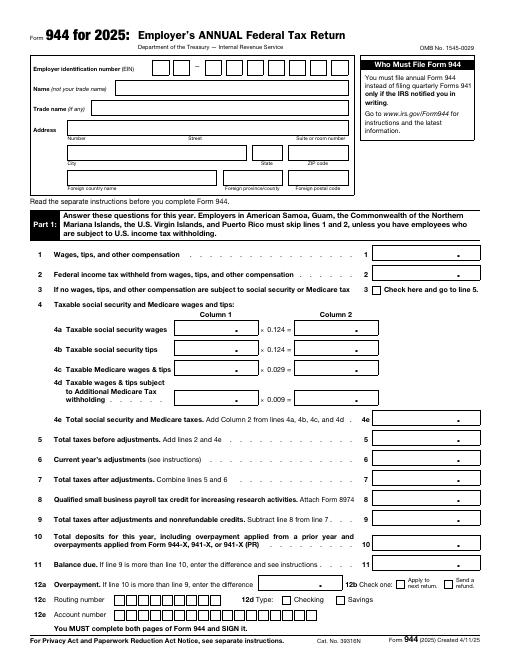
What a 944 reports
Form 944 is built for the smallest employers, those whose yearly liability for Social Security, Medicare and withheld federal income taxes is $1,000 or less, so that they file and pay once a year (About Form 944). Two (2) parties stand behind it: the employer and the IRS. The form totals wages, tips, withheld income tax, both shares of Social Security and Medicare tax, Additional Medicare Tax withheld, and the year’s adjustments.
The 2025 rates, as printed in the Instructions for Form 944, are 6.2% Social Security tax for the employer and 6.2% for the employee on wages up to $176,100, and 1.45% Medicare tax for each with no wage limit. Additional Medicare Tax of 0.9% is withheld on an employee’s wages above $200,000. On the form these appear as the multipliers 0.124, 0.029 and 0.009.
Who files a 944
An employer files Form 944 in place of the quarterly Form 941 only when the IRS has notified it in writing. That notice controls: an employer told to file a 944 files it even when its 2025 liability went over $1,000.
| Employer | Form |
|---|---|
| IRS sent a written notice to file Form 944 | Form 944 |
| IRS did not send that notice | Quarterly Form 941 |
| IRS confirmed in writing a change from 944 to 941 | Quarterly Form 941 |
| Only household employees | Schedule H (Form 1040) |
| Only agricultural employees | Form 943 |
An employer that expects $1,000 or less for the coming year can ask to file a 944. For 2026 the instructions set the window as a phone call between January 1 and April 1, or a written request postmarked between January 1 and March 16. Wages of $5,000 or less subject to Social Security, Medicare and withholding are generally likely to produce $1,000 or less in tax. The IRS answers with a written notice, and without it the employer files 941s.
Due date
| Situation | 2025 Form 944 due |
|---|---|
| Standard due date | February 2, 2026 |
| Taxes fully paid by on-time deposits | February 10, 2026 |
One 944 is filed per calendar year, and an e-filed return is not filed again on paper. A paper return is on time when the envelope is addressed correctly, has enough postage, and is postmarked by the U.S. Postal Service (or sent by an IRS-designated private delivery service) no later than the due date. A return that misses those conditions is treated as filed on the day the IRS receives it.
Deposits
Line 9 of the return is the number that sorts deposit duties. The chart in the instructions has three rows.
| Tax for the year | What is required |
|---|---|
| Under $2,500 | No deposit; the tax is paid with the return |
| $2,500 or more for the year, under $2,500 in the quarter | A deposit by the last day of the month after the quarter ends; a fourth-quarter amount under $2,500 can be paid with the return |
| $2,500 or more in the quarter | Monthly or semiweekly deposits by schedule; a $100,000 balance on any day is deposited by the next business day |
A monthly depositor that reaches $100,000 in a deposit period becomes semiweekly the next day, for at least the rest of that year and the following one. The lookback period for a 944 filer differs from the one used for 941 filers. All deposits go by electronic funds transfer: the free EFTPS, the business tax account, or a payroll service, bank or tax professional acting for the employer (see the IRS e-file page for employment taxes). A card is never used for deposits.
Page 2 of the form mirrors this. Line 13 is checked for “less than $2,500” or “$2,500 or more”, and the larger group enters liability for each month. A semiweekly depositor, or one who hit $100,000 in a day, completes Form 945-A and skips the monthly boxes.
Where the 944 goes
E-filing is encouraged. A paper return is mailed according to the employer’s state, and the Louisville address takes any return that has money enclosed.
| Employer’s location | Mail a return without a payment to |
|---|---|
| Northeast and Mid-Atlantic: Maine, New Hampshire, Vermont, Massachusetts, Rhode Island, Connecticut, New York, New Jersey, Pennsylvania, Delaware, Maryland, District of Columbia | Department of the Treasury, Internal Revenue Service, Kansas City, MO 64999-0044 |
| Southeast and Midwest: Virginia, West Virginia, North Carolina, South Carolina, Georgia, Kentucky, Tennessee, Ohio, Michigan, Indiana, Illinois, Wisconsin | Department of the Treasury, Internal Revenue Service, Kansas City, MO 64999-0044 |
| Any other state | Department of the Treasury, Internal Revenue Service, Ogden, UT 84201-0044 |
| No legal residence or principal place of business in any state, including Puerto Rico, American Samoa, Guam, the Northern Mariana Islands and the U.S. Virgin Islands | Internal Revenue Service, P.O. Box 409101, Ogden, UT 84409 |
| Exempt organization or federal, state, local or Indian tribal government, wherever located | Ogden, UT 84201-0044 |
A return that includes a payment is mailed to P.O. Box 932100, Louisville, KY 40293-2100, in every case. Packages from a private delivery service are not accepted at a P.O. box. The Social Security Administration receives neither the return nor a payment. A check or money order is made out to “United States Treasury” and travels with Form 944-V.
Signing and the other copies
Both pages are completed and the signature goes on page 2, Part 5.
| Business type | Who signs |
|---|---|
| Sole proprietorship | The owner |
| Corporation, or an LLC taxed as one | The president, a vice president or another authorized principal officer |
| Partnership, or an LLC taxed as one | A responsible and authorized partner, member or officer |
| Single-member LLC disregarded for income tax | The owner or an authorized principal officer |
| Trust or estate | The fiduciary |
The IRS compares the federal income tax, Social Security wages, Social Security tips and Medicare wages on a 944 with the totals of the year’s W-2 forms on Form W-3, and a mismatch can bring a contact from the IRS or the SSA. A business that closes checks the box on line 14, enters the last date wages were paid and attaches a statement.
Penalties
The deposit penalty rates in section 11 of Publication 15 apply to Form 944, and they do not apply when the failure had a reasonable cause.
| Problem | Penalty (Publication 15, 2026) |
|---|---|
| Deposit 1 to 5 days late | 2% |
| Deposit 6 to 15 days late | 5% |
| Deposit 16 or more days late, but before 10 days after the first IRS notice | 10% |
| Amounts paid with the return that should have been deposited | 10% |
| Unpaid more than 10 days after the first IRS notice | 15% |
| Return filed late | 5% of the unpaid tax for each month or part, generally up to 25% |
| Tax paid late | 0.5% a month, up to 25% |
| Withheld tax not paid over | 100% of the unpaid trust fund tax, against each responsible person who acted willfully |
A penalty notice is answered with an explanation, and a request to abate a penalty is made on Form 843, never on the 944 itself.
Frequently asked questions
Can a business choose to file a 944?
Only by asking the IRS and receiving a written notice back. Without that notice, quarterly 941s are filed.
How is a filed 944 corrected?
On Form 944-X, which is filed separately from the 944 and not attached to it.
What goes in the EIN space for a new business?
The nine-digit EIN goes in the box, with no SSN or ITIN. A paper return from a business still waiting for its number says “Applied For” and the date, while an e-filed return needs a valid EIN; the SS-4 page covers the application. Other IRS payroll forms are collected in the IRS forms section.