

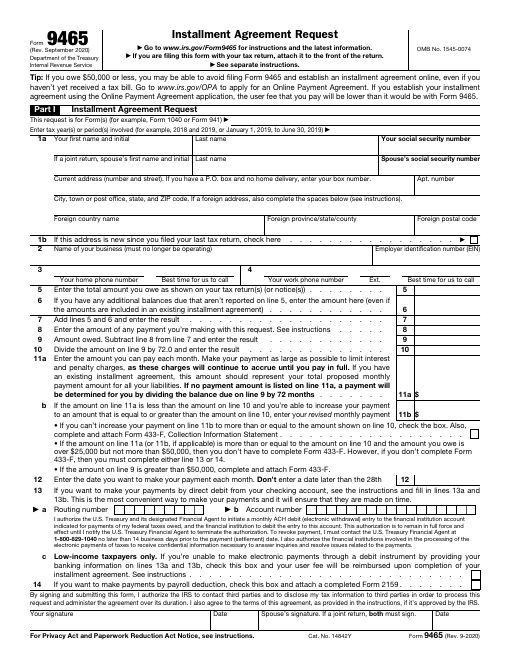
What Form 9465 does
Form 9465 requests a monthly installment agreement for an individual who cannot pay the full amount shown on a tax return or an IRS notice (About Form 9465). Two (2) parties are involved: the taxpayer, or spouses on a joint return, and the IRS. The instructions suggest weighing a bank loan or available credit first, since either may cost less.
The form is for an individual who owes income tax on a Form 1040 or 1040-SR, who is or may be responsible for a trust fund recovery penalty, who owes employment taxes (reported, for example, on a Form 941) from a sole proprietor business that no longer operates, or who owes an Affordable Care Act shared responsibility payment. Four situations rule it out.
|
Kinds of agreement
| Type | Conditions in the instructions |
|---|---|
| Guaranteed | Tax owed of $10,000 or less; all returns filed and income tax paid on time for the past five (5) years with no earlier agreement; payment in full within three (3) years; the taxpayer is financially unable to pay when due |
| Balances up to $50,000 | Assessed tax of $25,000 or less, or $25,001 to $50,000 with payment by direct debit or payroll deduction; the payment must clear the balance within 72 months or by the Collection Statute Expiration Date, whichever is sooner |
| Partial payment | The payment will not clear the balance before the Collection Statute Expiration Date; a financial statement is required, with later reviews |
The Collection Statute Expiration Date is normally ten (10) years from the date of the assessment. An agreement for a balance up to $50,000 generally needs no financial statement, and a Notice of Federal Tax Lien is generally not filed for it or for a guaranteed agreement.
Lines on the form
| Lines | What they ask | Rules from the instructions |
|---|---|---|
| 1a to 4 | Form and years, names, SSNs, address, business name and EIN, phones | Spouses appear in the order used on the return; a business on line 2 must no longer operate |
| 5 to 9 | Amount owed, other balances, total, payment sent, balance | Line 5 may cover several years; line 6 takes balances not on line 5, even if already in an agreement; line 9 is line 7 minus line 8 |
| 10 to 11b | Line 9 divided by 72, monthly payment, revised payment | If line 11a is blank the IRS divides the balance by 72 months. A payment under line 10 that cannot be raised means the box is checked and Form 433-F attached |
| 12 | Payment day | The 1st through the 28th |
| 13a to 13c | Routing number, account number, low-income box | The routing number has nine digits, starting 01 to 12 or 21 to 32; the account number takes up to 17 characters |
| 14 | Payroll deduction | A signed Form 2159 is attached, with the employer’s part completed |
A payment sent with the request is a check or money order payable to “United States Treasury”, never cash, marked with the name, address, SSN or EIN, phone, tax year and return. A balance over $50,000 means Form 433-F is attached. Part II (lines 15 to 27) is completed only when three things are true: an agreement was defaulted on in the past 12 months, the balance is over $25,000 but not over $50,000, and line 11a or 11b is below line 10.
Setup fees
The fees below are from the IRS payment plan page, updated March 3, 2026 (Payment plans; installment agreements). The July 2024 instructions print $22 for an online direct-debit agreement; the IRS page now shows $29, and its $69, $107, $178 and $89 amounts match the instructions.
| Plan | Applied for online | By phone, mail or in person |
|---|---|---|
| Short-term, 180 days or less | $0 | $0 |
| Direct debit installment agreement | $29 | $107 |
| Any other payment method | $69 | $178 |
| Changing an existing plan | $6 | $89 |
A low-income taxpayer (adjusted gross income at or below 250% of the federal poverty guidelines) pays no setup fee on a direct debit agreement; another method costs a reduced $43 that may be reimbursed. A taxpayer not flagged as low-income asks for review on Form 13844 within 30 days of the acceptance letter. Topic 202 covers the payment options.
Where Form 9465 goes
The form is attached to the front of a return and sent to the address in the return’s booklet. A taxpayer who has already filed, or is answering a notice, mails it alone.
| Taxpayer lives in (no Schedule C, E or F) | Address |
|---|---|
| Alaska, Arizona, Colorado, Connecticut, Delaware, District of Columbia, Hawaii, Idaho, Illinois, Maine, Maryland, Massachusetts, Montana, Nevada, New Hampshire, New Jersey, New Mexico, North Dakota, Oregon, Rhode Island, South Dakota, Tennessee, Utah, Vermont, Washington, Wisconsin, Wyoming | 310 Lowell St., Stop 830, Andover, MA 01810 |
| Alabama, Florida, Georgia, Kentucky, Louisiana, Mississippi, North Carolina, South Carolina, Texas, Virginia | P.O. Box 47421, Stop 74, Doraville, GA 30362 |
| Arkansas, California, Indiana, Iowa, Kansas, Michigan, Minnesota, Missouri, Nebraska, New York, Ohio, Oklahoma, Pennsylvania, West Virginia | Stop P-4 5000, Kansas City, MO 64999-0250 |
A Form 1040 or 1040-SR with Schedule C, E or F for any year in the request goes to a different set of addresses.
| Taxpayer lives in (Schedule C, E or F) | Address |
|---|---|
| Connecticut, Maine, Massachusetts, New Hampshire, New York, Rhode Island, Vermont | P.O. Box 480, Stop 660, Holtsville, NY 11742-0480 |
| Alabama, Arkansas, Georgia, Illinois, Indiana, Iowa, Kansas, Kentucky, Louisiana, Michigan, Minnesota, Mississippi, Missouri, Nebraska, New Jersey, North Dakota, Ohio, Oklahoma, Pennsylvania, South Dakota, Tennessee, Texas, West Virginia, Wisconsin | P.O. Box 69, Stop 811, Memphis, TN 38101-0069 |
| Alaska, Arizona, California, Colorado, Hawaii, Idaho, Montana, Nevada, New Mexico, Oregon, Utah, Washington, Wyoming | P.O. Box 9941, Stop 5500, Ogden, UT 84409 |
| District of Columbia, Delaware, Florida, Maryland, North Carolina, South Carolina, Virginia | Stop 4-N31.142, Philadelphia, PA 19255-0030 |
| Outside the 50 states: a foreign country, a U.S. territory, an APO or FPO address, Form 2555 or 4563 filers, dual-status aliens | 3651 South I-H 35, 5501AUSC, Austin, TX 78741 |
Every address is “Department of the Treasury, Internal Revenue Service” above the line shown.
Signing
The requester signs and dates the form, and on a joint return the spouse signs too: both must sign. Signing lets the IRS contact third parties and disclose tax information to process and administer the agreement. The line 13 bank authorization allows a monthly ACH debit until it is ended; revoking a payment takes a call to 800-829-1040 at least 14 business days before the payment date.
What happens after the request
The IRS usually replies within 30 days, though a request for tax due on a return filed after March 31 can take longer. An approval comes as a notice with the terms and the user fee. While a request is pending, the IRS is generally barred from levying, with certain exceptions.
Payments must arrive on time, later tax bills must be covered, and a refund applied to the balance does not cancel the monthly payment. A request is denied while a required return is unfiled. An agreement in default can be terminated, after which the IRS can file a Notice of Federal Tax Lien or levy for the whole amount; an appeal through the Collection Appeals Program may be available first. The Taxpayer Advocate Service can be reached at 877-777-4778.
Frequently asked questions
Does the first payment wait for the IRS reply?
If no reply has come by the date chosen on line 12, the first payment can be sent to the service center address above or paid electronically.
Can a payment plan stop interest and penalties?
No. The instructions state that interest and a late payment penalty are charged on tax not paid by its due date even when installments are granted, and continue until the balance is paid in full.
How does a payroll deduction agreement work?
The requester checks line 14 and attaches Form 2159 completed and signed. The employer completes and signs its own portion of Form 2159.