

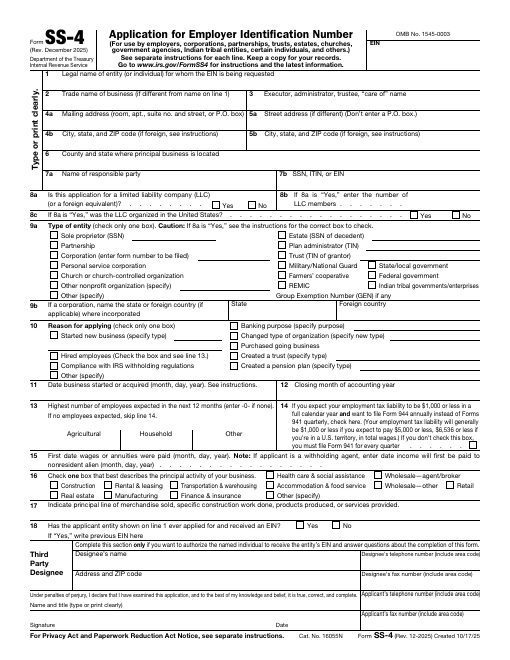
What Form SS-4 is for
An employer identification number is a nine (9) digit number written 12-3456789 that the IRS assigns to employers, sole proprietors, corporations, partnerships, estates, trusts, certain individuals and other entities for filing and reporting (About Form SS-4). Form SS-4 is the application for one, and what the applicant writes on it opens the entity’s business tax account (Instructions for Form SS-4, Purpose of Form). Three (3) parties can appear on the form: the applicant (the entity), the responsible party (the individual who controls it) and, when named, a third party designee (authorized to receive the number).
Page 2 of the form, “Do I Need an EIN?”, gives the test: an entity files when it has no EIN yet and must show one on a return, statement or other document. A sole proprietor who sets up a qualified retirement plan, or who has to file excise, employment, alcohol, tobacco or firearms returns, needs one, and one (1) EIN covers every business and trade name that person runs. However, a sole proprietorship that incorporates or takes in a partner needs a new number, while a business that only changed its name keeps the one it has (form, page 2, note 2).
Four ways to apply
The instructions recommend applying electronically and using one (1) method per entity, so that no entity ends up with two numbers.
| Method | Who may use it | How long it takes | Where |
|---|---|---|---|
| Online | An applicant with a residence, business or office in the United States or its territories, whose principal officer or owner has a valid SSN, ITIN or EIN | The EIN appears at the end of the session and can be used at once | Apply for an EIN online |
| Fax | Any applicant; the form should carry a return fax number | Generally four (4) business days | 855-641-6935 from the 50 states or DC; 855-215-1627 or 304-707-9471 with no address in a state or DC |
| Any applicant | About four (4) weeks | Internal Revenue Service, Attn: EIN Operation, Cincinnati, OH 45999 (from the 50 states or DC; otherwise Attn: EIN International Operation, same city and ZIP code) | |
| Telephone | International applicants only, with no residence, business or office in the United States or its territories | During the call | 267-941-1099, not toll-free, 6:00 a.m. to 11:00 p.m. Eastern, Monday through Friday |
The SS-4 PDF on irs.gov is a fillable form, and the instructions say a completed copy is suitable for faxing or mailing to the IRS. The IRS posts its current processing status for tax forms, the SS-4 among them.
Before filling in the form
|
Line by line
Lines 1 through 7b: the applicant
A line that does not apply generally takes “N/A”.
| Line | IRS label | What to enter |
|---|---|---|
| 1 | Legal name of entity (or individual) | Required. A sole proprietor’s own name; a corporation’s name with its suffix, such as Inc. |
| 2 | Trade name of business | The DBA, only when it differs from line 1 |
| 3 | Executor, administrator, trustee, “care of” name | The trustee for a trust; the executor or other fiduciary for an estate |
| 4a, 4b and 5a, 5b | Mailing address; Street address | Where IRS correspondence goes, then the physical address only when it differs |
| 6 | County and state where principal business is located | The entity’s primary physical location |
| 7a, 7b | Name of responsible party; SSN, ITIN, or EIN | The individual who owns or controls the entity; “foreign” or N/A on 7b for a person who cannot get an SSN or ITIN |
Lines 8a through 9b: LLCs and entity type
Check one (1) box on line 9a; the box describes the entity and is not a tax election.
Line 8a asks whether the applicant is an LLC, 8b how many members it has and 8c whether it was organized in the United States. The 9a box follows a domestic LLC’s default federal treatment:
| LLC | Default treatment | Box on line 9a |
|---|---|---|
| One (1) member, no election | Disregarded entity, reported on the owner’s return | Other, with “Disregarded entity” written in |
| Two (2) or more members, no election | Partnership | Partnership |
| Any LLC filing Form 8832 or Form 2553 to be taxed as a corporation | Corporation | Corporation, with 1120 or 1120-S written in |
A nonprofit other than a church checks Other nonprofit organization, and one that wants tax-exempt status files Form 1023 or Form 1024 (Pub. 557). Line 9b takes the state or foreign country where a corporation was incorporated.
Lines 10 through 18: why, when and what
One (1) box on line 10 and one (1) on line 16; both are required.
Line 10 is the reason for applying, from started new business (with its type) to hired employees, banking purpose, created a trust or created a pension plan. Line 11 is the date the business started or was acquired. Line 12 is the closing month of the accounting year, usually December for an individual, with the rules for partnerships and trusts in Pub. 538. Line 13 counts the employees expected in the next twelve (12) months, and with none expected line 14 is skipped. Line 14 lets a small employer file Form 944 once a year instead of Form 941 every quarter, when its employment tax for a full calendar year is expected to be $1,000 or less, which the form equates with $5,000 or less in wages; once checked, Form 944 stays the return until the IRS says otherwise (Pub. 15). Line 16 is the principal activity, one of eleven (11) named boxes or Other, and line 17 describes it in more detail.
Third party designee and signature
Sign and date the application; a designee’s authority holds only with the signature.
The designee section lets a named individual receive the new EIN and answer the IRS’s questions about the form, and that authority ends the moment the number is released. A principal officer signs for a corporation, an authorized member or officer for a partnership, and the fiduciary for a trust or estate.
After the number arrives
A return that falls due before the EIN arrives shows “Applied For” and the application date in the EIN space, never the owner’s SSN. Once issued, the number goes on the business returns the entity files and on the W-9 it hands to anyone who pays it. A change of responsible party, address or location is reported on Form 8822-B, the first within sixty (60) days (Regulations section 301.6109-1(d)(2)(ii)).
Frequently asked questions
Can the EIN be used the same day?
An online applicant can, to file a return or make a payment. A fax applicant generally has the number within four (4) business days and a mail applicant in about four (4) weeks.
Who is the responsible party?
The individual who owns or controls the entity at the top, with enough command of its funds and assets to direct them. For a trust it is the grantor, owner or trustor, and for an estate the executor or other fiduciary.
Does a single-member LLC that adds a member need a new number?
Yes. A disregarded entity that takes on one or more additional owners becomes a partnership under the default rules and applies for an EIN with the Partnership box checked on line 9a.