

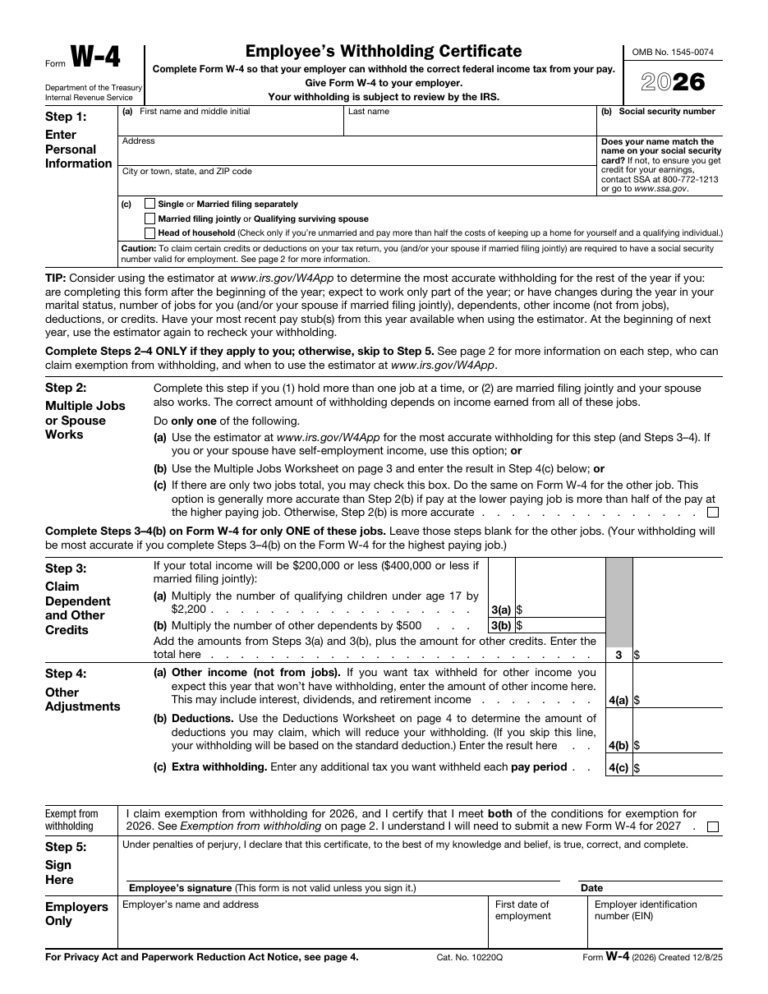
What Form W-4 does
Form W-4 (Employee’s Withholding Certificate) sets the amount of federal income tax an employer takes out of an employee’s wages. It involves two (2) parties: the employee (the worker whose pay is taxed) and the employer (the business that pays the wages). The employer, not the IRS, receives the completed form; nothing is filed with the IRS. However, the IRS may review any W-4 and may direct the employer to send in a copy (Pub. 505, “IRS review of your withholding”).
Too little withholding leaves a balance due at filing time, and a penalty can come with it; too much comes back as a refund (form, page 2, “Purpose of Form”). The form runs five (5) steps. Every employee completes Steps 1 and 5, while Steps 2, 3 and 4 are filled in only by an employee whose situation matches the step’s heading (form, page 1).
The 2026 revision is a five (5) page PDF: page 1 is the form itself, page 2 holds the instructions, page 3 the Multiple Jobs Worksheet, page 4 the Deductions Worksheet and page 5 the three (3) wage tables. The IRS’s About Form W-4 page listed it as the current revision when irs.gov was checked on October 15, 2026, and the file offered here is that PDF without any change.
When a new W-4 is needed
An employee does not owe the employer a fresh W-4 each January. A form signed in 2025 or any earlier year keeps working until the employee replaces it (Pub. 15 (2026), section 9, “Effective date of Form W-4”). Exempt status is the one exception; it runs out every year and is covered below.
| Situation | Deadline | Source |
|---|---|---|
| You start a new job | Give the signed form to the employer when you start; it applies from your first paycheck | Pub. 15, section 9 |
| You give your employer a replacement W-4 | The employer applies it no later than the start of the first payroll period ending on or after the 30th day after receiving it | Pub. 15, section 9; Pub. 505, “When Will Your New Form W-4 Go Into Effect?” |
| A change cuts the withholding you are entitled to (your filing status goes from Married filing jointly to Single, for example) and you will be under-withheld for 2026 | A new W-4 within 10 days of the change | Pub. 505, “Changing Your Withholding” |
| Your filing status changes from Married filing jointly (or Qualifying surviving spouse) to Head of household or Single, or from Head of household to Single, during 2026, and you will still have enough withheld for 2026 | A new W-4 for 2027 by December 1, 2026, or 10 days after the change if that is later | Pub. 505, “Change of status resulting in withholding that will cover your tax liability” |
| You claimed exempt for 2026 and want to stay exempt in 2027 | A new W-4 by February 16, 2027 | Form W-4 (2026), page 2 |
| You claimed exempt for 2026 but expect to owe tax for 2027 | A new W-4 by December 1, 2026 | Pub. 505, “Claiming exemption from withholding” |
Outside those situations, the employee may replace the W-4 at any time and for any reason (Pub. 505, “Change of status resulting in withholding that will cover your tax liability”). However, a form that makes a change for the following year has no effect on the current year’s withholding (Pub. 15, section 9).
What to have ready
Gather these before starting.
|
How to fill out Form W-4
The steps below follow the form’s own order and labels on page 1 of the 2026 PDF.
Step 1 – Enter personal information
Every employee completes all three (3) lines of this step.
Line 1(a) takes the first name, middle initial, last name and home address, and line 1(b) the Social Security number. A name that differs from the Social Security card is a problem: the form tells the employee to call the Social Security Administration at 800-772-1213 or go to ssa.gov, because wages reported under a mismatched name may never be credited to that employee (form, Step 1).
Line 1(c) is the filing status, and exactly one of three (3) boxes is checked:
- Single or Married filing separately
- Married filing jointly or Qualifying surviving spouse
- Head of household, which the form limits to an unmarried employee who pays over half the cost of keeping up a home for themselves and a qualifying individual
The box checked here decides the standard deduction and the tax rates the employer builds the withholding from (form, page 2, “Step 1(c)”). The form does not say which status an employee is entitled to; the rules are in Pub. 501.
Step 2 – Multiple jobs or spouse works
Skip this step unless the employee holds two (2) or more jobs at once, or files jointly with a spouse who also works.
The correct withholding depends on what every job in the household pays, taken together (form, Step 2). Therefore each employer gets its own W-4 (form, page 2, “Step 2”), and the employee picks one of three (3) options:
| Option | What you do | When the IRS says to use it |
|---|---|---|
| 2(a) | Run the Tax Withholding Estimator and copy its results into Steps 3 and 4 | The most accurate option; the form says to use this option if you or your spouse have self-employment income |
| 2(b) | Complete the Multiple Jobs Worksheet on page 3 and enter its line 4 in Step 4(c) | Slightly less accurate than 2(a); keeps the other job off this employer’s form (see “Your privacy”, page 2) |
| 2(c) | Check the box, and check it on the W-4 for the other job too | Only when the household has exactly two jobs. Each job’s standard deduction and brackets are cut in half. The IRS says it beats 2(b) when the lower-paying job pays more than half of the higher-paying one; otherwise too much is withheld |
Whatever option is chosen, Steps 3 through 4(b) are completed on one W-4 and left empty on every other; the IRS adds that the result is most accurate when that form belongs to the highest-paying job (form, page 2, “Multiple jobs” caution).
For example, option 2(b) for a single employee with a $70,000 job and a $25,000 job: the Single or Married Filing Separately table on page 5 gives $5,030 where the $60,000 to $79,999 row meets the $20,000 to $29,999 column. The higher-paying job pays every other week, so $5,030 divided by 26 pay periods is $193.46, which goes in Step 4(c) of that job’s W-4 (form, page 3, Multiple Jobs Worksheet, lines 1 to 4).
When more than one (1) job pays above $120,000 a year, or the household holds more than three (3) jobs, the form points the employee to Pub. 505 or the estimator (form, page 3, note).
Step 3 – Claim dependent and other credits
Only an employee whose total income will be $200,000 or less ($400,000 or less when married filing jointly) uses this step.
Step 3 cuts the withholding by the credits the employee expects to claim on the 2026 return (form, Step 3). The 2026 form prints two (2) multipliers:
| Line | Multiply | By (2026 form) |
|---|---|---|
| 3(a) | Number of qualifying children under age 17 | $2,200 |
| 3(b) | Number of other dependents | $500 |
| 3 | Add 3(a), 3(b) and any other credits you expect (the instructions name the foreign tax credit and the education credits) | Total |
Three (3) conditions make a child count on line 3(a): under age 17 on December 31, a dependent who generally lives with the employee for more than half the year, and the required Social Security number. A child who is older, or a qualifying relative, may count on line 3(b) instead (form, page 2, “Step 3”). Pub. 501 explains who is a dependent.
Step 4 – Other adjustments
The form marks this step optional; each of its three (3) lines stands on its own.
Line 4(a) is for other income that has no withholding of its own, interest, dividends and retirement income being the form’s examples. Wages do not belong here, and self-employment income does not either: the instructions send that to the estimator (form, page 2, “Self-employment”). An employee who would rather pay estimated tax on other income than have it withheld from wages uses Form 1040-ES in place of this line (form, page 2, “Step 4(a)”).
Line 4(b) carries line 15 of the Deductions Worksheet on page 4. Left blank, the withholding assumes the standard deduction (form, Step 4(b)).
Line 4(c) is extra withholding: a flat amount the employer takes out every pay period on top of the computed figure, and it includes line 4 of the Multiple Jobs Worksheet (form, page 2, “Step 4(c)”). This is the only flat figure the form accepts. An employer may not swap the computed withholding for a dollar amount or a percentage the employee names (Pub. 15, section 9, “Completing Form W-4”).
Deductions Worksheet figures for 2026
Page 4 of the form, marked “Keep for your records”; the employer does not receive it.
Lines 1a, 1b, 1c and 3 are deductions created by Public Law 119-21 (qualified tips, qualified overtime, passenger vehicle loan interest and a deduction for seniors), which the IRS summarizes on its page How to update withholding to account for tax law changes for 2025. The dollar limits below are printed on page 4 of the 2026 form. Who qualifies for those four (4) lines is explained in the Instructions for Schedule 1-A (Form 1040), which the worksheet itself names.
| Line | Deduction | 2026 limit on the worksheet |
|---|---|---|
| 1a | Qualified tips | Up to $25,000 if total income is under $150,000 ($300,000 married filing jointly) |
| 1b | Qualified overtime compensation (the “and-a-half” part of time-and-a-half) | Up to $12,500 ($25,000 married filing jointly), same income limit as 1a |
| 1c | Qualified passenger vehicle loan interest | Up to $10,000 if total income is under $100,000 ($200,000 married filing jointly) |
| 3a, 3b | Age 65 or older (you; your spouse) | $6,000 each if total income is under $75,000 ($150,000 married filing jointly) |
| 5 | Student loan interest, deductible IRA contributions, educator expenses, alimony paid and other Schedule 1 Part II adjustments | Your estimate |
| 6a | Medical and dental expenses | The part above 7.5% of total income |
| 6b | State and local taxes | Up to $40,400 ($20,200 married filing separately) if total income is under $505,000 ($252,500 married filing separately) |
| 6c | Home mortgage interest, including mortgage insurance premiums | If acquisition debt is under $750,000 ($375,000 married filing separately) |
| 6d | Gifts to charity (itemizers) | The part above 0.5% of total income |
| 11 | Standard deduction | $32,200 married filing jointly or qualifying surviving spouse; $24,150 head of household; $16,100 single or married filing separately |
| 12 | Cash gifts to charity if you take the standard deduction | Up to $1,000 ($2,000 married filing jointly) |
Above a set income, only 94% of itemized deductions count. The worksheet applies that cut on lines 8 to 10 when total income minus the line 4 senior deduction reaches $768,700 (married filing jointly or qualifying surviving spouse), $640,600 (single or head of household) or $384,350 (married filing separately). The total on line 15 is what the employee copies to Step 4(b).
Step 5 – Sign here
The employee signs and dates; the employer completes the “Employers Only” box.
An unsigned W-4 is not valid (form, Step 5). The signature sits under a penalties-of-perjury statement, and the “Employers Only” box beneath it (employer name and address, first date of employment, EIN) belongs to the employer.
Pub. 15 adds two (2) rules. Any unauthorized change or addition to the printed form makes it invalid, and a false W-4 carries a possible $500 penalty. An employer holding an invalid form must ask for a new one; in the meantime it withholds under the employee’s previous valid W-4, or, where none exists, as if the employee were single with no other entries (Pub. 15, section 9, “Invalid Forms W-4”).
Claiming exempt from withholding
The form allows an exemption for 2026 only when two (2) things are both true: the employee had no federal income tax liability for 2025 and expects none for 2026. The 2025 half of the test is read off the 2025 return: line 24 of Form 1040 or 1040-SR was zero, or was less than lines 27a, 28, 29 and 30 combined, or the employee’s income was below the filing threshold and no return was required (form, page 2, “Exemption from withholding”).
The claim is made by checking the box in the “Exempt from withholding” section under Step 4(c) and completing Steps 1(a), 1(b) and 5, with nothing else on the form. It holds for one (1) calendar year. The 2026 form prints February 16, 2027 as the date by which a new W-4 must arrive to keep the exemption; past that date without one, the employer withholds as if the employee were single with no other entries (Pub. 15, section 9, “Exemption from federal income tax withholding”). Social Security and Medicare taxes come out of an exempt employee’s wages regardless (same section), and being a student does not make anyone exempt on its own (Pub. 505, “Students”).
When no W-4 is handed in
Some employees never return the form. For them the 2026 rule is fixed: the employer treats the W-4 as if line 1(c) said “Single or Married filing separately” and Steps 2, 3 and 4 were empty (Pub. 15, section 9; Pub. 505, “No Form W-4”).
Frequently asked questions
Is a new W-4 required every year?
No. A W-4 from 2025 or an earlier year keeps running until the employee replaces it (Pub. 15, section 9). The exception is exempt status, which the 2026 form says must be claimed again by February 16, 2027. The IRS does suggest a check of withholding every January and after a new job, a marriage or divorce, a birth or adoption, or a home purchase (Tax Withholding Estimator page).
Where does the finished W-4 go?
To the employer, and nowhere else. The IRS sees it only if it asks the employer for a copy (Pub. 505, “IRS review of your withholding”). Pages 3 and 4, the two (2) worksheets, say “Keep for your records” and stay with the employee.
Does an employee with two jobs complete two forms?
Yes, one for each employer. Under option 2(c) the box is checked on both forms. Under 2(b) the worksheet result appears once, in Step 4(c) of the W-4 for the higher-paying job, and under 2(a) the estimator itself produces the pre-filled W-4. Steps 3 through 4(b) go on a single form, and the IRS recommends the higher-paying job’s (form, page 1, Step 2, and page 3, Multiple Jobs Worksheet).
What does the Tax Withholding Estimator do?
It is the IRS’s online calculator, at irs.gov/individuals/tax-withholding-estimator, and it ends by generating a pre-filled W-4. A session takes about twenty-five (25) minutes, works from recent pay stubs and never asks for a name or Social Security number. The form suggests it for anyone handing in a W-4 after the year has begun, working only part of the year, expecting changes during the year, receiving dividends, capital gains, Social Security, bonuses or business income, earning self-employment income, or wanting the most accurate result across several jobs (form, page 2, “When to use the estimator” and “Self-employment”). A nonresident alien cannot use the estimator and begins with Notice 1392 instead.
How quickly does a replacement W-4 change the paycheck?
The employer has until the start of the first payroll period ending on or after the thirtieth (30th) day after it receives the form, and it may act sooner (Pub. 505, “Rules Your Employer Must Follow”). Tax already taken out under the old form stays withheld; the employer cannot refund it, and the employee claims it on the 2026 return (Pub. 505, “Repaying withheld tax”).
Can the employee name one flat amount instead?
No. The computed withholding comes from the entries in Steps 1 through 4, and an employer may not replace it with a dollar figure or a percentage. The one flat amount the form permits is line 4(c), added on top of the computed figure (Pub. 15, section 9, “Completing Form W-4”).