

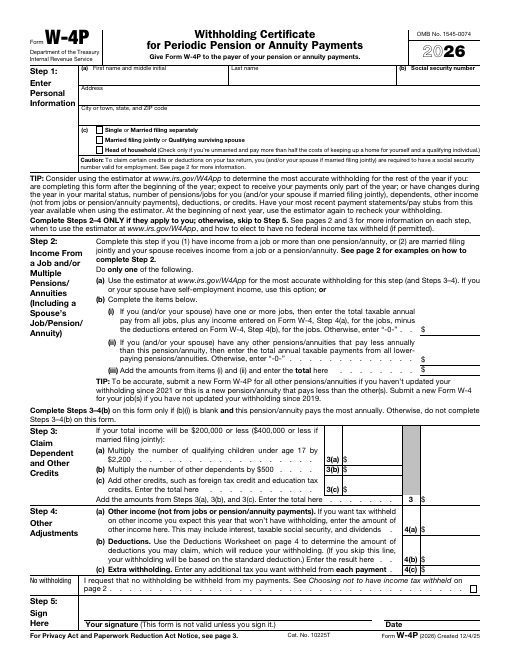
What Form W-4P does
A recipient completes Form W-4P so that the payer holds back the right amount of federal income tax from periodic pension payments, annuity payments (commercial annuities included), profit-sharing and stock bonus plan payments, and IRA payments. Federal income tax withholding applies to the taxable part of those payments. The IRS page for Form W-4P gives the same purpose.
Periodic means installments at regular intervals, such as annually, quarterly or monthly, over a period of more than 1 year. Two kinds of payment are outside the form. A nonperiodic payment, which includes an IRA distribution payable on demand, and an eligible rollover distribution such as a lump-sum pension payment, both use Form W-4R. Payments to nonresident aliens and foreign estates do not use Form W-4P at all; the form sends those payers to Publication 515 and Publication 519.
The five steps
Steps 2 to 4 are filled in only when they apply; otherwise skip to Step 5.
Step 1 – Personal information
Boxes (a) and (b) take the name, address and Social Security number. Box (c) is the anticipated filing status, and it sets the standard deduction and tax rates the payer uses. The choices are single or married filing separately, married filing jointly or qualifying surviving spouse, and head of household. The head of household box is checked only by an unmarried person who pays more than half the cost of keeping up a home for a qualifying individual.
Step 2 – Other jobs and pensions
Use the estimator, or complete items (i) to (iii).
This step applies to a person with income from a job or from more than one pension or annuity, and to a married-filing-jointly person whose spouse has a job or pension. The form allows one of two methods. The first is the Tax Withholding Estimator, printed on the form as irs.gov/W4App, which the form calls the most accurate and which a person with self-employment income is told to use. The second is the worksheet on the form: item (i) holds the total annual taxable pay from jobs (adjusted by any Form W-4 Step 4(a) income and Step 4(b) deductions for those jobs), item (ii) the annual payments from any pension that pays less than this one, and item (iii) the sum.
The page-2 examples show the pattern. A single filer whose pension pays $50,000 and who also has a $25,000 job enters $25,000 in (i) and (iii). A filer with that job and a second pension paying $20,000 enters $25,000 in (i), $20,000 in (ii) and $45,000 in (iii). A filer whose other pension pays more than this one leaves Step 2 empty.
Step 3 – Dependent and other credits
Steps 3 and 4(b) are completed on one form only.
For total income of $200,000 or less ($400,000 or less if married filing jointly), line 3(a) multiplies the number of qualifying children under age 17 by $2,200 and line 3(b) multiplies the number of other dependents by $500. Line 3(c) adds other credits, such as the foreign tax credit and education credits. A person with a job completes Steps 3 through 4(b) on the Form W-4 for that job and leaves them blank here; a person without a job completes them only on the pension that pays the most each year. The job version is Form W-4.
Step 4 – Other adjustments
Line 4(a) adds other income without withholding, such as interest, taxable Social Security and dividends. A person who completes it likely does not need to pay estimated tax on that income, and the alternative is Form 1040-ES. Line 4(b) takes the result of the Deductions Worksheet on page 4, line 17; skipping it means the withholding is based on the standard deduction. Line 4(c) is an extra amount withheld from each payment.
| Worksheet line 11 | Standard deduction |
|---|---|
| Married filing jointly or qualifying surviving spouse | $32,200 |
| Head of household | $24,150 |
| Single or married filing separately | $16,100 |
The Deductions Worksheet also carries income-limited deductions for qualified tips (up to $25,000), qualified overtime compensation (up to $12,500, or $25,000 if married filing jointly), passenger vehicle loan interest (up to $10,000) and age 65 or older ($6,000 on each of lines 3a and 3b).
Step 5 – Sign
The form is not valid unless it is signed.
The signature and the date go on Step 5, and the payer cannot treat the form as valid without the signature.
Choosing no withholding
A box labeled “No withholding” sits above the signature. A person who checks it completes Steps 1(a), 1(b) and 5. A U.S. citizen or resident alien generally cannot choose no withholding on payments delivered outside the United States and its territories. The IRS Topic no. 410 adds that such a person must give the payer a home address in the United States or its territories to choose none.
The same box is checked for disability payments that are not taxable because the injury was a direct result of a terrorist attack.
Changes and defaults
The form says to submit a new Form W-4P if the tax situation changes or if no withholding was chosen and withholding is now wanted. For payments that began before 2026, the current election or default rate stays in effect until a new form is submitted.
If no form is given, no SSN is provided, or the IRS tells the payer the SSN is wrong, the payer withholds as if the filing status were single with no adjustments in Steps 2 through 4. A form that is not properly completed is treated the same way.
Consequences of withholding too little
A person who has too little tax withheld generally owes tax with the return and may owe a penalty unless estimated tax is paid on time. Too much withholding comes back as a refund. Publication 505 explains both withholding and estimated tax. The privacy notice on the form adds that fraudulent information may subject the person to penalties. The form states no fee and no filing deadline.
Frequently asked questions
Where does a completed Form W-4P go?
To the payer of the pension or annuity, as the top of the form says.
Is Form W-4P the same as Form W-4?
No. Form W-4 is the employee’s certificate for wages, and Form W-4P is for periodic pension, annuity and IRA payments. A person with both fills in the form for each, and Step 2 of Form W-4P draws on the entries made on Form W-4, Step 4(a) and 4(b).
Does each pension need its own form?
Yes. The instructions say to submit a separate Form W-4P for each pension, annuity or other periodic payment received.