

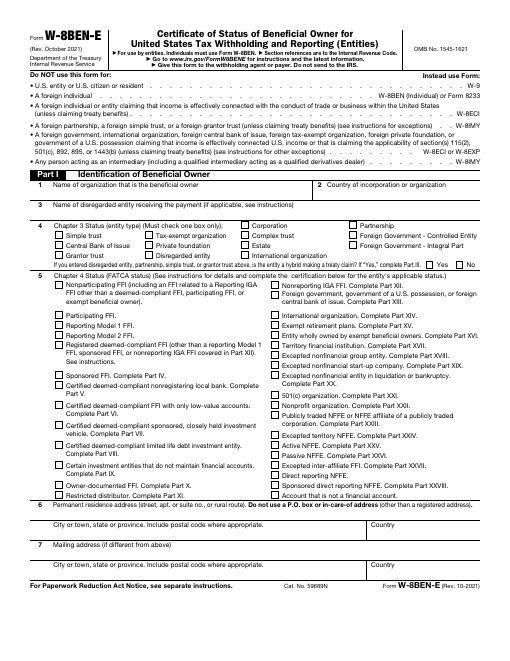
What the form does
Form W-8BEN-E documents the status of a foreign entity for two sets of rules, chapter 3 (the 30% tax on U.S. source income such as interest, dividends, rents and royalties) and chapter 4 (FATCA, under which a withholding agent or financial institution identifies the chapter 4 status of an entity). The IRS describes it as the form foreign entities use to document their status (About Form W-8BEN-E). Two (2) parties are involved: the beneficial owner (the entity that is entitled to the income) and the withholding agent (the payer, partnership or financial institution that asks for the form).
According to the Instructions for Form W-8BEN-E, the 30% tax is figured on the gross amount paid and is generally collected by withholding. An entity that skips the form when asked may have 30% or the backup withholding rate taken from the payment. The entity can also use the form to claim a treaty rate, to claim the portfolio interest exemption, or to be treated as an exempt foreign person for broker transactions and barter exchanges.
A foreign partner in a partnership with a U.S. business generally meets the partnership’s documentation rules for withholding on its share of income by giving this form. A buyer of a partnership interest from a foreign seller generally must withhold 10% of the amount realized when part of the gain counts as effectively connected income, unless an exception applies, and a foreign partnership or foreign grantor trust that is the seller provides Form W-8IMY instead.
Which form fits
The form’s first page lists the entities that use something else, and the instructions add more.
| Who is giving the form | Form to give the payer | Form W-8BEN-E |
|---|---|---|
| Foreign corporation or other foreign entity receiving a withholdable payment or a payment subject to chapter 3 withholding, or holding an account with a financial institution that asks for the form | W-8BEN-E | Required |
| U.S. entity, citizen or resident alien | W-9 | Not required |
| Foreign individual | W-8BEN or Form 8233 | Not required |
| Foreign partnership, simple trust or grantor trust | W-8IMY | Not required, except to claim treaty benefits |
| Entity with income effectively connected with a U.S. business | W-8ECI | Not required, unless the entity claims treaty benefits or the income is allocated through a partnership |
| Intermediary, qualified intermediary or qualified securities lender | W-8IMY | Not required |
| Foreign government, international organization, central bank, tax-exempt organization or private foundation claiming section 115(2), 501(c), 892, 895 or 1443(b) | W-8EXP or W-8ECI | Not required, except to claim treaty benefits; optional to document chapter 4 status or exemption from backup withholding |
A disregarded entity with one owner does not use this form for itself, except to document its chapter 4 status because it holds an account with a financial institution. The foreign owner gives a W-8BEN or W-8BEN-E, and a U.S. owner gives a W-9. A disregarded entity or partnership that is a hybrid entity, liable to tax as a resident under a treaty, can use this form to claim treaty benefits.
Part by part
Part I, identification of the beneficial owner
Part I identifies the entity; lines 3, 7 and 8 apply only in the cases described below.
| Line | Caption | What goes there |
|---|---|---|
| 1 and 2 | Name and country of incorporation or organization | The legal name, and the country whose law created the entity |
| 3 | Name of disregarded entity receiving the payment | A disregarded entity receiving a withholdable payment enters its name when it has its own GIIN, is a reporting Model 1 or Model 2 FFI and is not a hybrid making a treaty claim |
| 4 | Chapter 3 status | One box from thirteen entity types, from corporation to international organization, and a Yes or No for a hybrid treaty claim |
| 5 | Chapter 4 status | One FATCA status, most of which send the filer to a later part |
| 6 and 7 | Permanent residence address and mailing address | The address in the country of residence for tax; not a financial institution’s address or a post office box, with the exceptions the instructions list |
| 8 | U.S. taxpayer identification number | The EIN, when one is required; an entity without one applies on Form SS-4 |
| 9a to 9c | GIIN and foreign TIN | A GIIN for certain FFI statuses; a foreign TIN, or the box saying a foreign TIN is not legally required, for an account at a U.S. office of a financial institution |
| 10 | Reference numbers | An account number or any code the payer finds useful |
A treaty claim needs a U.S. TIN on line 8 when line 9b has no foreign TIN. A U.S. TIN is not needed to claim treaty benefits on four kinds of income: dividends and interest from actively traded stocks and debt, dividends from a mutual fund registered under the Investment Company Act of 1940, income from SEC-registered unit investment trusts offered to the public, and income from loans of those securities. A filer that is still waiting for a GIIN may write “applied for”, and the requester must receive and verify the number within ninety (90) days. An account holder at a U.S. office of a financial institution that receives U.S. source income reported on Form 1042-S must give a foreign TIN, except in a few cases, including a resident of a jurisdiction on the IRS list of jurisdictions that do not issue foreign TINs.
Part II, disregarded entity or branch
Complete lines 11 through 13 only for a disregarded entity with its own GIIN or a branch outside the FFI’s country of residence.
The part takes the branch’s chapter 4 status (nonparticipating, participating, reporting Model 1 or 2, or U.S. branch), its address and its GIIN.
Part III, claim of tax treaty benefits
Skip this part when no treaty benefit is claimed.
Line 14a certifies treaty residence and names the country. Line 14b certifies that the entity derives the income and, if the treaty has a limitation on benefits provision, meets it, and the filer checks one of eleven types, such as publicly traded corporation, derivative benefits test or no LOB article in the treaty. Line 14c is the qualified resident claim for U.S. source dividends from a foreign corporation and interest from its U.S. business, and the instructions limit it to a foreign corporation under a treaty that entered into force before January 1, 1987. Line 15 is used only when the claim depends on conditions the other lines do not cover; it gives the treaty article, the rate and the type of income. The IRS keeps the treaties on its tax treaties page.
Chapter 4 status and the part it points to
Line 5 offers 32 boxes, and 25 of them send the entity to a certification part to complete before signing. The most common are below.
| Line 5 status | Part to complete | What the part certifies |
|---|---|---|
| Active NFFE | XXV | Under 50% of gross income and of assets is passive |
| Passive NFFE | XXVI and XXIX | No substantial U.S. owners, or each one named in Part XXIX |
| Publicly traded NFFE or affiliate | XXIII | Stock regularly traded on an established market, with the exchange named |
| Nonprofit organization | XXII | Five conditions, including a religious, charitable, scientific, artistic, cultural or educational purpose and exemption from income tax in its country |
| 501(c) organization | XXI | An IRS determination letter in effect, or an opinion from U.S. counsel |
| Exempt retirement plan | XV | One of six boxes, 29a through 29f |
| Nonreporting IGA FFI | XII | The IGA, its model and its status under the IGA |
| Owner-documented FFI | X | An owner reporting statement with owner documentation, or an auditor’s letter |
| Sponsored FFI | IV | The name of the sponsoring entity |
Signing, validity and delivery
An authorized officer or representative signs and dates Part XXX under penalties of perjury, prints a name, and checks the box stating the capacity to sign for the entity named on line 1. The date is written month, day and year. An agent acting under a power of attorney must attach it, and it must authorize the agent to make, execute and present the form, and Form 2848 can be used. The agent and the entity can both be liable for a false form.
A withholding agent may accept an electronic signature that indicates the form was signed electronically by an authorized person, for example with a time and date stamp and a statement. A typed name on the signature line does not count.
| Question | Rule from the instructions |
|---|---|
| Who gets the form | The person asking for it; generally a separate form per withholding agent, and the agent may ask for one per type of income |
| When it is due | Before the payment is made, credited or allocated |
| How long it lasts | Generally from the signing date through the last day of the third following calendar year, with a longer period in some cases; a form signed September 30, 2014 ran through December 31, 2017 |
| When a new one is due | Within thirty (30) days after a change in circumstances makes anything on it incorrect |
| Joint owners | Each owner must provide a Form W-8BEN or W-8BEN-E (or other applicable document) for the income to be treated as foreign-owned |
Frequently asked questions
Does an entity with a U.S. EIN still file a W-8BEN-E?
Yes, when the entity is foreign. Line 8 asks for a U.S. TIN (an EIN, for an entity) when the entity claims treaty benefits without a foreign TIN, claims the section 871(f) annuity exemption, or is a partner in a partnership with a U.S. business. Form W-9 is for U.S. persons, which include an entity such as a corporation organized under the law of a state.
Can a foreign partnership use this form?
A foreign partnership generally provides Form W-8IMY. It can use Form W-8BEN-E only to document its chapter 4 status when it holds an account with a financial institution, to document itself as a participating payee for section 6050W, or, as a hybrid entity liable to tax as a resident under a treaty, to claim treaty benefits.
What happens when no form is given?
The withholding agent may have to withhold at the 30% rate, the backup withholding rate, or the rate under section 1446, depending on the payment.