

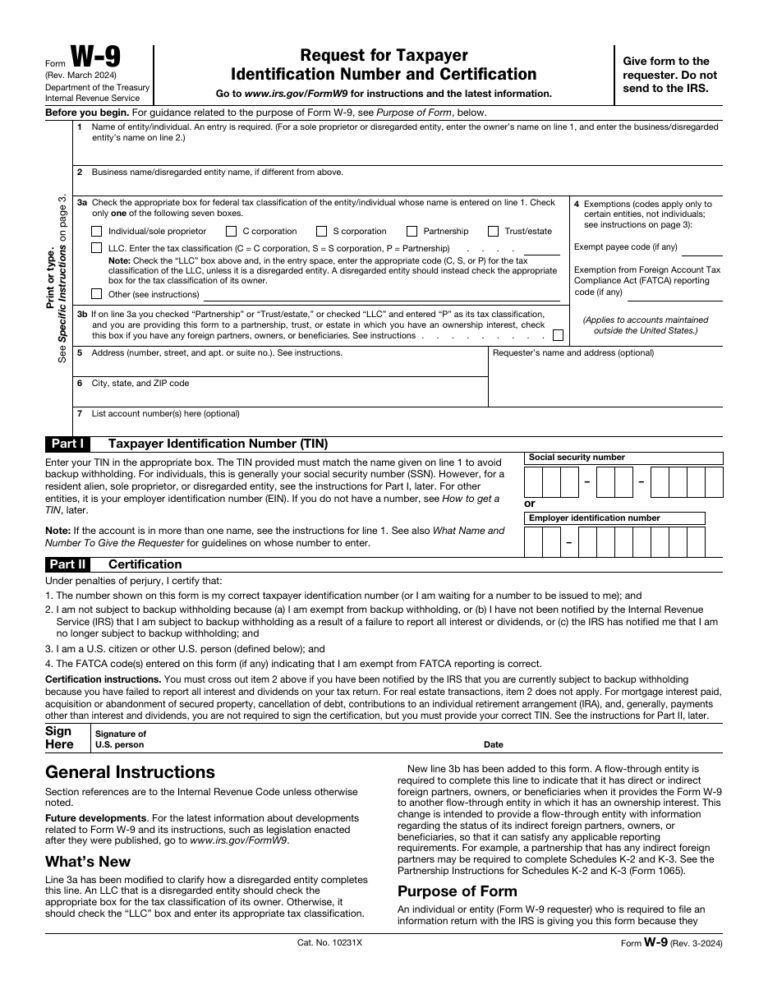
What a W-9 form is used for
An IRS Form W-9 is used when a business, bank or broker has to tell the IRS what it paid someone and needs that person’s taxpayer identification number (TIN) to do so. There are two (2) parties: the requester (the payer) and the payee (the person or entity being paid). The payee completes the form and hands it back; the requester keeps it on file and copies the name and number onto the information return it sends the IRS, such as a 1099 or a 1098 (About Form W-9). The IRS itself never receives the W-9.
Only a U.S. person may sign one. The form defines that term as a U.S. citizen or resident alien, a partnership, corporation, company or association organized in the United States, a domestic estate, or a domestic trust (Definition of a U.S. person, page 2). A foreign individual or a foreign entity gives the requester Form W-8 BEN, another W-8 form or Form 8233 in its place. For example, a nonresident alien who already holds an ITIN still hands over a W-8 BEN, because a U.S. TIN does not make a foreign person eligible for the W-9 (page 3).
Which revision is current
The IRS lists Form W-9 (Rev. March 2024) as the current revision and shows no newer developments, and the PDF on irs.gov still carries that date (checked October 15, 2026). The form has no tax year printed on it. Therefore there is no “2026 W-9”: Form W-4 gets a fresh edition for each tax year, the W-9 does not. A revision appears only when the IRS changes something on the form itself. In March 2024 it added line 3b and rewrote the line 3a wording for LLCs (What’s New, page 1). A W-9 signed in 2024 or 2025 stays good until the payee’s name, TIN or exempt status changes (Updating Your Information, page 3).
Who asks for a W-9, and when
The requester is the payer and the payee fills in the form. The W-9 itself carries no deadline. However, a payer must apply backup withholding to every reportable payment it makes before it holds the payee’s TIN (Backup Withholding, page 2), so the form belongs in the requester’s hands before the first payment goes out. When a business takes on an independent contractor, the IRS tells it to collect the W-9 as its first step and keep the form on file for four (4) years (Forms and associated taxes for independent contractors).
| Payment to you | Who asks for the W-9 | Information return it feeds | Threshold in the current instructions |
|---|---|---|---|
| Pay for services as a nonemployee (contractor, freelancer, attorney) | The business that hired you | Form 1099-NEC, due to the IRS by January 31 | $2,000 or more in a year, for tax years beginning after 2025 (Instructions for Forms 1099-MISC and 1099-NEC, rev. 12/2026) |
| Rent, prizes, medical payments, other income | The business paying you | Form 1099-MISC | $2,000 or more, same rule; royalties at $10; gross proceeds paid to an attorney at $600 (same instructions) |
| Interest or dividends | Bank, credit union, brokerage | Form 1099-INT or 1099-DIV | Set by each form’s own instructions |
| Sale of stock or a home | Broker, title company or closing agent | Form 1099-B or 1099-S | Set by each form’s own instructions |
| Card or app payments to your business | Payment processor or marketplace | Form 1099-K | Set by the 1099-K instructions |
The $2,000 figure comes from the Instructions for Forms 1099-MISC and 1099-NEC (revised 12/2026): it covers tax years beginning after 2025 and may be adjusted for inflation starting in 2027. That threshold tells the payer whether it has to file a 1099. It puts no limit on when a requester may ask for the form.
Before filling in the form
|
Line by line
Lines 1 through 7
Print or type, and follow the IRS’s own line labels in order.
Every rule below comes from the Specific Instructions on pages 3 and 4 of the form; the LLC wording is repeated under What’s New in the Instructions for the Requester of Form W-9.
| Line | IRS label | What to enter |
|---|---|---|
| 1 | Name of entity/individual | Required. The name on your tax return. A sole proprietor enters their own name, not the business name. A single-member LLC that has not elected corporate status (a disregarded entity) enters the owner’s name. A last name changed without telling the Social Security Administration goes in as first name, last name on the Social Security card, new last name. |
| 2 | Business name/disregarded entity name | Trade name, DBA or the LLC’s name, if different from line 1. Otherwise blank. |
| 3a | Federal tax classification | Check one of seven boxes. If you check LLC, write C, S or P in the space for how the LLC is taxed. A disregarded LLC does not check LLC; it checks its owner’s classification, usually Individual/sole proprietor. |
| 3b | Foreign partners, owners or beneficiaries | Only for a partnership, trust or estate with foreign partners, owners or beneficiaries that is giving this W-9 to another partnership, trust or estate it owns part of. Everyone else leaves it blank. |
| 4 | Exemptions | Exempt payee code 1 through 13 for entities exempt from backup withholding (5 is a corporation, 1 a tax-exempt organization). Individuals and sole proprietors are generally not exempt and leave it blank. The FATCA code A through M is for accounts held outside the United States; for a U.S. account, blank. |
| 5 | Address | Number, street and apartment or suite. The requester mails your 1099 here. If it differs from the address the requester has on file, write “NEW” at the top of the form. |
| 6 | City, state, and ZIP code | As labeled. |
| 7 | List account number(s) here | Optional, as is the requester’s name and address box. |
Part I, Taxpayer Identification Number
Enter one (1) number only, in the box that matches it.
The Social Security Administration issues the SSN; the IRS issues every other TIN, the EIN and the ITIN among them (Taxpayer identification numbers). Whichever number goes in Part I, it has to belong to the name on line 1. When the two do not match, the IRS notifies the payer and backup withholding begins (Part I box, page 1, and Backup Withholding, page 2). For a single-member LLC that has not elected corporate status the IRS is explicit: the W-9 shows the owner’s SSN or EIN, never the LLC’s EIN (Single member limited liability companies).
| Who you are | Number to enter |
|---|---|
| Individual | Social Security number (SSN) |
| Resident alien with no SSN and not eligible for one | ITIN, written in the SSN boxes |
| Sole proprietor | SSN or EIN, your choice; the IRS encourages the SSN (footnote 3, page 5) |
| Single-member LLC, disregarded | The owner’s SSN (or the owner’s EIN if the owner has one), not the LLC’s EIN |
| LLC taxed as a corporation or partnership | The LLC’s EIN |
| Corporation, partnership, multi-member LLC, trust, estate | The entity’s EIN |
A joint account puts both names on line 1 and circles the person whose number appears in Part I. However, when nobody is circled, the IRS treats the first name listed as the owner of the number (What Name and Number To Give the Requester, page 5).
Part II, Certification
Sign and date as the U.S. person named on line 1.
The signer certifies four (4) numbered statements under penalties of perjury (form, page 1). On a joint account the signature belongs to the person whose TIN is in Part I; for a disregarded entity, the owner shown on line 1 signs (Part II, page 5). Item 2 is crossed out before signing when the IRS has notified the payee that backup withholding applies because of unreported interest or dividends, and in a real estate transaction item 2 does not apply and may also be struck (Certification instructions, page 1). For nonemployee pay, rents, royalties and the other payments listed in item 4 of the signature requirements, the IRS wants the TIN alone and not a signature, unless the payee was told earlier that it gave a wrong TIN. However, the requester may ask for a signature anyway (Part II, page 5), and the simplest course is to sign.
Backup withholding and penalties
Backup withholding runs at 24% of each reportable payment (form, page 2; IRS backup withholding page). Four (4) events set it off: the payee gives no TIN, the payee skips a certification that was required, the IRS reports the TIN as wrong, or the IRS has notified the payee of underreported interest or dividends (Backup Withholding, page 2). Payments in a real estate transaction sit outside the rule.
| Failure by the payee | Penalty (form, page 3) |
|---|---|
| Not giving the requester a correct TIN | $50 for each failure, unless the failure is due to reasonable cause and not willful neglect |
| A false statement with no reasonable basis that results in no backup withholding | $500 civil penalty |
| Willfully falsifying the certification or affirmations | Criminal penalties, which can include fines and imprisonment |
Mistakes the IRS instructions call out
|
Giving the requester the finished form
The payee returns the form by whatever route the requester accepts: in person, by mail, by fax or through an upload portal (Electronic Submission of Forms W-9, requester instructions). A dated copy stays with the payee. Nothing goes to the IRS, and the form says as much in its top right corner.
Frequently asked questions
Does a payee need a new W-9 every year?
No. The form has no tax year on it, so last year’s W-9 is still good. A new one is due when the payee’s name or TIN changes, or when a payee that claimed exempt status stops being exempt; the form’s example is a C corporation that elects to become an S corporation (Updating Your Information, page 3). A requester may still want a fresh one for its own files.
Can a W-9 be signed electronically?
Yes, when the requester has built an electronic system for it. The requester instructions accept electronic submission, fax included, provided the system records who sent the form and closes with an electronic signature made under penalties of perjury in the same words as the paper form. A W-9 that needs no signature (see Part II) may be sent electronically without one.
What if the payee has no SSN or EIN yet?
Apply for the number first, then write “Applied For” in the Part I box, sign, date and deliver the form (How to get a TIN, page 4). An EIN comes from the IRS online application at no charge, and the number is issued the moment the application is approved; Form SS-4 is the paper application for an EIN and Form W-7 is the application for an ITIN. For interest and dividend payments the payee then has sixty (60) days to supply the number before backup withholding starts; for nonemployee pay and other payments, withholding applies at once until the requester has the TIN.
Does a non-citizen fill out a W-9?
The test is tax residency. A resident alien for tax purposes is a U.S. person and completes the W-9 with an SSN or ITIN (Part I, page 4). A nonresident alien or a foreign entity gives the requester Form W-8 BEN (individuals), Form W-8 BEN-E or another W-8 form (entities), or Form 8233 (Foreign person, page 2).