

What the agreement settles
A limited liability company comes into being with one filing: a certificate of formation in Delaware or Texas, articles of organization in Florida or New York. Florida § 605.0201(2) asks that filing for three (3) things, the name, the principal office and the registered agent. Everything inside the company, the share each member holds, who may sign a lease, whether profits follow the money put in or are split by head count, who buys out a member who dies, is settled by the operating agreement.
Where the members write nothing, the act decides. Florida § 605.0105(2) puts it in one line: to the extent the operating agreement does not provide for a matter described in subsection (1), chapter 605 governs it. Delaware states the same policy from the other direction, “to give the maximum effect to the principle of freedom of contract” (6 Del. C. § 18-1101(b)).
Each act also fences off what no agreement may do. Florida § 605.0105(3) lists sixteen (16) items, among them eliminating the obligation of good faith and fair dealing and unreasonably restricting a member’s right to records under § 605.0410. Delaware § 18-1101(c) and Maine 31 M.R.S. § 1521(3)(A) let the agreement (in Maine, a written one) expand, restrict or eliminate fiduciary duties but keep the implied covenant of good faith. A complete agreement runs to eleven (11) parts: formation, members and capital, allocations and distributions, management, voting, books and tax, transfers, leaving (death, withdrawal, dissolution and the order of payment), liability and indemnification, amendments and governing law, and the signatures of every member and any manager.
The two documents
| Document | Use it when | Page |
|---|---|---|
| Single-member operating agreement | One person or one entity owns the whole company and wants its manager and its succession on paper | Single-member LLC operating agreement |
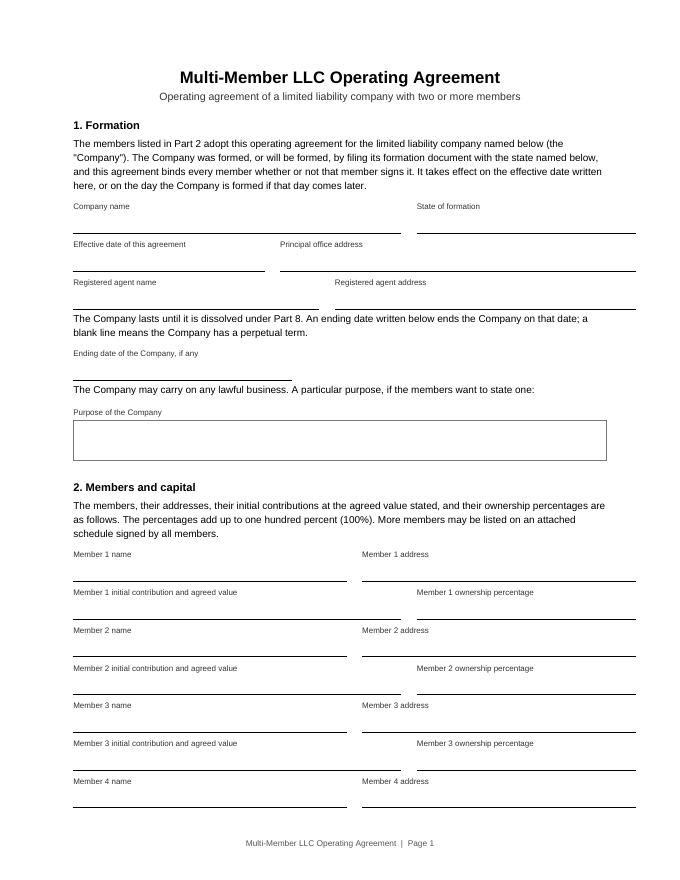
| Multi-member operating agreement | Two (2) or more people hold percentages and need voting, transfer and buyout rules of their own (four (4) member rows; more go on a schedule) | Multi-member LLC operating agreement |
State Laws
Two (2) of the acts read on 2026-10-31 order the members to adopt an operating agreement, and two more make one a condition of forming the company. New York’s § 417(a) says the members “shall adopt a written operating agreement”; subdivision (c) lets it be entered into before, at the time of, or within ninety (90) days after the articles are filed, and nothing in § 417 names a penalty for missing that date. Missouri § 347.081.1 says the member or members “shall adopt an operating agreement”, and the section uses neither the word “written” nor the word “oral”. Maine § 1531(1)(B) and Delaware § 18-201(d) make an agreement “entered into or otherwise existing” a condition of forming the company; Maine § 1502(14) treats a filed certificate plus one member as conclusive evidence that an agreement exists, and both acts count an oral or implied agreement.
The remaining acts leave the choice to the members. Delaware § 18-101(9) defines the agreement as “written, oral or implied”, frees it from any statute of frauds and binds a member whether or not the member signs it; Texas § 101.001(1) reads “written, implied, or oral”. Nevada § 86.286(1) is the plainest: a company “may, but is not required to, adopt an operating agreement”, and adoption takes the unanimous vote or written consent of the members, or the act of the sole member.
| State | Required by the act | Form the act accepts | Section |
|---|---|---|---|
| New York | Required | Written | LLC Law § 417(a), (c) |
| Missouri | Required | The section names neither written nor oral | RSMo § 347.081.1 |
| Maine | Condition of formation: “entered into or otherwise existing” (oral or implied counts) | Written, oral or implied | 31 M.R.S. § 1531(1)(B), § 1502(15) |
| Delaware | Condition of formation: “entered into or otherwise existing” (oral or implied counts) | Written, oral or implied | 6 Del. C. § 18-201(d), § 18-101(9) |
| Florida | Not required by § 605.0201 | Oral, implied, in a record, or any combination | § 605.0102(45), § 605.0106 |
| Texas | None found in chapter 101 | Written, implied or oral | BOC § 101.001(1), § 101.052 |
| North Carolina | Not stated in the sections read | Any form, written, oral or implied, subject to other controlling law and to any form the agreement itself requires; an oral term cannot override a written one against a relying outsider | G.S. 57D-1-03(23), 57D-2-30(c) |
| Ohio | Not stated in the sections read | Written or oral, or a written declaration of the sole member | R.C. 1706.01(R), 1706.08 |
| Washington | Not stated in the sections read | Oral, implied, in a record, or any combination | RCW 25.15.006(8), 25.15.018 |
| Arizona | Not stated in the sections read | Oral, implied, in a record or any combination | A.R.S. 29-3102(17), 29-3105 |
| Virginia | Not stated in the sections read; § 13.1-1023(A)(1) says the members “may enter into” one | Need not be in writing unless the articles or a written agreement say so | Code § 13.1-1023(A)(1), (B)(1) |
| Minnesota | Not stated in the sections read | Oral, in a record, implied, or any combination | § 322C.0102 subd. 17, 322C.0110 |
| Nevada | Not required | Any tangible or electronic format | NRS 86.101, 86.286(1) |
| Massachusetts | Not stated in the sections read | Written or oral | G.L. c. 156C § 2(9) |
Filed with the state, and not
The formation document goes to the Secretary of State with a fee; the operating agreement stays in the company’s own records.
Florida’s Division of Corporations charges $100 to file articles of organization plus a $25 registered agent fee (Sunbiz LLC fees, read 2026-10-31), then $138.75 for the annual report and $538.75 after May 1. Delaware’s August 2026 fee schedule lists $110 for a domestic formation, and § 18-1107(b) and (c) add an annual tax of $400, due June 1. New York also requires publication: § 206(a) requires a notice once a week for six (6) successive weeks in two (2) newspapers within one hundred twenty (120) days of formation, proved by a certificate of publication, or the company’s authority to do business is suspended. The Delaware and Florida formation sections do not list the agreement among what is filed, and the acts put it in the company’s records: Delaware § 18-305(a)(4) lists a copy of “any written limited liability company agreement” among the records a member may obtain from the company on reasonable demand for a purpose reasonably related to the member’s interest, Florida § 605.0410(1)(b) keeps it, if made in a record, at the principal office or another location, and Texas § 101.501(a)(4) keeps a written one at the principal office in the United States.
Operating agreements by state (38)
- North Carolina
- Ohio
- Pennsylvania
- Texas
- Florida
- New York
- New Jersey
- Virginia
- Washington
- Michigan
- Arizona
- Massachusetts
- Colorado
- Minnesota
- South Carolina
- Indiana
- Missouri
- Maryland
- Kentucky
- Oregon
- Iowa
- Utah
- Alabama
- Louisiana
- Nevada
- Nebraska
- Kansas
- Maine
- West Virginia
- Idaho
- Montana
- Rhode Island
- North Dakota
- South Dakota
- Alaska
- Delaware
- Vermont
- Wyoming
Tax classification
Treasury Regulation § 301.7701-3(b)(1), read on govinfo.gov, classifies a domestic eligible entity such as an LLC with two (2) or more members as a partnership and one with a single owner as disregarded as an entity separate from its owner, unless the company elects otherwise. The election goes on Form 8832, and a company that wants S corporation treatment files Form 2553 instead. The IRS’s limited liability company page (irs.gov, reviewed October 10, 2026) says an election generally cannot take effect more than seventy-five (75) days before it is filed or more than twelve (12) months after, and late-election relief exists in certain circumstances. An LLC that hires employees gets its employer identification number on Form SS-4.
Frequently asked questions
Does a company with one owner need an operating agreement?
In New York, yes: § 417(a) applies to “the members” without an exception for one. Delaware § 18-201(d) and Maine § 1531(1)(B) ask only that an agreement be “entered into or otherwise existing”; Delaware § 18-101(9), Florida § 605.0106(5) and Texas § 101.001(1) each say an agreement is not unenforceable because only one person is a party to it.
What happens with no operating agreement at all?
The act runs the company. In Delaware, management then rests with the members in proportion to their share of profits, with the holders of more than fifty percent (50%) deciding (§ 18-402), and distributions follow the agreed value of each member’s contributions (§ 18-504). Texas gives every member an equal vote at a meeting (§ 101.354) and shares distributions by contribution value (§ 101.203).
Who has to sign it?
The members adopt it (New York § 417(a), Missouri § 347.081.1), but a signature is not what binds them in every act. Delaware § 18-101(9) binds the company “whether or not” it executes the agreement, and Florida § 605.0106(1) and (2) bind the company and each person who becomes a member regardless of execution. None of the sections opened names a notary or a witness.