

State Laws
Alabama’s act is Chapter 5A of Title 10A, the Alabama Limited Liability Company Law (10A-5A-1.01), which has governed every Alabama limited liability company since January 1, 2017 (10A-5A-12.01(b)). Its own term for the document is “limited liability company agreement”, defined in 10A-5A-1.02(l) as any agreement (whether referred to as a limited liability company agreement, operating agreement or otherwise), “written, oral or implied”, of the member or members about the company’s activities and affairs, and a one-member agreement is not unenforceable for having a single party. 10A-5A-1.08(a) gives the agreement its job: it governs relations among the members as members and between the members and the company, and the chapter governs any such matter the agreement does not provide for. 10A-5A-1.06(a) states the policy of giving maximum effect to freedom of contract and to the enforceability of these agreements.
Some of that freedom needs paper. Under 10A-5A-1.08(b)(1) and (b)(2) it is a written agreement that may expand, restrict or eliminate the duties of a member or other person, fiduciary duties included, and may limit or eliminate liability for breach of contract and breach of those duties. The implied contractual covenant of good faith and fair dealing survives either way, and no agreement may limit liability for a bad faith violation of it.
10A-5A-1.08(c) then lists sixteen (16) things no agreement may do. The ones a member will meet: restrict the rights under the chapter of a person other than a member, dissociated member or transferee; eliminate the covenant of good faith or the liability for a bad faith violation of it; waive the signed-writing rule for contribution promises in 10A-5A-4.04(c); vary the law applicable under 10A-5A-4.06(c) or shorten the two (2) year limitations period of 10A-5A-4.06(d); vary the governing law of 10A-5A-1.05; vary the court’s power to decree dissolution under 10A-5A-7.01(d); vary the requirement to wind up in 10A-5A-7.02(a); or vary the professional services rules of 10A-5A-8.01. Where a filed writing and the agreement conflict, the agreement prevails as to members, dissociated members and transferees, and the filed writing prevails as to others who reasonably rely on it (10A-5A-1.10(d)).
The defaults the document replaces
| Rule | Alabama default | Section |
|---|---|---|
| Management | The activities and affairs are under the direction and oversight of the members; the agreement may put them under one or more managers or another governance structure | Code of Alabama 10A-5A-4.07(a), (b)(1)(A) |
| Weight of a vote | If the agreement does not say who directs the company, a matter in the ordinary course may be decided by a majority of the members | 10A-5A-4.07(b), (b)(2)(A) |
| Matters that take every member | If the agreement does not say who directs the company, the consent of all members is required to amend the agreement, to file a bankruptcy petition for the company, to undertake any act outside the ordinary course, and to undertake or approve any other act for which the chapter requires the consent of all members. Whoever directs the company, all members must consent to admit a member by consent (10A-5A-4.01(b)(3)), to compromise a contribution obligation (10A-5A-4.04(b)(1)), to dissolve by consent (10A-5A-7.01(b)) and to approve a plan of conversion or merger (10A-5A-10.02(a), 10A-5A-10.06(a)) | 10A-5A-4.07(b), (b)(3)(A) |
| Choosing or removing a manager | Not addressed; a manager exists only if the agreement provides for one, and the agreement sets how | 10A-5A-4.07(a) |
| Meetings and consents | Any matter requiring the consent of members may be decided without a meeting; a member may appoint a proxy or other agent by signing an appointing writing | 10A-5A-4.07(c) |
| Pay for services | None, except reasonable compensation for winding up | 10A-5A-4.07(d) |
| Sharing of distributions | All members share equally in distributions made before dissolution; a decision to distribute is an ordinary-course decision; no right to a distribution in any form other than money | 10A-5A-4.05(a)(1) to (3) |
| Transfer of an interest | A transfer of a transferable interest is permissible and does not by itself end the transferor’s membership; the transferee receives the distributions the transferor would have received but, subject to 10A-5A-5.04, may not take part in direction or oversight or see records; after formation a person is admitted as a member as the agreement provides, with the consent of all the members, as the result of a transaction under Article 10 or Article 8 of Chapter 1, or as 10A-5A-7.01(c)(1) or (c)(2) provides | 10A-5A-5.02(a), (b), 10A-5A-4.01(b) |
| Dissociation | A person has the power to dissociate; dissociation is wrongful only if it breaches an express provision of the agreement, the person is expelled by judicial determination under 10A-5A-6.02(e), or the person becomes a debtor in bankruptcy or makes a general assignment for the benefit of creditors; a dissociated member has no right to take part in direction and oversight and is entitled only to the distributions the member would have received, apart from the information right of 4.09(c) and, for a deceased member’s representative, the rights of 5.04, and gets no distribution on account of leaving | 10A-5A-6.01(a), (b)(1) to (3), 10A-5A-6.03(a), 10A-5A-4.05(a)(2) |
| A member’s death | Death dissociates the member; the personal representative holding the interest has a transferee’s rights and, to settle the estate, a current member’s information rights under 10A-5A-4.09; a representative who does not hold the interest has, to settle the estate, a dissociated member’s information rights (5.04(b)) | 10A-5A-6.02(f), 10A-5A-5.04 |
| Dissolution | On an event the agreement states; on the consent of all members; when no member remains, unless the holders of all transferable interests agree in writing within ninety (90) days to continue and appoint a new member or the agreement provides a way to continue; or on a court order sought by a member because carrying on in conformity with the agreement is not reasonably practicable | 10A-5A-7.01 |
| Order of payment on winding up | Creditors first, including, to the extent permitted by law, members who are creditors; then each owner of a transferable interest gets back unreturned contributions; then the rest in the proportions in which distributions were shared before dissolution | 10A-5A-7.06 |
| Ceiling on distributions | None after which the company’s liabilities, other than liabilities to members on their transferable interests and nonrecourse liabilities, would exceed the fair value of its assets; a member who receives a distribution that breaks that rule or the agreement, and knew it did at the time, repays it to the company; a recipient who did not know is not liable; an action is barred two (2) years after the distribution; the section does not apply to distributions made in winding up under 10A-5A-7.06 | 10A-5A-4.06(a), (d), (f) |
| Records and inspection | The company keeps a current member list, the filed certificate and amendments with any powers of attorney used, three (3) years of tax returns, the current agreement and three (3) years of financial statements; a member may demand those records on ten (10) days’ written notice and any other books and records on thirty (30) days’ notice, to inspect and copy for any proper purpose, meaning a purpose directly related to the member’s interest as a member, and not a demand the company reasonably determines is connected with an active or pending derivative proceeding the member or the member’s affiliate expects to bring or with an active or pending civil lawsuit in which the company or its affiliate and the member are adversaries (10A-5A-4.09(i)); the company may deny the right to a person who improperly used information from a prior examination within the two (2) years before the demand (10A-5A-4.09(h)), subject to the company’s reasonable restrictions, confidentiality and redaction rights under 10A-5A-4.09(g); a dissociated member may inspect and copy, on thirty (30) days’ notice, records that pertain to the period of membership and were material to the person’s rights and duties, if sought in good faith for a proper purpose (10A-5A-4.09(c)); the rights do not extend to a transferee | 10A-5A-4.09(a), (b), (c), (f), (g), (h), (i) |
Part 5 of the document weighs votes by ownership percentage and Part 3 shares profits, losses and distributions the same way, in place of one vote per member and equal shares. Part 4’s eight (8) unanimous acts replace the open-ended “any act outside the ordinary course” of 10A-5A-4.07(b)(3)(A)(iii), which the chapter lets the agreement replace. The ceiling row stays the chapter’s, with the document adding a debts-as-they-come-due test of its own.
Forming the company
Reserve the name, then deliver the certificate of formation to the Secretary of State with $200; keep the agreement with the company’s records.
One or more organizers sign a certificate of formation and deliver it to the Secretary of State, and the company exists when the certificate becomes effective under Article 4 of Chapter 1 (10A-5A-2.01(a), (b), (e)). The certificate states the company’s name, the street address and county of its registered office, the name of its registered agent there, a statement that the company has at least one member, a series statement where 10A-5A-11.02(b)(3) applies, and anything else the members choose (10A-5A-2.01(a)); 10A-1-3.05 does not apply. The name must contain “Limited Liability Company”, “L.L.C.” or “LLC” (10A-1-5.06), and 10A-1-5.10 makes every filing entity reserve its name first and attach the reservation certificate; the reservation costs $25 and lasts one (1) year (10A-1-4.31(a)(1)c, 10A-1-5.14). At least one organizer signs (10A-5A-2.04(a)(1)).
The fee is $200 for a certificate of formation, of which the Secretary of State pays $100 to the county of the initial registered agent (10A-1-4.31(a)(1)a, (e)(1)); an amendment costs $100 and a certificate of existence $25. The Secretary of State’s LLCs page, read 2026-11-04, lists the domestic filing fee at $200.00, asks for the original and one copy of the certificate, and says the name reservation comes first; its fee schedule PDF, revised August 23, 2023, carries the same $200.00.
Chapter 5A contains no annual report, and the annual report fee on the Secretary of State’s fee schedule ($10.00) is listed only under corporations. The yearly filing for a limited liability company is the Alabama business privilege tax under Sections 40-14A-21 to 40-14A-29, levied on net worth in Alabama at $0.25 to $1.75 per $1,000, with a $15,000 ceiling ($500 for an electing family limited liability entity) and a $50 minimum in place of $100 for taxable years beginning after December 31, 2022. Pass-through entities, limited liability entities among them, file Form PPT, titled in its 2026 print version “Alabama Business Privilege Tax Return and Annual Report for Pass Through Entities Only”; a company taxed as a corporation files Form CPT. The Department of Revenue’s FAQ on the due date puts the return at two and a half months after the taxable year begins, March 15 for a calendar year, and the 2026 instructions require a return only when the tax due is more than $100, with a late filing penalty of 10% of the tax or $50, whichever is greater. An initial return, Form BPT-IN, is due two and a half months after the company is organized (Section 40-14A-29).
The agreement is not filed. 10A-5A-2.01 asks the Secretary of State for the certificate alone, and 10A-5A-2.01(d) lets the agreement be entered into before, after or at the time of that filing and take effect as of the filing or any other date it names. 10A-5A-4.09(a) requires the company to maintain five (5) sets of records, the then effective agreement among them, without naming a place; a member’s demand reaches “any other books and records of the limited liability company, wherever situated” (10A-5A-4.09(b)). Part 6 of the document keeps them at the principal office and opens them to every member for a purpose related to the member’s interest, a wider test than the “directly related” purpose that 10A-5A-4.09(i) requires.
Signing
Each member in Part 2 signs one block of Part 11; the manager signs the last block when Part 4 marks the company manager-managed.
Every member signs because the document is the members’ agreement, and the chapter treats admission as assent: a person admitted as a member “becomes a party to and assents to” the agreement (10A-5A-1.09(b)), and persons intending to be the initial members may agree before formation that their agreement becomes the company’s agreement at formation (10A-5A-1.09(c)). “Sign” in Title 10A means to authenticate or adopt a writing with present intent, and an electronic signature counts (10A-1-1.03(86), (28)). No notary, witness or acknowledgment requirement appears in 10A-5A-1.02, 10A-5A-1.08, 10A-5A-1.09 or 10A-5A-2.04, or anywhere else in chapter 5A as read in full on 2026-11-04; the only signing rules are for writings delivered to the Secretary of State (10A-5A-2.04). 10A-5A-12.02 says the chapter modifies and supersedes the federal E-SIGN Act except Section 7001(c), and 15 U.S.C. 7001(a)(2) still bars denying a contract in interstate commerce legal effect solely because an electronic signature or record was used to form it.
Federal tax
Treasury Regulation § 301.7701-3(b)(1) classifies a domestic eligible entity with two (2) or more members as a partnership, and one with a single owner as disregarded, until it elects otherwise. Alabama follows along: 10A-5A-1.07(b) treats a limited liability company as a partnership for state taxes, other than the business privilege tax of Chapter 14A of Title 40, unless it is classified otherwise for federal income tax, in which case the federal classification applies. Form 8832 is the entity classification election, Form 2553 the S corporation election under section 1362(a), and Part 6 of the document records which box applies; the company’s employer identification number comes from Form SS-4.
Without an agreement
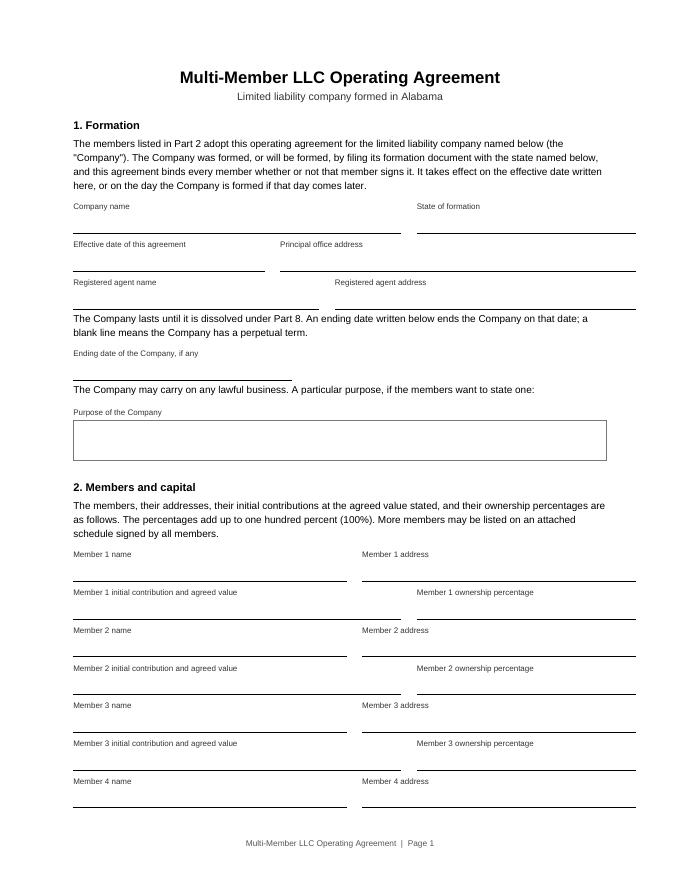
The chapter supplies the terms. With nothing agreed, 10A-5A-1.08(a)(2) hands any matter about relations among the members and between the members and the company to chapter 5A: equal shares of each distribution (4.05(a)(1)), the members directing the company, a majority of the members deciding ordinary matters and all of them any act outside the ordinary course (4.07(b)), admission of a new member with the consent of all members unless it comes by a merger or conversion or under 7.01(c) (4.01(b)), no pay for a member’s services, and a dissociated member paid only the distributions the member would have received anyway. The liability shield does not depend on the agreement: under 10A-5A-3.01 a member is not liable, solely by reason of being a member, for any debt, obligation or liability of the company or for the acts of any other member, agent or employee. A company with one (1) owner starts from the single-member operating agreement in the LLC operating agreement section, which 10A-5A-1.06(j) applies to one-member companies as fully as to others; the multi-member operating agreement describes the eleven (11) parts this Alabama version carries.
Frequently asked questions
Does a member who leaves get bought out?
No. 10A-5A-4.05(a)(2) says a member’s dissociation does not entitle the dissociated member to a distribution, and 10A-5A-6.03(a) leaves the person only the distributions the member would have received without dissociating. Part 8 of the document matches that and gives the remaining members a one hundred eighty (180) day option to buy the interest at fair value.
Can the agreement cut a manager’s duties?
Only a written agreement is named as able to (10A-5A-1.08(b)(1)). 10A-5A-4.08 gives whoever directs the company a duty of loyalty and a duty of care that includes refraining from grossly negligent or reckless conduct, intentional misconduct and knowing violations of law, and 10A-5A-1.08(b)(1) lets a written agreement expand, restrict or eliminate those duties, short of the implied covenant of good faith and fair dealing. Part 9 of the document indemnifies good-faith acts and excludes bad faith, willful misconduct, knowing violations of law, breaches of loyalty and improper personal benefits.
Who may see the company’s books?
A member, on written demand: the records of 10A-5A-4.09(a) within ten (10) days and any other books and records within thirty (30) days, for a proper purpose during regular business hours (10A-5A-4.09(b)), subject to the company’s reasonable restrictions on use and confidentiality (10A-5A-4.09(g)). A dissociated member’s thirty (30) day demand reaches only the records of the period of membership that were material to the person’s rights and duties, and only when made in good faith for a proper purpose (10A-5A-4.09(c)); a transferee gets nothing under that section (10A-5A-4.09(f)). Part 6 of the document opens the listed records to every member at any reasonable time.