

State Laws
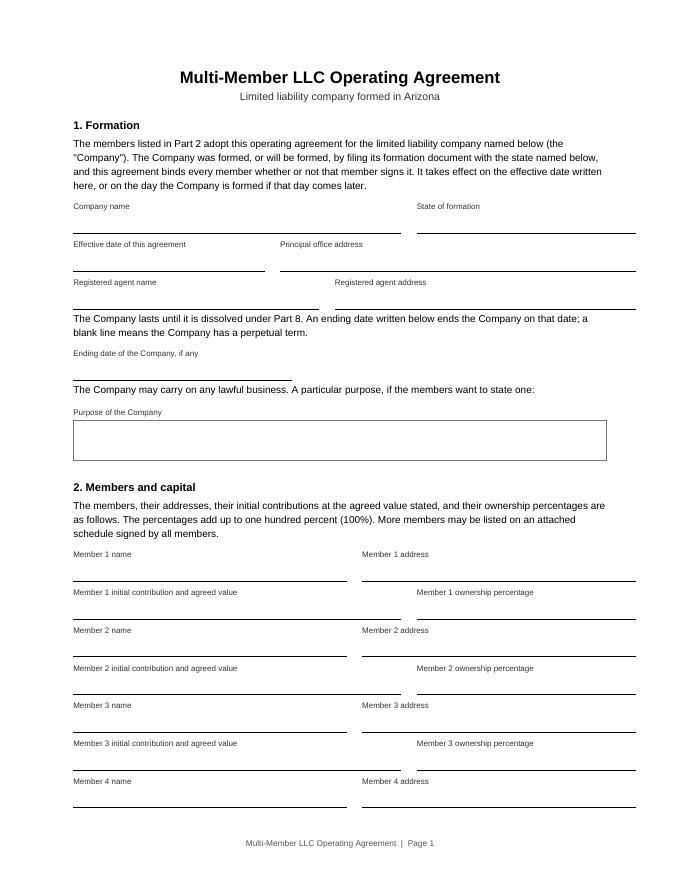
Arizona’s act is chapter 7 of title 29, the Arizona Limited Liability Company Act (A.R.S. § 29-3101), and it has governed every limited liability company in the state since September 1, 2020 (§ 29-3110(B)). No section read on 2026-11-02 requires the members to have an operating agreement. § 29-3102(17) defines one as the agreement of all the members, a sole member included, “whether oral, implied, in a record or in any combination thereof”, about the matters listed in § 29-3105(A), and the Corporation Commission’s articles instructions (form L010i, Rev. 7/2021) add that one “is not required by statute” and tell filers not to file it with the Commission. The company is bound by the agreement without signing it and a later member is deemed to assent (§ 29-3106(A), (B)); when a filed record conflicts with the agreement, then, subject to § 29-3105(C), the agreement prevails as to members, persons dissociated as members, transferees and managers, while the record prevails as to other persons to the extent they reasonably rely on it (§ 29-3107(D)).
§ 29-3105(A) gives the agreement four (4) subjects: relations among the members and with the company, a manager’s rights and duties, the company’s activities and affairs, and the means of amending the agreement itself. Except as subsections C and D provide, in a conflict the agreement governs (§ 29-3105(A)(3)); where it is silent, the chapter does (§ 29-3105(B)). Subsection C lists fourteen (14) things the agreement may not do, among them: eliminate the contractual obligation of good faith and fair dealing or the duty to refrain from wilful or intentional misconduct, or limit liability for either ((C)(5), (6)); unreasonably restrict the information rights of § 29-3410 ((C)(7)); or, to the detriment of a person other than a member or manager, reduce the distribution limits of § 29-3405 and the liability under § 29-3406 ((C)(13)). Subsection D runs the other way: subject to (C)(5) and (6), the duties of care and loyalty may be expanded, limited or eliminated.
The defaults the document replaces
| Rule | Arizona default | Section |
|---|---|---|
| Management | Reserved to the members unless the articles of organization provide for one or more managers | § 29-3407(A) |
| Weight of a vote | In a member-managed company a “majority in interest of the members” decides matters outside the ordinary course but within the purpose, matters on which members are known to differ, interim distributions and advances to a member or manager: members who together hold a majority of the interests in the company’s profits; in a manager-managed company a majority of the managers decides those matters | § 29-3407(B)(3), (C)(3), § 29-3102(12) |
| Ordinary decisions | In a member-managed company each member may manage and conduct the company’s activities within the ordinary course, and matters outside the ordinary course but within the purpose, and matters on which members are known to differ, go to a majority in interest; in a manager-managed company each manager acts in the ordinary course and a majority of the managers decides those matters | § 29-3407(B)(2), (3), (C)(2), (3) |
| Admitting a member | After formation, as the agreement provides, through an article 10 transaction, by agreeing to become a member with the affirmative vote or consent of all the members, or as § 29-3701(A)(3) provides | § 29-3401(C) |
| Amending the agreement | The affirmative vote or consent of all the members | § 29-3407(B)(4)(b), (C)(4)(b) |
| Selling substantially all assets | § 29-3407 names no separate vote for the sale; a matter outside the ordinary course but within the company’s purpose takes a majority in interest in a member-managed company and a majority of the managers in a manager-managed one, and an act outside the purpose stated in the agreement takes all the members in either | § 29-3407(B)(3)(a), (4)(a), (C)(3)(a), (4)(a) |
| Sharing of distributions | In equal shares among members and persons dissociated as members, except as needed to comply with a transfer or a charging order; paid before dissolution only if the company decides to make an interim distribution | § 29-3404(A), (B) |
| Transfer of an interest | Permissible in whole or in part; subject to § 29-3504, the transferee may not take part in management or, except as (B) and (C) provide, see records; the transferee receives the distributions the transferor would have received and, solely for a purpose reasonably related to that right, has the information rights of § 29-3410(B) | § 29-3502(A), (B) |
| Withdrawal | A person may dissociate at any time, rightfully or wrongfully, by express will; the dissociation is wrongful only if it breaches an express provision of the agreement or occurs before winding up is complete through judicial expulsion or an event in § 29-3602(7), and a wrongful dissociation makes the person liable for the damages it causes | § 29-3601(A) to (C) |
| A member’s death | The individual is dissociated; the legal representative may exercise a transferee’s right under § 29-3502(C) to an account from the date of dissolution and, to settle the estate, the rights the deceased member had under § 29-3410 | § 29-3602(6)(a), § 29-3504 |
| Vote to dissolve | Consent in a signed record by the number of members the agreement specifies or, if none, by a majority in interest together with members who would receive more than one-half of the value distributed on liquidation; also one hundred eighty (180) consecutive days with no member, unless transferees entitled to more than one-half of the liquidation value consent in a signed record to admit a specified person and that person becomes a member in time | § 29-3701(A)(2), (3) |
| Order of payment on winding up | Creditors first, members who are creditors included; then, subject to any charging order, the value of unreturned contributions (in proportion to their value if the surplus is short); then owners of transferable interests in proportion to their distribution rights just before dissolution, all paid in money | § 29-3707(A), (B), (C), (D) |
| Ceiling on distributions | None after which the company could not pay its debts as they become due in the ordinary course, or its total assets would be less than the sum of its total liabilities | § 29-3405(A) |
Part 5 of the document counts votes by ownership percentage rather than by share of profits, Part 4 reserves six (6) acts to the written consent of every member, and Part 3 divides profits and distributions by percentage in place of the equal shares of § 29-3404(A); each is a matter § 29-3105(A) leaves to the members. The last row binds creditors and other outsiders: § 29-3105(C)(13) bars an agreement from reducing either rule in a way that adversely affects the rights of a person other than a member or manager. A person who receives a distribution that violates § 29-3405 owes the company the excess, with three (3) years to sue (§ 29-3406(A), (B)).
Forming the company
Deliver the articles of organization to the Arizona Corporation Commission, then publish or wait for the Commission’s posting; the operating agreement stays with the company’s records.
One or more organizers form the company by delivering articles of organization to the Commission (§ 29-3201(A)). § 29-3201(B) requires four (4) statements: a name that satisfies § 29-3112; the principal address; the name and the street and mailing addresses in Arizona of the statutory agent; and whether the company is manager-managed or member-managed, with the name and address of each manager and of each member owning an interest of twenty percent (20%) or greater in the capital or profits in a manager-managed company, or of every member in a member-managed one. The company is formed when the articles become effective (§ 29-3201(D)). Whether the company is manager-managed is decided by the articles, not by the operating agreement (§ 29-3407(A), § 29-3201(B)(4)), so the box marked in Part 4 of the document has to match the articles on file; a change from one to the other is made by amending the articles (§ 29-3202(A)(2)) with the affirmative vote or consent of all the members (§ 29-3407(B)(4)(c), (C)(4)(c)). The fee is $50 (§ 29-3213(A)(1)); the Commission’s payment information page, read 2026-11-02, links an LLC fee schedule (Rev. 3.2026) showing $50, or $85 expedited.
Within sixty (60) days after the Commission files the articles, one of two things must happen (§ 29-3201(G)): a notice carrying the § 29-3201(B) information is published in a newspaper of general circulation in the county of the statutory agent’s street address for three (3) consecutive publications, or, where that county has more than eight hundred thousand (800,000) people, the Commission enters the information in the database kept under § 10-130. The L010i instructions name the counties: Maricopa or Pima means the notice is posted on the Commission’s website, anywhere else means the company publishes. The articles must also be amended within thirty (30) days after a change in members (member-managed) or in managers or twenty percent (20%) members (manager-managed), for $25 (§ 29-3202(B), § 29-3213(A)(3)). Neither § 29-3213 nor the LLC fee schedule lists an annual report for a limited liability company, and § 29-3708(A) names no missed report among the grounds for administrative dissolution.
The Commission’s articles instructions say not to file the agreement with the Commission. § 29-3410(A) makes the company keep a current list of each member’s and manager’s name and address, the articles and amendments, every current and prior written operating agreement, any record of a member’s obligation to contribute, and the three (3) most recent years of tax returns and financial statements, if any. A member or manager inspects and copies them during regular business hours, after a demand in a record naming the records and a purpose reasonably related to the member’s rights and duties, and the company answers within ten (10) days (§ 29-3410(B), (C)). Part 6 of the document keeps those records at the principal office with six (6) years of returns.
Signing
The four member blocks in Part 11 are signed; the manager signs the fifth block when Part 4 is marked manager-managed.
Every member named in Part 2 signs; § 29-3102(17) makes the operating agreement the agreement “of all the members”, and a person admitted later is deemed to assent without signing (§ 29-3106(B)). Under § 29-3102(25), to “sign” means, with present intent to authenticate or adopt a record, either to execute or adopt a tangible symbol or to attach to or logically associate with the record an electronic symbol, sound or process. Nothing in § 29-3102, §§ 29-3105 to 29-3107 or § 29-3410 calls for a notary or a witness, and § 29-3206(A)(5) says even a record delivered to the Commission needs no seal, attestation, acknowledgment or verification. The federal E-SIGN rule, 15 U.S.C. 7001(a)(2), covers the electronic version: where the deal is in or affects interstate or foreign commerce, a contract may not be denied legal effect, validity or enforceability solely because an electronic signature or electronic record was used in its formation.
Federal tax
Under Treasury Regulation § 301.7701-3(b)(1)(i), a domestic eligible entity with two (2) or more members is a partnership for federal income tax unless it elects otherwise, and for the purposes of title 23, chapter 4 (employment security) and title 43 (income taxes), § 29-3123 taxes the company and its members as a partnership, a corporation or a disregarded entity, as the Internal Revenue Code determines. The first box in Part 6 records the partnership default; the second is for a company that has filed Form 8832 to be classified as a corporation or Form 2553 to elect S corporation status under section 1362(a). A partnership files its information return on Form 1065, and the company applies for its employer identification number on Form SS-4.
Without an agreement
§ 29-3105(B) gives the answer: to the extent the agreement does not provide for a matter, “this chapter governs the matter”. A company with no agreement shares every distribution made before dissolution equally, except to the extent a transfer or a charging order requires otherwise, settles disputed matters in a member-managed company by majority in interest and lets any member dissociate by express will at any time. The liability shield is in the act itself: a debt of the company is solely the company’s, a member or manager is not personally liable for it solely by reason of that position, and a failure to observe formalities is no ground for imposing liability (§ 29-3304(A), (B)). The LLC operating agreement also exists in a form for a company with one owner, and the multi-member operating agreement is the general form of the same document.
Frequently asked questions
Can two spouses hold one transferable interest with a right of survivorship?
Yes, in writing. § 29-3401(G) creates community property with right of survivorship in a transferable interest when a written operating agreement expressly declares that a married couple holds it that way, and § 29-3401(F) does the same for joint tenants; the survivor takes the interest without any act by the company (§ 29-3401(I)(1)). Each co-owner, during life and after the other’s death, has only a transferee’s rights until admitted as a member under § 29-3401(C) (§ 29-3401(H)).
Is a member paid for working in the business?
Not by default in a member-managed company. § 29-3407(G) denies a member remuneration for services performed for a member-managed company, apart from reasonable compensation for winding up its activities. Part 3 of the document says only that reasonable compensation for services is not a distribution, which follows § 29-3102(6)(c).
Who can expel a member?
The other members, a court, or the operating agreement. § 29-3602(3) dissociates a person expelled as the operating agreement provides; § 29-3602(4) lets the other members expel a member by unanimous vote or consent in four (4) situations, among them when carrying on with the person is unlawful and when the person has transferred the entire transferable interest other than for security or under a charging order. § 29-3602(5) adds expulsion by judicial order for wrongful conduct that adversely and materially affects the company, a wilful or persistent material breach of the agreement or of § 29-3409, or conduct that makes it not reasonably practicable to carry on with the person as a member.