

State Laws
Colorado’s act is the Colorado Limited Liability Company Act, C.R.S. 7-80-101 to 7-80-1101, Article 80 of Title 7, published by the General Assembly among the Colorado Revised Statutes. Nothing in the article as read on 2026-11-03 tells the members to adopt an operating agreement at all. 7-80-102(11)(a) defines one as “any agreement of all of the members as to the affairs of a limited liability company and the conduct of its business” and adds that, except as the article or a written operating agreement otherwise requires, “the operating agreement need not be in writing”. The company is bound by any operating agreement of its members, which may be made before, after or at the time the articles are filed (7-80-108(1)(b), (c)).
7-80-108(1)(a) puts the agreement ahead of the statute: it governs the rights, duties and relations among the managers, the members, their assignees and transferees and the company, and its provisions control over any contrary provision of the article except subsections (1.5), (2) and (3); “to the extent the operating agreement does not otherwise provide, this article shall control”. Subsection (1.5) lets the agreement restrict or eliminate a member’s or manager’s duties, fiduciary duties included, as long as the provision is not manifestly unreasonable. Subsection (2) names four (4) things the agreement may not do: unreasonably restrict the rights of members and managers under 7-80-408; eliminate the obligation of good faith and fair dealing under 7-80-404(3), though it may prescribe reasonable standards for measuring it; eliminate or modify 7-80-801(1)(c)(I), other than to extend its deadline to no later than the first anniversary of the last member’s departure; or restrict the rights of, or impose duties on, persons other than the members, their assignees and transferees and the company without their consent.
The defaults the document replaces
| Rule | Colorado default | Section |
|---|---|---|
| Management | Vested in the members or in one or more managers, whichever the articles of organization state; the members of a company whose articles vest management in managers may designate them | C.R.S. 7-80-204(1)(e), 7-80-402 |
| Weight of a vote | Decisions are made by a majority of the members or, if the company has managers, by a majority of the managers; the agreement may grant the right to vote on a per capita or other basis | 7-80-401(1), 7-80-706(1) |
| Ordinary decisions | A majority of the members, or of the managers; in a member-managed company each member is an agent whose act for apparently carrying on the business in the ordinary course binds the company, unless the member had no authority in the matter and the other party had notice of that | 7-80-401(1), 7-80-405(2) |
| Acts outside the ordinary course | The consent of each member | 7-80-401(2)(c) |
| Admitting a member | After the original articles are filed, on the consent of all members; when the company has no members, on the unanimous consent of everyone holding the last member’s interest by assignment or transfer | 7-80-701(1), (2) |
| Amending the agreement | The consent of each member; an amendment to the articles is invalid unless approved by all members or in the manner the agreement provides | 7-80-401(2)(b), 7-80-209(1.5) |
| Choosing or removing a manager | By the consent of a majority of the members; an individual manager must be eighteen (18) or older | 7-80-402 |
| Sharing of profits, losses and distributions | On the basis of the value, as stated in the records 7-80-408 requires, of the contributions each member made; distributions before resignation or dissolution are paid as the agreement states or as all the members otherwise agree | 7-80-503, 7-80-504, 7-80-601 |
| Transfer of an interest | A membership interest is personal property and may be assigned; unless admitted as a member, the assignee gets only the share of profits, other income and return of contributions the member would have received, with no right to take part in management or to become a member; a member who transfers the whole interest ceases to be a member | 7-80-702(1), (2) |
| Resignation | A member may resign at any time by giving notice to the other members; if the resignation violates the agreement the company may recover damages and offset them against what is distributable to that member; a resigned member has no say in management and is entitled only to the profits and return of contributions the member would have had without resigning | 7-80-602, 7-80-603 |
| A member’s death | The executor, administrator, guardian, conservator or other legal representative may exercise all of the powers of an assignee or transferee of the member | 7-80-704(1) |
| Dissolution | On the agreement of all members; at the time or on the events the agreement states; or, once the company has no members, on the earlier of the ninety-first (91st) day without one, unless a person has been admitted before then, and the effective date of a statement of dissolution | 7-80-801(1) |
| Winding up | The dissolved company carries on no business except to wind up, which includes collecting its assets, disposing of property, discharging or providing for its liabilities, distributing what remains among the members and doing every other act necessary to wind up; the manager or, if none, any member may wind up, and the district court may supervise for good cause | 7-80-803(1), 7-80-803.3(1) |
| Ceiling on distributions | None to the extent that, after it, all liabilities (other than liabilities to members on their interests and liabilities whose recourse is limited to specific property) exceed the fair value of the company’s assets, counting property subject to a limited-recourse liability only to the extent its fair value exceeds that liability; reasonable compensation for services is not a distribution | 7-80-606(1) |
Part 5 of the document weighs votes by ownership percentage, which 7-80-706(1) allows, and Part 3 shares profits, losses and distributions by those same percentages instead of by contribution value. Part 4 lists six (6) acts that take the written consent of all members and removes a manager by members holding more than fifty percent (50%) of the percentages, a departure from the majority-of-members rule of 7-80-402 that 7-80-108(2) leaves open. The ceiling in the last row stays, and Part 3 adds a second test of its own: no distribution that would leave the company unable to pay its debts as they come due. A member who receives a distribution in violation of 7-80-606(1) and knew it at the time is liable to the company for the amount, one who did not know is not (though 7-80-606(2) leaves any obligation under an agreement or other law for the amount untouched), and unless otherwise agreed a member has no liability once three (3) years have passed since the distribution, unless an action to recover it was commenced within that time and liability adjudicated in it (7-80-606(2), (3)).
Forming the company
Deliver articles of organization to the Secretary of State online with the $50 fee; file the periodic report each year for $25; keep the operating agreement with the company’s records.
One or more persons, each individual eighteen (18) or older, form the company by delivering articles of organization to the Secretary of State for filing under Part 3 of Article 90, and they need not be members once the company exists (7-80-203(1)). The articles state the company’s name, which must comply with Part 6 of Article 90; its principal office address; its registered agent’s name and address; the true name and mailing address of each person forming it; whether management is vested in one or more managers or in the members; and that there is at least one member (7-80-204(1)). The company is formed when its articles become effective (7-80-207). The Secretary of State’s schedule of fees, under Business organizations and marked “Revised July 1, 2024”, lists articles of organization for a limited liability company at $50.00 online with no paper option.
Part 5 of Article 90 applies to every limited liability company formed under the article (7-80-301). Each reporting entity delivers a periodic report stating its name, the jurisdiction under whose law it is formed, its registered agent and its principal office address (7-90-501(1)). The first report is due no later than the last day of the second calendar month following the first anniversary of the calendar month in which the articles became effective, and one is due annually after that, unless the entity selects a different anniversary month or elects biennial reporting as the Secretary of State permits (7-90-501(4)(c)). The schedule prices the periodic report at $25.00 and its late filing penalty at $50.00; 7-90-501(7) subjects an entity that misses the due date to a penalty determined under 24-21-104(3).
The operating agreement is not filed. The article names no office where records must be kept and sets no list the company must maintain; 7-80-408(1) gives each member a right instead to inspect and copy, at the requesting member’s expense, on reasonable demand and for any purpose reasonably related to the member’s interest as a member, six (6) classes of records, from true and full information about the business and financial condition and the yearly tax returns to the articles, any written operating agreement, and what each member has contributed or promised. A demand must be in writing and state its purpose (7-80-408(5)). Part 6 of the document holds the agreement, the articles, the member list, the contribution record, six (6) years of tax returns and three (3) years of financial statements at the principal office, and lets a member inspect them for a purpose related to the member’s interest, which is the article’s own test.
Signing
All members sign Part 11, one block each; a company that marked manager-managed in Part 4 adds the manager’s signature in the fifth block.
Every member listed in Part 2 signs. The agreement is defined as the agreement “of all of the members” (7-80-102(11)(a)), the consent of each member is needed to amend it (7-80-401(2)(b)), and 7-80-502(3) makes a promise to contribute enforceable only if set out in a writing signed by the member, a rule Part 2 repeats. No notary or witness appears in 7-80-102, 7-80-108, 7-80-203, 7-80-204 or 7-80-502, nor anywhere else in Article 80 as read whole on 2026-11-03. Article 90, which governs filings, says in 7-90-106 that it modifies the federal Electronic Signatures in Global and National Commerce Act apart from 15 U.S.C. 7001(c) and the electronic delivery of the notices in 15 U.S.C. 7003(b); that act’s own rule, in 7001(a)(2), keeps an electronic signature or record from being the reason a contract touching interstate commerce is held unenforceable.
Federal tax
Treasury Regulation § 301.7701-3(b)(1)(i) classifies a domestic eligible entity with two (2) or more members as a partnership for federal income tax unless it elects otherwise, and 7-80-107(3) adds that the company’s federal tax status does not affect its status as a distinct entity under the article. An eligible entity uses Form 8832 to elect how it is classified for federal tax purposes, corporation included, and the S corporation election is Form 2553; Part 6 of the document marks the default or the election made. A partnership reports on Form 1065, and Form SS-4 is the application for the employer identification number.
Without an agreement
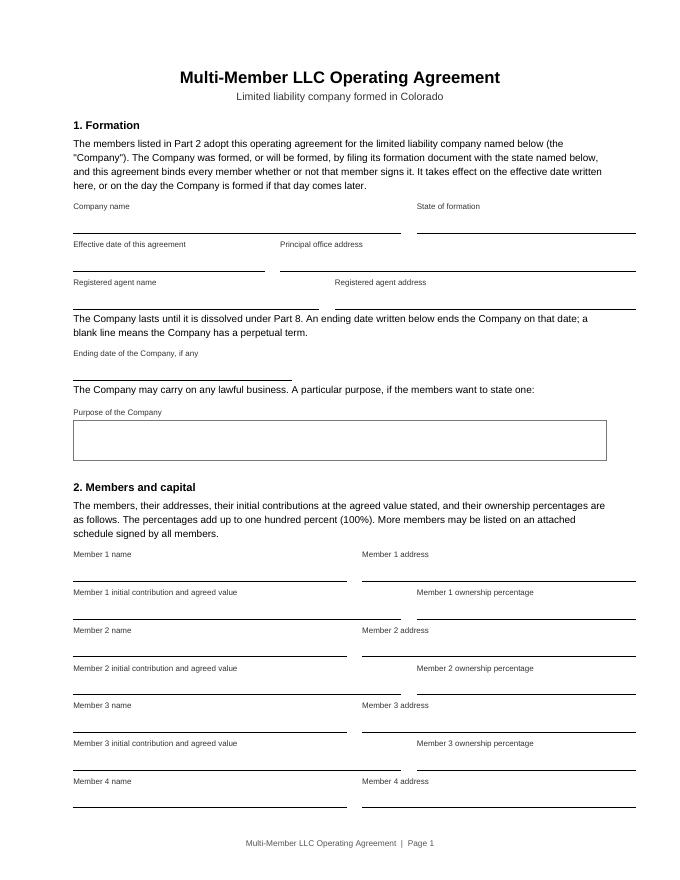
The fallback is the last sentence of 7-80-108(1)(a): where the agreement does not provide otherwise, “this article shall control”. A company with no agreement therefore shares profits and distributions by contribution value, decides by a majority of its members, needs each member’s consent for anything outside the ordinary course, and lets any member resign on notice with no payout beyond the economic share the member already had (7-80-602, 7-80-603). Limited liability does not depend on the agreement either: members and managers are not liable under a judgment, decree or court order, or in any other manner, for a debt of the company (7-80-705), and a failure to observe formalities is not in itself a ground for personal liability (7-80-107(2)), though a court asked to hold members responsible applies the case law on piercing a corporation’s veil (7-80-107(1)). An owner with no co-owners starts from the single-member version of the LLC operating agreement; the multi-member operating agreement goes through the eleven (11) parts of the four-member document one by one.
Frequently asked questions
Do the articles of organization have to say who manages a Colorado LLC?
Yes. 7-80-204(1)(e) requires the articles to state whether management is vested in one or more managers or in the members, and 7-80-402 lets the members designate managers only when the articles vest management in managers. The check box in Part 4 of the document should match the articles; a change takes articles of amendment approved by all members unless the agreement provides another way (7-80-209(1.5)).
Can a member be paid for working in the business?
Not as of right. Under 7-80-404(6) a member has no claim to pay for services to the company, apart from reasonable compensation for winding up its business, so a salary is a term for the members to agree. 7-80-606(1) leaves reasonable compensation for present or past services outside the distribution ceiling, and Part 3 of the document does the same.
What happens when a member assigns the whole interest?
The member ceases to be a member (7-80-702(2)). The assignee receives the share of profits and the return of contributions the member would have received but cannot take part in management or become a member without admission on the consent of all members (7-80-702(1), 7-80-701(1)). Part 7 of the document adds a thirty (30) day right of first refusal before any sale to an outsider.