

State Laws
Iowa’s act is chapter 489 of the Iowa Code, cited as the “Uniform Limited Liability Company Act” (489.101), published by the Legislature as one chapter 489 document in the 2026 Code. The operating agreement is defined in 489.102(19) as the agreement of all the members, a sole member included, on the matters in 489.105(1), and it counts whether it is oral, implied, in a record or any combination of those. Those matters are four (4): relations among the members and between them and the company, a manager’s rights and duties, the company’s activities and affairs, and the means and conditions for amending the agreement. Where the agreement is silent on one of them, the chapter speaks (489.105(2)). The company is bound by it without having assented to it (489.106(1)). One rule rewards paper: an agreement in a signed record that excludes modification except by a signed record cannot be modified any other way (489.106(4)).
489.105(3) names fifteen (15) things the agreement shall not do, lettered (a) to (o): vary the governing law of 489.104; vary the rules on registered agents or on records filed with the secretary of state; alter or eliminate the duty of loyalty or the duty of care except as 489.105(4) allows; eliminate the contractual obligation of good faith and fair dealing in 489.409(4); relieve or exonerate a person from liability except as 489.105(6) provides; unreasonably restrict the information rights of 489.410; vary the court-ordered dissolution of 489.701(1)(d) or the duty to wind up in 489.702; or restrict the rights of a person other than a member or manager, apart from what 489.106 and 489.107(2) allow, among others. 489.105(6) then draws the line on exculpation: the agreement may limit a member’s or manager’s liability for money damages, but not for a breach of the duty of loyalty, a financial benefit the person was not entitled to, a breach of a duty under 489.406 on improper distributions, intentional infliction of harm on the company or a member, or an intentional violation of criminal law.
The defaults the document replaces
| Rule | Iowa default | Section |
|---|---|---|
| Management | A company is member-managed by default; it becomes manager-managed only when the operating agreement expressly provides that it is or will be “manager-managed”, “managed by managers” or has management “vested in managers”, or uses words of similar import | Iowa Code 489.407(1) |
| Weight of a vote | In a member-managed company, each member has equal rights in the management and conduct of the company’s activities and affairs; in a manager-managed company, each manager has equal rights in the management and conduct of the company’s activities and affairs | 489.407(2)(b), (3)(b) |
| Ordinary decisions | In a member-managed company, a difference among members on a matter in the ordinary course may be decided by a majority of the members; in a manager-managed company, any matter is decided exclusively by the manager (or a majority of several managers), except as the chapter expressly provides | 489.407(2)(c), (3)(a) |
| Matters that take every member | The affirmative vote or consent of all members is needed to sell, lease, exchange or dispose of all or substantially all of the company’s property outside the ordinary course, to undertake any other act outside the ordinary course, to approve a merger, interest exchange, conversion or domestication, and to amend the operating agreement; a person is admitted after formation as the operating agreement provides, as the result of a merger, interest exchange, conversion or domestication under subchapter X, with the consent of all the members, or under 489.701(1)(c) when transferees holding a majority of the distribution rights consent within ninety (90) days after the company has no member (489.401(3)(a) to (d)); all members also compromise a contribution obligation, dissolve the company by consent, rescind a dissolution and, in a member-managed company, transfer Iowa real estate unless the agreement provides otherwise | 489.407(2)(d), (3)(c), 489.401(3), 489.403(3), 489.701(1)(b), 489.703(2)(a), 489.407A(2) |
| Choosing or removing a manager | A majority of the members may choose a manager at any time, and the manager serves until a successor is chosen unless the manager sooner resigns, is removed or dies; a majority may also remove a manager at any time, with no notice and no cause; membership is not a condition of being manager, though a member-manager who dissociates ceases to be manager | 489.407(3)(d), (e) |
| Meetings and consents | No meeting is needed for an action that requires the members’ vote or consent, and a member may act through a proxy or other agent named in a signed appointing record | 489.407(4) |
| Distributions before dissolution | Shared equally among members and dissociated members, save to the extent needed to honor a transfer under 489.502 or a charging order under 489.503; paid only when the company decides to make an interim distribution; dissociation itself entitles no one to a distribution; nobody may demand a distribution in any form but money | 489.404(1) to (3) |
| Transfer of an interest and the transferee’s rights | A transferable interest is personal property that may be transferred in whole or in part; the transferee takes the distributions the transferor would otherwise have received but, apart from the rights 489.504 gives a deceased member’s legal representative, has no part in management and no access to records; in a dissolution the transferee’s account of the company’s transactions runs only from the date of dissolution; a transfer that breaks a restriction in the agreement is ineffective if the intended transferee knew or had notice of the restriction at the time of transfer | 489.501, 489.502(1) to (3), (6) |
| Dissociation and what the member gets | Any member has the power to dissociate at any time by withdrawing by express will; the dissociation is wrongful only when it breaches an express provision of the agreement or when, before winding up is complete, the person withdraws by express will, is expelled by judicial order, is dissociated by a bankruptcy-type event under 602(8) (in a member-managed company only) or, being an entity, willfully dissolved; a wrongful dissociation makes the person liable for the damages; from then on the person owns the interest solely as a transferee (subject to 489.504 and to subchapter X, which governs a merger, interest exchange, conversion or domestication) and gets no distribution for dissociating; membership also ends when the company merges and is not the survivor or the person otherwise ceases to be a member, when an interest exchange or a domestication leaves the person no longer a member, or when the company converts (489.602(12) to (15)); and where neither the certificate nor the agreement says when a member may dissociate, a member may also dissociate by notice given within sixty (60) days after an amendment adopted over the member’s written dissent adversely affects one of the transferable-interest rights listed in 489.604(1), unless the agreement waives that section | 489.601, 489.602(1), (12) to (15), 489.603(1)(c), 489.404(2), 489.604 |
| A member’s death | An individual member’s death is a dissociation; the legal representative holds a transferee’s right to an account and, for settling the estate, the information rights the member had | 489.602(7)(a), 489.504 |
| Dissolution events | Dissolution follows an event or circumstance the agreement names; the affirmative vote or consent of all members; ninety (90) consecutive days without a member, unless transferees owning a majority of the distribution rights consent to admit one and someone becomes a member; a district court order on a member’s application because the business is unlawful or cannot practicably be carried on, or because the managers or controlling members act illegally, fraudulently or oppressively (on that conduct ground the court may order a remedy other than dissolution); or the secretary of state’s statement of administrative dissolution | 489.701 |
| Winding up order | The company’s assets go first to its creditors, members among them; the surplus then repays the value of each unreturned contribution (pro rata if the surplus falls short) and is then shared among the owners of transferable interests in proportion to their rights to distributions immediately before dissolution; the surplus steps are subject to a charging order under 489.503, and every payment is made in money | 489.707 |
| Records and inspection | Chapter 489 lists no required records and no office for them; in a member-managed company a member inspects and copies, on reasonable notice and during regular business hours, any record material to the member’s rights and duties, and the company furnishes without demand what it knows is material to the proper exercise of those rights, except to the extent the company can establish that it reasonably believes the member already knows the information, and on demand any other information except to the extent the demand is unreasonable or otherwise improper; in a manager-managed company the member demands information in a record that describes the information and the purpose with reasonable particularity, for a purpose reasonably related to the member’s interest as a member, with the information sought directly connected to that purpose, gets the company’s answer in a record within ten (10) days, and is told without demand whatever is material whenever asked to vote or to give or withhold consent; the company may impose reasonable restrictions and conditions on access to and use of the information, and bears the burden of proving them reasonable | 489.410(1), (2), (8) |
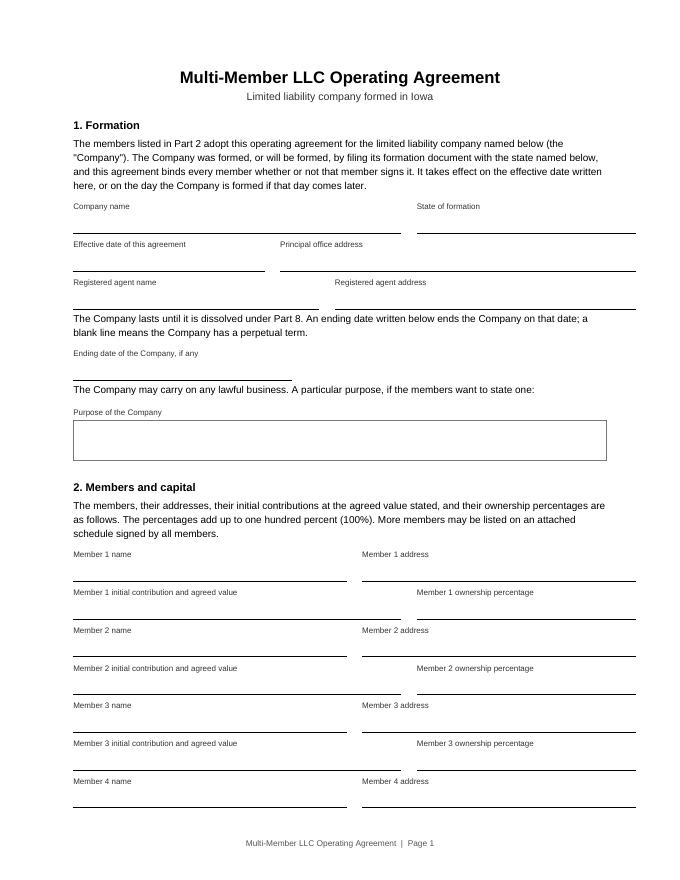
Part 5 of the document weighs votes by ownership percentage where 489.407(2)(c) counts members, Part 3 shares profits, losses and distributions by the same percentages where 489.404(1) pays equal shares, and Part 4 fixes nine (9) acts for the written consent of all members in place of the “outside the ordinary course” test of 489.407(2)(d)(2). Part 3 keeps the act’s limit on distributions: the company pays none if afterward it could not meet its debts as they fall due, or if its total assets would be less than its total liabilities plus the preferential rights of members and transferees who rank ahead of the recipients on dissolution (489.405(1)), a second test whose preferential-rights amount the agreement may remove under 489.105(4)(a)(2). Unless the agreement has moved the authority to consent to distributions to other members (489.406(2)), a member or manager who consents to a distribution over the line without meeting the duties in 489.409 is personally liable to the company for the excess, so is a person who knowingly receives it, and the claim is barred two (2) years after the distribution (489.406(1), (3), (5)).
Forming the company
File the certificate of organization through Fast Track Filing at filings.sos.iowa.gov with the $50 fee; keep the operating agreement with the company’s own records.
One or more organizers form the company by delivering a certificate of organization to the secretary of state (489.201(1)). It states three (3) things: the company’s name, which under 489.112(1) must contain “limited liability company”, “limited company” or the abbreviation L.L.C., LLC, L.C. or LC; the street and mailing addresses of the principal office; and the name and Iowa street and mailing addresses of the registered agent, who must have a place of business in the state (489.201(2), 489.115(2)). At least one (1) organizer signs it (489.203(1)(b)), a filed record needs no seal, attestation, acknowledgment or verification (489.206(1)(e)), and the company is formed when the certificate becomes effective, on filing or on a delayed date up to ninety (90) days out (489.201(4), 489.207). The fee is fifty dollars (489.122(1)(c)); the Secretary of State’s business entity forms and fees page, read 2026-11-04, lists the certificate at $50 and marks it, with the amendment, the dissolution and the termination, as a filing that can be made online through Fast Track Filing.
Every company then reports every other year. The biennial report states the company’s name, the registered agent’s name and street address, and the principal office street address, current as of delivery (489.212(1), (2)). The first one is due between January 1 and April 1 of the first odd-numbered year after the year of formation, and the next between the same dates of each odd-numbered year after that (489.212(3)); the fee is set by the secretary under 489.122(4), and the same forms and fees page puts it at $30 online or $45 on paper for an LLC. A report not delivered within sixty (60) days after it is due is a ground for administrative dissolution, as is a company without a registered agent for sixty (60) days; the secretary serves notice, the company has sixty (60) days to correct the ground (489.708, 489.709), and reinstatement costs $5 (489.122(1)(q), 489.710).
The operating agreement is not among the records the chapter sends to the secretary of state. 489.201(3) lets the certificate carry statements beyond the required three, but chapter 489 names no required records and no office for them, and 489.410 governs access in their place. No publication is required to form a company or to keep one; the chapter’s only published notice is the optional one a dissolved company may run for unknown claimants, once in a newspaper of general circulation in the county of its principal office (or, if that office is outside Iowa, the county of its registered agent’s office), or by posting it on its own website for at least thirty (30) days (489.705(2)(a)). Under Part 6 the principal office holds the agreement with its amendments, the certificate, the list of members, the record of contributions, six (6) years of tax returns and three (3) years of financial statements, and each member may inspect them for a purpose reasonably related to the member’s interest as a member, the wording 489.410(2)(b)(1) uses for a manager-managed company.
Signing
Each member in Part 2 signs one of the four member blocks in Part 11; the manager signs the fifth if Part 4 marks the company manager-managed.
Every member signs. The agreement is by definition one “of all the members” (489.102(19)), and its amendment takes the affirmative vote or consent of all of them in either form of company (489.407(2)(d)(4), (3)(c)(4)). Under 489.102(27), signing means executing or adopting a tangible symbol, or attaching an electronic symbol, sound or process to the record or logically associating it with the record, in each case with present intent to authenticate or adopt the record. No notary or witness requirement appears in 489.102, 489.105, 489.106, 489.201 or 489.203, nor anywhere else in the chapter as read whole on 2026-11-04; the one mention of an acknowledgment, in 489.206(1)(e), says a filed record does not need one. An electronic signature is covered by 15 U.S.C. 7001(a)(2): a contract in or affecting interstate commerce may not be denied legal effect or enforceability solely because an electronic signature or electronic record was used in its formation. 489.1202 adds that the chapter modifies, limits and supersedes that federal act, leaves its consumer-consent rule in 7001(c) untouched, and does not authorize electronic delivery of the notices described in section 103(b) of that act, 15 U.S.C. 7003(b).
Federal tax
A domestic eligible entity with two (2) or more members is a partnership for federal income tax under Treasury Regulation § 301.7701-3(b)(1)(i) unless it elects out, and chapter 489 contains no classification rule of its own. The election to be classified as a corporation is Form 8832, the election under section 1362(a) to be an S corporation is Form 2553, and Part 6 of the document marks the default or the election made. The partnership’s information return is Form 1065; Form SS-4 gets the employer identification number.
Without an agreement
A company whose members agree on nothing is governed by the table, because 489.105(2) hands any matter described in 489.105(1) that the agreement leaves open to the chapter, and its members are still shielded: a debt, obligation or other liability of the company is solely the company’s, a member or manager is not personally liable for it solely by reason of being or acting as one, and skipped formalities are no ground for liability (489.304). What the silence costs is authority: a member is not an agent of the company solely by being a member (489.301), and a member-managed company cannot transfer an interest in Iowa real estate without the consent of all members or a statement of authority filed with the secretary of state and the county recorder (489.407A(2), 489.302). A company with one (1) owner starts from the single-member operating agreement in the LLC operating agreement section; the multi-member operating agreement sets out the eleven (11) parts this Iowa version carries.
Frequently asked questions
When is an Iowa LLC’s first biennial report due?
Between January 1 and April 1 of the first odd-numbered year after the year the company was formed (489.212(3)), so a company formed in 2026 reports in early 2027 and every odd-numbered year after that. Sixty (60) days after the April 1 due date the missing report becomes a ground for administrative dissolution (489.708(2)).
Can a member be removed from the company?
Only on the grounds the chapter or the agreement sets; among them, the other members may expel a member by unanimous consent when it is unlawful to carry on with that member, when the member has transferred the whole transferable interest, or when an entity member has been dissolved or suspended and not reinstated (489.602(5)), and a court may expel a member for wrongful conduct, a willful or persistent material breach, or conduct that makes it not reasonably practicable to carry on with that member (489.602(6)). Part 8 of the document treats an expulsion as a dissociation and sets no grounds of its own, so the statutory ones apply.
What is the dissent rule in 489.604?
A member whose rights are adversely affected by an amendment adopted over the member’s written dissent may dissociate, if neither the certificate of organization nor the operating agreement specifies the time or events on which a member may dissociate, by giving the company notice not more than sixty (60) days after the date of the amendment, and owes no damages for breaking an agreement not to withdraw (489.604(1), (2)). The section applies to a company whose original certificate of organization was filed on or after July 1, 1997, and the agreement may waive it (489.604(3), (5)). Part 10 of the document lets no amendment pass without every member’s signature, so no amendment can be adopted over a dissent.