

State Laws
Indiana’s act is the Indiana Business Flexibility Act, IC 23-18-1-1 to 23-18-13-2 (IC 23-18-1-1). No section read on 2026-11-03 orders the members to adopt an operating agreement. IC 23-18-1-16 defines one as “any written or oral agreement of the members as to the affairs of a limited liability company and the conduct of its business that is binding upon all the members”, and IC 23-18-4-5 lets the members regulate “any aspect of the affairs” of the company by it; IC 23-18-4-13 names freedom of contract as the act’s policy.
The distinction that runs through the act is between an operating agreement and a written one. A written operating agreement may modify or eliminate the duties, fiduciary duties included, or the liability of a member or manager for breach of them, provide for indemnification or officers, or give a non-member a veto over a dissolution, a merger or an amendment (IC 23-18-4-4(a)). The liability standard of IC 23-18-4-2(a), the unanimous vote to amend (23-18-4-3(c)), the assignment rules (23-18-6-3.1(b), 23-18-6-4.1(b)), and the bar on withdrawal (23-18-6-6.1(b)) each yield to a written one; the events that end membership by death or by the end of a trust, partnership, corporation or estate member yield to a written one or to the written consent of all other members (23-18-6-5(a)(4) to (8)), and an amendment to a written agreement must itself be written and, unless the agreement says otherwise, unanimous (IC 23-18-4-6(c)).
The defaults the document replaces
| Rule | Indiana default | Section |
|---|---|---|
| Management | Vested in the members unless the articles of organization provide for a manager or managers; where they do, the managers have the authority to manage except to the extent the operating agreement reserves it to members | IC 23-18-4-1(a), (b) |
| Weight of a vote | A “majority in interest of the members” is the members who have made more than fifty percent (50%) of the agreed value of the total contributions, as stated in the company’s records, to the extent not returned | IC 23-18-1-13 |
| Ordinary decisions | Unless the articles provide for managers, and except as a written operating agreement or the act provides, the affirmative vote, approval or consent of a majority in interest of the members decides a matter connected with the business; with more than one (1) manager, a majority of the managers decides matters that need manager approval | IC 23-18-4-3(a), (b) |
| Acts outside the usual course | An act of a manager or member that is not apparently for carrying on the business in the usual way does not bind the company unless authorized in accordance with a written operating agreement or by the unanimous consent of all members | IC 23-18-3-1.1(d) |
| Amending the agreement | Except as a written operating agreement provides, the affirmative vote, approval or consent of all members, as it is to authorize an act that contravenes the agreement | IC 23-18-4-3(c) |
| Choosing or removing a manager | Unless a written operating agreement provides otherwise, designated, appointed, elected, removed or replaced by a vote, approval or consent of a majority in interest of the members; managers need not be members or natural persons | IC 23-18-4-1(b)(1), (2) |
| Admitting a member | A person acquiring an interest from the company is admitted on compliance with the operating agreement or, if it does not provide in writing, on the written consent of all members; an assignee becomes a member only if the other members unanimously consent, except as a written operating agreement provides | IC 23-18-6-1(a), 23-18-6-4.1(b) |
| Sharing of profits, losses and distributions | Unless the operating agreement provides otherwise, allocated on the basis of the agreed value, as stated in the company’s records, of the contributions each member made, to the extent received and not returned; interim distributions are paid at the times the agreement specifies or the members or managers decide voting under IC 23-18-4-3 | IC 23-18-5-3, 23-18-5-4 |
| Transfer of an interest | Except as a written operating agreement provides, an interest is assignable in whole or in part; the assignee receives, to the extent assigned, only the distributions the assignor would be entitled to, and the assignment does not of itself dissolve the company or let the assignee take part in management or exercise a member’s rights | IC 23-18-6-3.1(b) |
| Withdrawal | For a company formed after June 30, 1999, a member may not withdraw before dissolution and winding up unless a written operating agreement provides otherwise, and then only at the times or on the events the agreement specifies | IC 23-18-6-6.1(b) |
| Payout on dissociation | A dissociating member receives any distribution owed under the act or the agreement and, unless the operating agreement provides otherwise, the fair value of the interest as of the date of dissociation within a reasonable time, less that distribution | IC 23-18-5-5.1(b) |
| A member’s death | Ends membership unless a written operating agreement provides otherwise or all other members consent in writing; the legal representative of a deceased member may obtain, on reasonable demand for a purpose reasonably related to the member’s interest, just, reasonable, true and full information of all things affecting the members | IC 23-18-6-5(a)(4), 23-18-4-8(c) |
| Vote to dissolve | For a company formed after June 30, 2013, the unanimous consent of the members unless a written operating agreement lets members holding fewer than all the interests authorize it; also the events specified in writing in the articles or the agreement, and a decree of judicial dissolution | IC 23-18-9-1.1(b) |
| Order of payment on winding up | To creditors, members and managers who are creditors included to the extent permitted by law, except for liabilities for distributions to members under IC 23-18-5-4 and 23-18-5-5.1; then, unless a written operating agreement provides otherwise, to members and former members for liabilities for distributions under IC 23-18-5-4 and 23-18-5-5; then, unless a written operating agreement provides otherwise, to members in proportion to the returned contribution | IC 23-18-9-6 |
| Ceiling on distributions | None after which the company could not pay its debts as they become due in the usual course of business, or its total assets would be less than its total liabilities plus, unless the operating agreement permits otherwise, the amount needed on winding up to satisfy preferential rights superior to those of the members receiving the distribution | IC 23-18-5-6(a) |
Part 5 of the document counts votes by ownership percentage in place of contribution value, Part 3 shares profits, losses and distributions by the same percentages, Part 8 grants the withdrawal right that IC 23-18-6-6.1(b) withholds until a written agreement grants it, and Part 4 names six (6) acts that take every member’s written consent. The ceiling is not for the members to lift: a member or manager who votes for or assents to a distribution that violates the operating agreement or IC 23-18-5-6 is personally liable to the company for the excess, with contribution from each member who knowingly received it, and the claim runs for two (2) years (IC 23-18-5-7(a) to (c)).
Forming the company
File the articles of organization with the Secretary of State electronically or on paper; keep the operating agreement at the principal office with the records IC 23-18-4-8 names.
At least one (1) person, who need not be a member, forms the company by causing articles of organization to be executed and filed for record with the office of the Secretary of State (IC 23-18-2-4(a)). The articles state the company’s name, the street address of its registered office in Indiana and the name of its registered agent there, the latest date on which the company is to dissolve or a statement that its duration is perpetual, and a statement that they provide for a manager or managers if they do (IC 23-18-2-4(b)). The filing need not contain a seal, attestation, acknowledgment or verification (IC 23-0.5-2-1(a)(5)). The fee under IC 23-0.5-9-19, read 2026-11-03, is $75 for an electronic filing and $100 for any other.
Every domestic filing entity delivers a biennial report with its name, registered agent and principal office address every two (2) calendar years on a schedule the Secretary of State determines; the office may accept it during the ninety (90) days before the month in which it is due (IC 23-0.5-2-13(a), (c)). For a for-profit entity the fee is $20 for an electronic filing and $50 otherwise (IC 23-0.5-9-34(a)(1), (b)(1)). A report or a fee that is sixty (60) days late is a ground for administrative dissolution after written notice and sixty (60) more days to cure; a dissolved company may only wind up under IC 23-18-9 or apply for reinstatement, at $20 electronically or $30 otherwise (IC 23-0.5-6-1, 23-0.5-6-2(a) to (c), 23-0.5-9-42).
IC 23-18 does not call for filing the operating agreement with the Secretary of State. IC 23-18-4-8(a) requires the company to keep at its principal office the names and last known mailing addresses of every member and manager since organization, the articles and all amendments, three (3) years of income tax returns and financial statements, “copies of any written operating agreements and all amendments and copies of any written operating agreements no longer in effect”, and a writing on contributions and dissolution events unless a written agreement covers them. A member who gives five (5) business days’ written notice may inspect and copy those records during ordinary business hours at the member’s own expense (IC 23-18-4-8(b)). Part 6 of the document holds that list at the principal office, with six (6) years of tax returns, and lets any member inspect it without stating a purpose.
Signing
Every member in Part 2 signs a member block in Part 11; the manager signs the last block if Part 4 marks the company manager-managed.
The document has every member sign. IC 23-18-4-6(a) requires the initial operating agreement to be agreed to by all persons who are members when it is accepted, without saying how that agreement is shown, and the definition in IC 23-18-1-16 reaches only an agreement “binding upon all the members”. A member may sign through an attorney in fact, whose power of attorney “may but is not required to be” acknowledged or “signed in the presence of a notary public” (IC 23-18-4-6(e)); that is the only mention of a notary in IC 23-18, and no section of the article mentions a witness. Signing electronically is also covered by federal law: under 15 U.S.C. 7001(a)(2), an electronic signature or electronic record used in forming a contract relating to a transaction in or affecting interstate or foreign commerce is no ground for denying that contract legal effect, validity or enforceability.
Federal tax
Treasury Regulation § 301.7701-3(b)(1)(i) classifies a domestic eligible entity with two (2) or more members as a partnership unless it elects otherwise. The first box in Part 6 of the document records that default; the second records an election to be taxed as a corporation on Form 8832 or, for S corporation treatment under section 1362(a), on Form 2553. A partnership reports on Form 1065, and the company obtains its employer identification number with Form SS-4.
Without an agreement
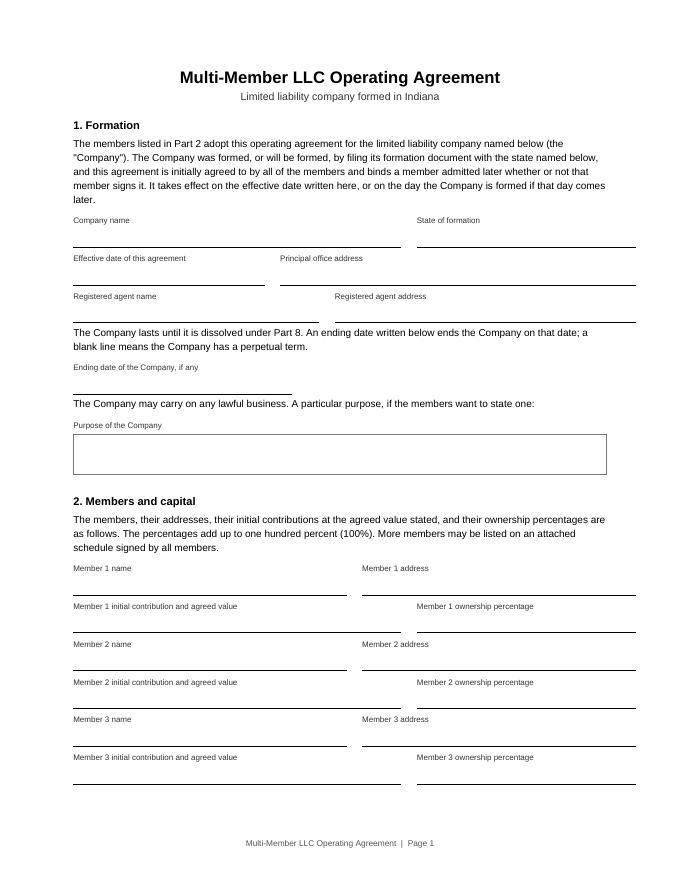
A company that never writes anything down is governed by the table: contribution value decides shares and votes, nobody may withdraw before dissolution, death ends membership and anyone who dissociates is paid fair value (IC 23-18-5-3, 23-18-5-4, 23-18-4-3(a), 23-18-6-6.1(b), 23-18-6-5(a)(4), 23-18-5-5.1(b)). The shield does not depend on the agreement: a member, manager, agent or employee “is not personally liable for the debts, obligations, or liabilities of the limited liability company”, though each answers for the person’s own acts or omissions (IC 23-18-3-3(a)). A company with one (1) owner uses the single-member operating agreement from the LLC operating agreement family; the multi-member operating agreement walks through the eleven (11) parts that this Indiana version carries.
Frequently asked questions
Is an oral operating agreement enough in Indiana?
It counts as an operating agreement under IC 23-18-1-16, but it cannot change the rules the act reserves to a written one, among them the liability standard of IC 23-18-4-2(a), the assignment rules of 23-18-6-3.1 and the withdrawal bar of 23-18-6-6.1(b). An amendment to an oral agreement needs the unanimous consent of all members (IC 23-18-4-6(b)).
Does the box in Part 4 have to match the articles of organization?
Yes. Management is vested in the members “unless the articles of organization provide for a manager or managers” (IC 23-18-4-1(a)), and the articles must say so when they do (23-18-2-4(b)(4)). A company that wants managers after filing member-managed articles files articles of amendment under IC 23-18-2-5, at $20 electronically or $30 otherwise (23-0.5-9-20).
Can a member be forced to keep contributing?
Only on a promise that is written and signed by that member; an unsigned promise to contribute is not enforceable (IC 23-18-5-1(a)). A member who does not make a required contribution of property or services owes, at the company’s option, cash equal to the value of the part not made (23-18-5-1(c)).