

State Laws
Kansas’s act is the Kansas Revised Limited Liability Company Act, K.S.A. 17-7662 through 17-76,155 (17-7662). 17-7663(m) defines the operating agreement. It may be entered into before, after or at the filing of the articles (17-7673(c)), and the act’s declared policy favors freedom of contract and the enforceability of operating agreements (17-76,134(b)).
An obligation to contribute, or to return a distribution made in violation of the act, may be compromised only by all the members unless the agreement provides otherwise, and a creditor who extended credit after an agreement or amendment reflected the obligation, and before the compromise, “may enforce the original obligation to the extent that, in extending credit, the creditor reasonably relied” on it (17-76,100(b)).
The defaults the document replaces
| Rule | Kansas default | Section |
|---|---|---|
| Management | Unless otherwise provided in an operating agreement, vested in the members in proportion to their then current percentage or other interest in the profits, the decision of members owning more than fifty percent (50%) controlling; if the agreement provides for management by a manager, in whole or in part, the manager manages to that extent, chosen, and ceasing to be a manager, as the agreement provides | 17-7693 |
| Weight of a vote | Unless the agreement or the act provides otherwise, every member holding an interest in profits may vote; the agreement may weigh votes per capita, by number, financial interest, class, group or any other basis, and may deny a member or class any vote | 17-7687(a), (b), (e) |
| Meetings and consents | Unless otherwise provided in an operating agreement, meetings may be held by conference telephone, members may act without a meeting, prior notice or a vote by written or electronic consent of the members holding the minimum votes the action would need at a meeting, and may vote by proxy given in writing or electronically | 17-7687(d) |
| Amending the agreement | If the agreement says how it may be amended, only in that manner or as otherwise permitted by law (a merger agreement may amend it, 17-7681(d)), a non-party’s approval or a condition included; if it does not, with the approval or consent of all of the members or as otherwise permitted by law, for a company whose original articles were filed on or after July 1, 2014 | 17-7687(f), (g) |
| Admitting a new member | At the time and on compliance with the operating agreement or, if it does not so provide, on the consent of all members; an assignee as the agreement provides or, unless it provides otherwise, on the consent of all members; unless the agreement provides otherwise by a specific reference to 17-76,114(a) or in connection with the assignment, on a sole member’s voluntary assignment of the whole interest to a single assignee (17-76,114(a)(3)); a person may be admitted without making a contribution | 17-7686(b), (c), 17-76,114(a), (a)(3) |
| Merger, division and other transactions | Unless otherwise provided in an operating agreement, a merger or consolidation is approved by members owning more than fifty percent (50%) of the interest in profits (for a company whose original articles were filed and effective on or before June 30, 2019, and unless the agreement provides otherwise, by the members or, if there is more than one class or group, by each class or group, in each case owning more than fifty percent (50%) of the interest in profits, 17-7681(a)(1)(B)); a division, where the agreement does not prohibit one, is adopted as the agreement provides, else as it provides for a merger, else by that same majority; an interest exchange, a conversion or a domestication is approved as the operating agreement provides for it, else in the way the act and the agreement provide for a merger (members owning more than fifty percent (50%) of the interest in profits unless the agreement provides otherwise), and by all the interest holders only if neither provides for a merger | 17-7681(a)(1), 17-7685a(c), 17-78-303(a), 17-78-403(a), 17-78-503(a) |
| Profits and losses | In the manner the operating agreement provides; if it does not so provide, on the basis of the agreed value, as stated in the company’s records, of the contributions each member has made, to the extent received and not returned | 17-76,101 |
| Distributions | Allocated on the same basis unless the agreement provides otherwise; except as provided in 17-76,104 through 17-76,110, paid before resignation and dissolution to the extent and at the times or on the events the agreement specifies; except as the agreement provides, a member may not demand a distribution in any form other than cash and may not be forced to take a share of an asset in kind larger than the member’s share of distributions | 17-76,102, 17-76,104, 17-76,108 |
| Transfer of an interest | Assignable in whole or in part except as the operating agreement provides; the assignee has no right to take part in management except as the agreement provides or, unless it provides otherwise, on the consent of all members; unless the agreement provides otherwise, the assignee receives only the assigned profits, losses, distributions and tax items, and a member who assigns the whole interest ceases to be a member | 17-76,112(a), (b) |
| Resignation | Only at the time or on the events the operating agreement specifies and in accordance with it; unless the agreement provides otherwise, a member may not resign before the dissolution and winding up of the company (unless its agreement provides otherwise, a company whose original articles were filed and effective on or before June 30, 2014 is governed by subsection (b) instead: a member may resign only at the time or on the events the agreement specifies and, unless the agreement provides otherwise, before dissolution, and on resigning is deemed an assignee with only an assignee’s rights) | 17-76,106(a), (b) |
| Payout on resignation | Except as provided in 17-76,104 through 17-76,110, any distribution the agreement gives a resigning member and, if not otherwise provided in an operating agreement, the fair value of the interest as of the date of resignation, based on the member’s right to share in distributions, paid within a reasonable time (unless its agreement provides otherwise, a company whose original articles were filed and effective on or before June 30, 2014 stays under the section as in effect on June 30, 2014, 17-76,107(b)) | 17-76,107 |
| A member’s death | The personal representative of a member who dies or is adjudged incompetent may exercise all of the member’s rights for the purpose of settling the estate or administering the property, including any power under the agreement of an assignee to become a member; unless otherwise provided in an operating agreement, a member’s death, retirement, resignation, expulsion, bankruptcy or dissolution does not dissolve the company | 17-76,115, 17-76,116(b) |
| Dissolution | The first of: the time the operating agreement specifies, with perpetual existence if it sets none; an event the agreement specifies; unless the agreement provides otherwise, the vote, consent or approval of members owning two-thirds (2/3) or more of the interest in profits (for a company whose original articles were filed and effective on or before June 30, 2019, and unless the agreement provides otherwise, more than two-thirds, by each class or group if there is more than one, 17-76,116(a)(3)(B)); no members, unless, within ninety (90) days or the period the agreement sets, the last member’s personal representative agrees to continue the company and be admitted (unless the agreement provides otherwise; it may oblige the representative to agree), or a member is admitted within that period under an agreement provision that specifically provides for admission after the last member is gone; or a decree of judicial dissolution | 17-76,116(a) |
| Winding up | Unless otherwise provided in the operating agreement, by a manager who has not wrongfully dissolved the company or, if none, by the members or a person approved by members owning more than fifty percent (50%) of the interest in profits; the district court may wind up on cause shown; a company whose original articles were filed and effective on or before June 30, 2019 is governed by 17-76,118(a)(2) instead, under which, if there is more than one class or group, each class or group must approve | 17-76,118(a)(1), (2) |
| Order of payment on winding up | To creditors, including members and managers who are creditors to the extent otherwise permitted by law, other than for distributions already owed; then, unless otherwise provided in an operating agreement, to members and former members for distributions owed under 17-76,104 or 17-76,107; then, unless otherwise provided in an operating agreement, to members first for the return of their contributions and second in the proportions in which they share distributions | 17-76,119(a) |
| Ceiling on distributions | None to the extent that, after it, the company’s liabilities (other than to members as such and nonrecourse liabilities) exceed the fair value of its assets; reasonable compensation for present or past services and bona fide retirement-plan payments are not distributions; a member who knew the distribution was unlawful is liable to the company for its amount, a member who did not know is not, and, unless otherwise agreed, a member has no liability after three (3) years unless an action to recover the distribution is begun within that time and liability is adjudicated in it | 17-76,110 |
| Records and information | Subject to reasonable standards set in the operating agreement or by the manager or members, a member may obtain, on reasonable written demand stating a purpose reasonably related to the member’s interest as a member, the status of the business and its financial condition, each year’s tax returns, a current list of members and managers, any written operating agreement and the articles with amendments, the contribution records and other just and reasonable information; the right may be expanded or restricted in an original agreement or in an amendment all the members adopt or that meets the agreement’s own requirements; the company must keep a current record of each member’s and manager’s name and address | 17-7690(a), (e), (g), (h) |
| Duties and liability | Fiduciary duties may be expanded, restricted or eliminated in the operating agreement, and liability for breach of contract or of duty limited or eliminated, except that the agreement may not eliminate the implied contractual covenant of good faith and fair dealing or excuse a bad faith violation of it; the company may indemnify any member, manager or other person against any and all claims, subject to the standards its agreement sets | 17-76,134(c), (e), 17-7670(a) |
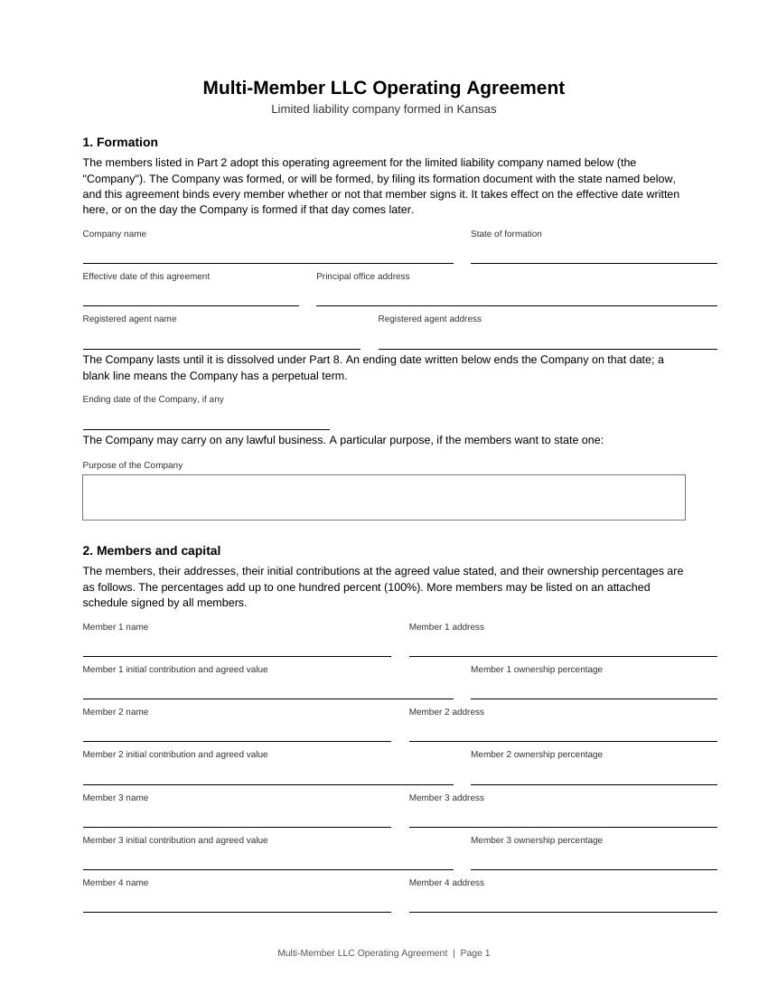
In the document each vote carries the member’s ownership percentage (Part 5) in place of the interest in profits, profits, losses and distributions follow those percentages (Part 3), and Part 4 lifts a merger, division, conversion, domestication and interest exchange, with a sale of substantially all assets, admitting a member, amending the agreement, debt outside the ordinary course and dissolution, to every member’s written consent. Part 8 supplies the resignation right 17-76,106(a) otherwise withholds and sets the payout; the ceiling row is the act’s own and stays, Part 3 adding that the company must also be able to pay its debts as they come due.
Forming the company
File the articles of organization (form DL) online through the Secretary of State’s register-a-business page, or mail the paper form to the Docking State Office Building, 915 SW Harrison Street, Topeka, KS 66612; the operating agreement stays with the company’s records.
One (1) or more authorized persons execute articles of organization and file them with the Secretary of State; on substantial compliance with 17-7673 the company is formed when they are filed, or on a later date they name within ninety (90) days (17-7673(a), (b), 17-7911). The articles give the name, the registered office and resident agent, anything else the members choose to include, each profession of a professional company and, for a company with series, the series matters (17-7673(a)). The name carries “limited liability company” or “limited company”, “L.L.C.” or “L.C.”, or “LLC” or “LC” (17-7920(a)); the registered office is an address in Kansas given by building and suite number, street name or rural route and box number, city, state and zip code (17-7924(a), (c)), and the resident agent may be the company itself, an individual resident in Kansas, a domestic entity or a foreign entity authorized to transact business in the state (17-7925(a), (b)(2)). Executing the filing is an oath under penalty of perjury (17-7909), and the signature may be a facsimile, a conformed signature or an electronic signature (17-7910(a)).
The act leaves the filing fee to the Secretary of State’s regulations, capped at $150 (17-76,136(b)). The Secretary of State’s Register a Business page carries form DL, Articles of Organization, on paper and online; its instructions (Rev. 2/27/26, read 2026-11-05) put the fee at $85 online and $90 on paper, accept checks and cards, process an online filing within minutes and mail the certified copy of a paper filing to the sender. The act’s own schedule adds $20 for a certificate of amendment, restated articles, a certificate of cancellation or a change of registered office or resident agent, and $7.50 for a certified copy or a certificate of good standing (17-76,136(a)).
Every Kansas company then files a business entity information report every second year, in the even years if its articles were filed in an even year and in the odd years if they were filed in an odd year, “not later than April 15” (17-76,139(a), (b)); the report names every member owning five percent (5%) or more of the capital and the principal office, and signing it is an oath (17-76,139(c), (e)). The fee is $80 plus the amount the regulations set (17-76,139(f)); the Secretary of State’s Information Reports page confirms the biennial cycle and the April 15 date for every for-profit business, and form ILC’s instructions (Rev. 1/23/26) put it at $90 online and $110 on paper. The page allows a three-month delinquency period after the due date, after which the company forfeits and can file nothing else until it submits the past due reports and is reinstated; the act applies the $75 penalty and forfeiture of 17-7509 and 17-7510(a) to a company that fails to file or pay within ninety (90) days of the due date, with reinstatement by certificate on paying the reinstatement fee, the report fees for the past ten (10) years and every fee and penalty due (17-76,139(g), 17-76,146(a)). The report has been biennial since January 1, 2024.
The operating agreement is not filed: 17-7673(a) leaves it out of the articles, while 17-7690(a)(4) lets a member obtain “a copy of any written operating agreement” from the company and 17-7690(h) has the company keep a current record of each member’s and manager’s name and address. The act names no place for them, so Part 6 of the document keeps them at the principal office.
Signing
Each member listed in Part 2 signs one block of Part 11; the manager signs the last block when Part 4 marks the company manager-managed.
The act demands no signature: an agreement may be oral or implied, and a member, manager or assignee is bound “whether or not” that person executes it (17-7663(m)); the document has every member sign because a signed writing is what fixes the terms the act would otherwise fill in. A signature the act or the agreement requires or permits “may be a manual, facsimile, conformed or electronic signature”, except as 17-7679a(b)(1) provides, for example for papers filed with the Secretary of State or a court (17-7679a(a)(1)(B), (b)(1)), and a person required to execute the agreement or an amendment who refuses can be ordered to by the district court (17-7677). No notary, witness or acknowledgment is named for the operating agreement in 17-7663, 17-7673, 17-7677, 17-7679a or 17-7687, nor in any other section of the act as read in full on 2026-11-05: “notar” and “witness” do not appear in it, and “acknowledg” appears once, for the electronic acknowledgement an information system sends (17-7679a(a)(1)(C)). If any provision of the act is deemed to modify, limit or supersede the federal E-SIGN Act, 17-7679a(c) has the act control to the fullest extent 15 U.S.C. 7002(a)(2) permits. Under 15 U.S.C. 7001(a)(2), with respect to a transaction in or affecting interstate or foreign commerce, a contract may not be denied legal effect, validity or enforceability solely because an electronic signature or electronic record was used in its formation.
Federal tax
Except for an entity in existence before the regulation took effect (paragraph (b)(3)), Treasury Regulation § 301.7701-3(b)(1) treats a domestic eligible entity with two (2) or more members as a partnership, and one with a single owner as disregarded, unless it elects otherwise, and 17-76,138 gives the company the same classification for every Kansas tax. The election for corporate treatment goes on Form 8832 and an S corporation election on Form 2553; in Part 6 of the document the second checkbox is marked when either election is made, the first when none is. The employer identification number comes from Form SS-4.
Without an agreement
Members who agree nothing run the company on the act’s defaults. Except as otherwise provided by the act, no member or manager is personally obligated for the company’s debts solely by reason of being a member or acting as a manager, unless that person agrees to be (17-7688). A company with one (1) owner uses the single-member operating agreement in the LLC operating agreement section; the multi-member operating agreement explains the eleven (11) parts this Kansas version carries.
Frequently asked questions
Do the articles have to say whether a manager runs the company?
No. The articles must give only the name, the registered office and resident agent, the professions of a professional company and, for a company with series, the series matters, plus whatever the members choose to add (17-7673(a)); the operating agreement is what vests management in a manager, “to the extent so provided” (17-7693). The Part 4 checkbox of the document is the deciding record.
What does a member who leaves receive?
What the agreement gives and, if it is silent on the payout, the fair value of the interest: the act lets a member of a company whose original articles were filed and effective after June 30, 2014 resign only at a time or on an event the agreement names (17-76,106(a)), and, except as provided in 17-76,104 through 17-76,110, pays a resigning member the fair value of the interest “if not otherwise provided in an operating agreement” (17-76,107(a)). Part 8 of the document allows withdrawal on ninety (90) days’ written notice, provides otherwise on the payout, and gives the remaining members a one hundred eighty (180) day option to buy the interest at fair value.
Who acts for a member who dies?
The member’s personal representative (17-76,115). Part 8 of the document keeps that power while the estate holds the interest as a transferee.