

State Laws
The Kentucky Limited Liability Company Act is KRS Chapter 275 (275.001). Nothing in it tells the members to adopt an operating agreement; the chapter instead defines one in 275.015(21) as “any agreement, written or oral, among all of the members, as to the conduct of the business and affairs of a limited liability company”. The General Assembly’s stated policy is “to give maximum effect to the principles of freedom of contract and the enforceability of operating agreements” (275.003(1)), and to the extent the articles of organization and the operating agreement do not provide otherwise, the chapter governs relations among the company, the members, the managers and the assignees (275.003(8)). A person who becomes a member is bound by and a party to the agreement (275.275(3)).
Kentucky has no single list of what the agreement may not do. Instead each default rule says what displaces it, and the word to watch is written: voting weight yields to the articles of organization or “a written operating agreement” (275.175(1), (3)), the ten matters reserved to the members to “a written operating agreement” (275.175(2)), as do the sharing of profits and distributions (275.205, 275.210), the rights of an assignee (275.255(1), 275.265(1)), resignation (275.280(3)) and the duties of care and loyalty (275.170). Among the rules that carry no “unless otherwise provided” opener are six (6): the obligation of good faith and fair dealing “may not be eliminated in the operating agreement”, though the agreement may set the standards for measuring it if they are not manifestly unreasonable (275.003(7)); a limitation on inspecting or using company records must be reasonable (275.185(5)); a promise to contribute is unenforceable unless it is in a writing signed by the member (275.200(1)); on winding up, creditors come first (275.310(1)); the members or managers must render true and full information of all matters affecting the members, to the extent just and reasonable, to any member and to the legal representative of a deceased member or of a member under legal disability (275.185(3)); and the terms of a conversion of the company into a limited partnership or a limited liability partnership “shall be approved by all of the members notwithstanding any provision to the contrary in the operating agreement” (275.372(4)). Where a written agreement says amendments must be written and adopted its way, any unwritten understanding about the business “shall be void and unenforceable” (275.177).
The defaults the document replaces
| Rule | Kentucky default | Section |
|---|---|---|
| Management | Vests in the members unless the articles of organization vest it in one or more managers; the articles must state which form the company takes | KRS 275.165(1), (2), 275.025(1)(d) |
| Weight of a vote | Members vote, approve or consent in proportion to their contributions, at the agreed value stated in the company’s records, to the extent received and not returned | 275.175(3) |
| Ordinary decisions | The vote, approval or consent of a majority-in-interest of the members, or a simple majority of the managers with one (1) vote each, decides any matter connected with the business | 275.175(1), 275.015(15) |
| Matters that take the members’ vote | Ten (10), whatever the form of management: amending a written operating agreement; authorizing an act that contravenes the agreement; amending the articles; merging, converting or selling all or substantially all assets; admitting a new member, an assignee included; removing a member who has assigned all assignable interest; waiving an agreement to contribute; approving voluntary dissolution; approving any act in contravention of a written agreement; and allowing a member to resign from a manager-managed company | 275.175(2) |
| Choosing or removing a manager | Designated, elected, removed or replaced by a majority-in-interest of the members; need not be a member or a natural person; serves until a successor is elected and qualified unless removed or resigned sooner | 275.165(2) |
| Meetings and consents | Any member action may be taken without a meeting and without prior notice by a writing approved by the necessary number or percentage; the agreement may set notice, quorum, record date and proxy rules | 275.175(6), (7) |
| Profits and losses | Allocated on the basis of the agreed value of each member’s contributions, received and not returned | 275.205 |
| Distributions before dissolution | Shared on the same contribution basis, at the times the agreement specifies or the members or managers decide; a member may demand cash only and cannot be forced to take a lopsided share in kind | 275.210, 275.220 |
| Transfer of an interest | Assignable in whole or in part; the assignee receives only the distributions the assignor would get and may not take part in management or exercise any other right of a member; unless a written operating agreement provides otherwise, the assignee becomes a member only if a majority-in-interest of the members consent, the assignor not voting, and a person who acquires an interest directly from the company becomes a member on compliance with the operating agreement or, if it does not so provide in writing, on the written consent of all members | 275.255(1), 275.265(1), 275.275(1) |
| Resignation | Unless a written operating agreement provides otherwise, in a member-managed company on thirty (30) days’ prior written notice and in a manager-managed company only with the consent of all other members; the resigning member becomes an assignee of the interest | 275.280(3), (4) |
| What a dissociated member gets | No distribution on account of the dissociation, whether the member resigned or was expelled, except as a written operating agreement provides | 275.280(6), 275.172(3) |
| A member’s death | Death, or a court order adjudicating the member incompetent, dissociates the member unless a written agreement or a majority-in-interest of the remaining members provides otherwise; the successor in interest is an assignee; the legal representative is owed, to the extent the circumstances render it just and reasonable, true and full information of all matters affecting the members | 275.280(1)(f), (5), 275.185(3) |
| Dissolution | The first of: a term in the articles expiring; an event the articles or a written agreement specifies; the written consent of all members unless the agreement provides otherwise; no remaining member, unless a successor is admitted under the agreement or agrees in writing within ninety (90) days to continue the company; a decree of judicial dissolution; a certificate of administrative dissolution | 275.285 |
| Order of payment on winding up | Creditors first, including, to the extent permitted by law, members who are creditors; then, unless a written agreement provides otherwise, distributions already owed, then the return of contributions, then shares in proportion to each member’s right to distributions before dissolution | 275.310 |
| Ceiling on distributions | None after which the company could not pay its debts as they become due in the usual course of business, none that leaves assets below liabilities plus (unless the agreement provides otherwise) the preferential rights of other members on dissolution, and none that violates the operating agreement | 275.225(1) |
Part 5 of the document weighs votes by ownership percentage instead of contributions, Part 3 shares profits and every distribution to a member the same way (an assignee, or a creditor holding a charging order, receives only the distributions that go with the interest: 275.255(1)(b), 275.260(2)), and Part 4 reserves six (6) acts for the written consent of all members where 275.175(2) names ten (10) for the members’ vote; each of those defaults yields to a written agreement. The last row is not negotiable, apart from the preferential-rights term that an operating agreement may vary (275.225(1)(b)). A member or manager who votes for or assents to a distribution that violates 275.225 or the agreement is personally liable to the company for the excess if it is established that the member or manager did not comply with 275.170, and the claim is barred two (2) years after the distribution’s measuring date (275.230).
Forming the company
Deliver articles of organization to the Secretary of State, online or by mail to P.O. Box 718, Frankfort, KY 40602, with the $40 fee; the operating agreement stays with the company’s records.
One or more organizers, who need not be members, form the company by delivering articles of organization to the Secretary of State; existence begins when the articles are filed, or on a delayed effective date no later than the ninetieth (90th) day after filing (275.020(1), (2), KRS 14A.2-070(2)). The articles set forth four (4) things: a name ending in “limited liability company”, “limited company”, “LLC” or “LC” (14A.3-010(3)); the registered office and initial registered agent; the mailing address of the initial principal office; and a statement that the company is managed by managers or by its members (275.025(1)). The term is perpetual unless the articles say otherwise (275.025(2)). Before formation the organizer signs the filing; afterwards a manager, a member of a member-managed company or an authorized representative does (14A.2-020(1)(b)). The fee is forty dollars (275.055(1)), and the Secretary of State’s business filing fees, read 2026-11-04, list Articles of Organization for a domestic limited liability company at $40.00, an amendment or articles of dissolution at $40.00 each and a statement of change of registered agent or office at $10.00; a veteran-owned business organized after August 1, 2018 pays no fee for its articles (14A.2-165(2)).
Every Kentucky company then files an annual report (275.190, 14A.6-010). The first one is delivered between January 1 and June 30 of the year after the year the company was organized, then one in the same window every year; a manager-managed company lists each manager’s name and business address (14A.6-010(1)(d)2., (3)). The fee is fifteen dollars (14A.2-060(2)(a)), waived for a veteran-owned business for its first four (4) years, and the Secretary of State’s annual reports page confirms the $15 fee, the June 30 deadline and online or mail filing. A domestic company that misses June 30 faces administrative dissolution: the company has sixty (60) days after the Secretary’s notice is mailed to correct the ground, and a dissolved company may carry on only the business needed to wind up (14A.7-010(1)(a), 14A.7-020(2), (3)). Reinstatement takes an application, a Department of Revenue certificate that all taxes are paid, the $100 reinstatement penalty and the fee for each delinquent report (14A.7-030(1), 14A.2-060(1)(j)). The Department of Revenue’s limited liability entity tax page, read 2026-11-04, adds a tax the Secretary of State does not collect: the LLET falls on every business protected from liability by state law, limited liability companies included, and a company whose total gross receipts or total gross profits are $3 million or less pays the $175 minimum.
No section of the chapter asks for the operating agreement to be filed. 275.185(1) has the company keep, at its principal office or at another location a written operating agreement names, current and past lists of members and managers, the articles and amendments, three (3) years of income tax returns and financial statements, every written operating agreement in force or superseded, and, unless the agreement contains them, writings on each member’s contributions and on the events that dissolve the company. A member may inspect and copy any company record on reasonable written request during ordinary business hours, subject to reasonable limitations a written agreement imposes (275.185(2), (5)); failing to keep the records is not a ground for personal liability (275.185(4)). Part 6 of the document keeps the agreement, the articles, the member list, the contribution record, six (6) years of tax returns and three (3) years of financial statements at the principal office, open to any member for a purpose related to the member’s interest.
Signing
Each member in Part 2 signs one of the four blocks in Part 11; the manager of a manager-managed company signs the fifth.
Every member signs. The act’s agreement is one “among all of the members” (275.015(21)), each member is a party to it on admission (275.275(3)), and amending a written agreement is the first matter that takes the members’ vote (275.175(2)(a)); with the written-amendment clause of Part 10 in place, 275.177 makes any unwritten side deal void. No notary or witness appears in 275.015, 275.175, 275.177, 275.185 or 275.275, nor anywhere else in the chapter as read in full on 2026-11-04; the nearest the filing act comes is 14A.2-010(7), under which a document delivered to the Secretary of State may but need not contain an acknowledgment. For an electronic signature, 15 U.S.C. 7001(a)(2) provides that a contract relating to a transaction in interstate commerce may not be denied legal effect solely because an electronic signature or electronic record was used in its formation.
Federal tax
Treasury Regulation § 301.7701-3(b)(1)(i) treats a domestic eligible entity with two (2) or more members as a partnership for federal income tax unless it elects otherwise, and KRS 275.010(2) makes the company a legal entity distinct from its members. An election to be taxed as a corporation goes on Form 8832, and the S corporation election under section 1362(a) on Form 2553; Part 6 of the document marks which applies and lets the members, or the manager with their written consent, sign. A company taxed as a partnership reports on Form 1065, and Form SS-4 gets it the employer identification number.
Without an agreement
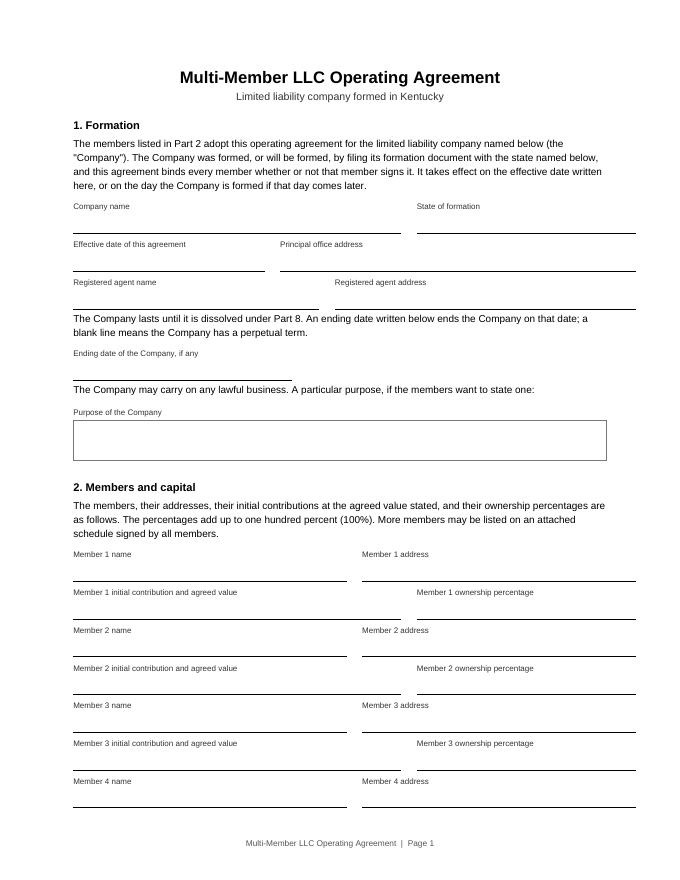
A company with no agreement, or with only an oral one, lives under the table: contributions set the votes and the shares, a resigning member becomes an assignee with no payout, and a merger or a sale of the whole business needs only a majority-in-interest (275.175(1), (3), 275.205, 275.280(4), (6), 275.350(1), 275.247(1)). Limited liability does not depend on it. Under 275.150(1) no member, manager, employee or agent is personally liable, by reason of that status, for a debt, obligation or liability of the company, and a single member or a single manager is no basis for setting the rule aside; a member or manager becomes personally liable for the company’s debts only by agreeing to it in a written operating agreement or another written agreement (275.150(2)), or where another section of the chapter specifically provides it, as 275.095 does for a person who acts for a company knowing it was never organized (275.150(1)), and a person’s own negligence or misconduct stays that person’s own (275.150(3)). A one-owner company uses the single-member operating agreement, which 275.015(21)(a) treats as an operating agreement because the sole member executed it; the LLC operating agreement section explains both documents, and the multi-member operating agreement is the eleven (11) part document this Kentucky version is built on.
Frequently asked questions
Does a Kentucky LLC need a written operating agreement?
No section of KRS Chapter 275 requires one, and 275.015(21) counts an oral agreement among all the members. The catch is that the defaults on voting weight, sharing, assignments, resignation and the duties of care and loyalty yield to a written operating agreement (and, for 275.175(3), to the articles of organization): 275.175(3), 275.205, 275.210, 275.255(1), 275.280(3), 275.170.
How is a manager appointed or removed?
By a majority-in-interest of the members unless the articles or the operating agreement provide otherwise (275.165(2)); Part 4 of the document uses more than fifty percent (50%) of the ownership percentages, with the manager’s own vote left out. Whether the company is manager-managed at all is a statement in the articles (275.025(1)(d)), and switching takes articles of amendment at $40 (275.030(1)(c), 275.055(2)).
Can a member be paid for working in the business?
Only if a written operating agreement says so: 275.165(4) gives a member or manager no right to remuneration for services except as set forth in a written agreement. Reasonable compensation for present or past services is not a distribution under 275.225(7), so a salary the agreement allows does not count against the distribution ceiling.
What does a member who leaves receive?
Nothing on account of the dissociation itself, unless a written operating agreement provides for a payment (275.280(6)); the former member holds the interest as an assignee and keeps receiving the distributions it carries (275.280(4), 275.255(1)(b)). Part 8 of the document leaves it there and gives the remaining members a one hundred eighty (180) day option to buy the interest at fair value.