

State Laws
Louisiana’s act is Chapter 22 of Title 12, the Limited Liability Company Law (R.S. 12:1369), in force for companies organized since July 7, 1992. Its definition of the document is short: an operating agreement is “any agreement, written or oral, of the members” on the affairs of the company and the conduct of its business, or, for a company with a single member, a written agreement between the member and the company (R.S. 12:1301(A)(16)). The chapter states its policy as giving “maximum effect to the principle of freedom of contract” (R.S. 12:1367(B)), and rules such as R.S. 12:1313, 12:1319(B) and 12:1330(A) open with “unless otherwise provided in the articles of organization or an operating agreement”.
The word “written” does the work. Allocation of profits and losses follows “a written operating agreement”, and only “to the extent the operating agreement does not so provide in writing” are they split equally (R.S. 12:1323); interim distributions follow the same rule (R.S. 12:1324(B)). Votes are one per member and decided by majority “unless otherwise provided in the articles of organization or a written operating agreement” (R.S. 12:1318(A)); the times and events for a member’s withdrawal, and what the member is paid, come from a written agreement or else from the statute (R.S. 12:1325(B), (C)); an assignee becomes a member only on the unanimous written consent of the others unless the articles or a written agreement say otherwise (R.S. 12:1332(A)); and the events of dissolution yield to the articles or a written agreement (R.S. 12:1334). Limits on a member’s or manager’s liability and any indemnification must likewise sit in the articles or a written operating agreement (R.S. 12:1315(A)).
Chapter 22 has no single list of terms an agreement may not vary, so the limits are read section by section. No provision may limit or eliminate liability for the amount of a financial benefit a member or manager was not entitled to, or for an intentional violation of a criminal law (R.S. 12:1315(B)). A promise to contribute is enforceable only if set out in a writing signed by the member (R.S. 12:1322(A)), and a creditor who extended credit after the member signed a writing reflecting the obligation may enforce the original obligation, to the extent the company refuses or is unable to honor the extension of credit, even after a later compromise (R.S. 12:1322(B), (C)). A payout that would leave the company unable to meet its debts as they fall due in the usual course of business is barred outright (R.S. 12:1327(A)(1)), and the liability of those who vote for or receive a wrongful distribution carries no “unless otherwise provided” (R.S. 12:1328). The records of R.S. 12:1319(A) must be kept at the registered office, and the liability of members and managers to outsiders is “determined solely and exclusively” by the chapter (R.S. 12:1320(A)).
The defaults the document replaces
| Rule | Louisiana default | Section |
|---|---|---|
| Management | By the members, except as the articles of organization provide, subject to a written operating agreement that restricts or enlarges any member’s management rights; managers exist only if the articles provide for them | R.S. 12:1311, 12:1312(A) |
| Weight of a vote | Each member casts a single vote on every matter properly brought before the members, and decisions take a majority vote, unless the articles or a written operating agreement provide otherwise | R.S. 12:1318(A) |
| Matters that take a majority vote whether or not there are managers | Dissolution and winding up; a sale, lease, mortgage or other transfer of all or substantially all of the assets; a merger or consolidation; debt outside the ordinary course; a sale, lease or encumbrance of immovable property; an amendment to the articles or the operating agreement, all unless the articles or a written operating agreement provide otherwise | R.S. 12:1318(B) |
| Choosing or removing a manager | Elected by plurality vote of the members and removable by a majority of the members, with or without cause, at a meeting called for that purpose, unless the articles or an operating agreement provide otherwise; a manager need not be a member | R.S. 12:1313, 12:1312(A) |
| Meetings and proxies | A member may vote in person or by a proxy authorized in writing, signed and filed at the registered office at or before the meeting; a proxy expires eleven (11) months after signing unless it says otherwise, and never lasts more than three (3) years | R.S. 12:1318(E) |
| Sharing of profits and losses | As a written operating agreement provides; otherwise equally among the members | R.S. 12:1323 |
| Sharing of distributions | At the times and in the amounts an operating agreement provides or the members authorize; shared as a written operating agreement provides, otherwise equally; unless a written operating agreement provides otherwise, no member may demand a distribution in any form other than cash | R.S. 12:1324, 12:1326 |
| Transfer of an interest | A membership interest is assignable in whole or in part unless the articles or an operating agreement provide otherwise; the assignee receives only the assigned share of distributions, profits and losses and tax items, and, unless the articles or a written operating agreement provide otherwise, becomes a member only on the unanimous written consent of the other members, the assignor staying a member until then | R.S. 12:1330(A), 12:1332(A) |
| Withdrawal | In a company not formed for a term, at the times or on the events a written operating agreement specifies, or, if it specifies none, on not less than thirty (30) days’ prior written notice to the company at its registered office and to each member and manager; in a company constituted for a term, a member may withdraw before the term ends without the other members’ consent if the member has just cause arising out of another member’s failure to perform an obligation (R.S. 12:1325(A)) | R.S. 12:1325(A), (B) |
| Payout on withdrawal | Except as the chapter otherwise provides, the distribution a written operating agreement provides; if it provides none, the fair market value of the member’s interest as of the date of withdrawal, paid within a reasonable time | R.S. 12:1325(C) |
| A member’s death | Membership ceases and the executor, administrator, guardian, conservator or other legal representative is treated as an assignee, unless the articles or a written operating agreement provide otherwise; in a company that had no assignees and only one member at the member’s death, the company continues and the interest passes to the heirs or legatees, and, unless the articles or a written operating agreement provide otherwise, the succession representative may exercise the member’s rights to settle the estate | R.S. 12:1333(A), 12:1333.1 |
| Dissolution | On the events specified in writing in the articles or the operating agreement; on the consent of the members under R.S. 12:1318 (a majority vote); or on a judicial decree where carrying on in conformity with the articles or the agreement is not reasonably practicable, all except as the articles or a written operating agreement provide; a company that is no longer doing business, owes no debts and owns no immovable property may also dissolve by affidavit filed with the secretary of state (12:1335.1) | R.S. 12:1334, 12:1335, 12:1335.1 |
| Order of payment on winding up | After paying or providing for all debts and liabilities, including known contingent liabilities: first, to members and former members for distributions owed under R.S. 12:1324 or 12:1325; then the return of capital contributions; then the rest in the proportions in which the members share distributions; each of those two steps applies except as the articles or a written operating agreement provide | R.S. 12:1337(A) |
| Ceiling on distributions | None after which the company could not pay its debts as they come due in the usual course, or its total assets would be less than its total liabilities plus, unless the articles or a written agreement provide otherwise, what dissolution would need to satisfy superior preferential rights; a member or manager who knowingly, or without the exercise of reasonable care and inquiry, votes for or assents to a wrongful distribution is liable to the company for the excess, and each member for what the member received, for two (2) years | R.S. 12:1327(A), 12:1328 |
| Records and inspection | Kept at the registered office: a current list of members and managers, records showing relative voting rights, the articles with amendments, three (3) years of federal and state returns, any written operating agreement and three (3) years of financial statements; a member may, at the member’s own expense, inspect and copy any record on reasonable request during ordinary business hours, and may demand on reasonable notice true and complete information on the state of the business and its financial condition, a copy of each year’s tax returns when available, other information as is just and reasonable, and a formal accounting whenever circumstances render it just and reasonable, unless the articles or an operating agreement provide otherwise (12:1319(B)) | R.S. 12:1319(A), (B) |
In the document each vote carries the member’s ownership percentage (Part 5), profits, losses and every distribution follow those same percentages (Part 3), and Part 4 puts the six (6) majority matters of R.S. 12:1318(B) under the written consent of every member: dissolution; a sale, lease, exchange, mortgage, pledge or other transfer of all or substantially all of the assets and the sale, lease or encumbrance of any immovable property; a merger or consolidation, with a conversion of the state of organization; debt outside the ordinary course; and an amendment of the articles or of the agreement, with admitting a new member added to the list. The ceiling row is the chapter’s own and stays, with Part 3 restating both of its tests.
Forming the company
File the articles of organization and the initial report through geauxBIZ or at 8585 Archives Avenue, Baton Rouge, with $125; keep the operating agreement at the registered office.
One or more persons capable of contracting form the company by filing articles of organization and an initial report with the secretary of state, who issues a certificate of organization; the company’s separate existence begins at the time of filing, or at the time of the acknowledgment or authentic act if the articles are filed within five (5) days, not counting legal holidays, after it (R.S. 12:1304(A) to (C)). The articles are signed by at least one (1) person, member or not, and are either acknowledged by a signer or executed as an authentic act (R.S. 12:1305(A)). They must give the company’s name, which carries “limited liability company”, “L.L.C.” or “L.C.” (a low-profit company uses “low-profit limited liability company” or “L3C”) (R.S. 12:1306(A)(1)), its purpose or a statement that it may engage in any lawful activity, and whether it is a low-profit company; they may say whether and how far managers run the business, state the latest date for dissolution, and name a person whose certificate outsiders may rely on (R.S. 12:1305(B), (C)). The initial report, signed by everyone who signed the articles, gives the registered office and each registered agent with the agent’s notarized affidavit of acceptance, and the first managers or members once chosen (R.S. 12:1305(E)). A name may be reserved for one hundred twenty (120) days (R.S. 12:1307(B)(2)).
R.S. 12:1364 sets the fees by reference to R.S. 49:222, so the amounts come from the Secretary of State’s Forms and Fee Schedule, read 2026-11-04: Articles of Organization, form 365, $125; Supplemental Initial Report, form 366, $30; Name Reservation, form 398, $25; Amended Articles, Mergers, Dissolutions or a Certificate of Correction, $125; Affidavit to Dissolve, form 368, $125; Annual Reports, $35. The Secretary of State’s filing page sends original filings, amendments and annual reports to the geauxBIZ portal (geauxbiz.sos.la.gov), which the Secretary of State, the Department of Revenue and the Workforce Commission are building as one place for business filings and tax registrations; walk-in filings at 8585 Archives Avenue may be expedited for $60 while the customer waits or $35 within 24 hours, on top of the filing fee, and a card payment adds a $5 convenience fee.
The annual report is due each year on or before the anniversary date of the company’s organization, filed by a manager, or by a member where the members manage, and signed in the company’s name by the manager, member or agent, and it states the registered office, each registered agent and each manager or member with a municipal address (R.S. 12:1308.1(A)). Nothing in R.S. 12:1308.1 or on the fee schedule adds a late fee, but a company that falls behind is “not in good standing” and barred from contracting with the state (R.S. 12:1308.2(E)), and after three (3) consecutive years without a report the secretary of state revokes the articles on thirty (30) days’ notice to the registered agent; reinstatement within three (3) years takes an application, the current report and the fee (R.S. 12:1308.2(A) to (C)). The Secretary of State’s FAQ adds that the report must be sent even when nothing has changed, and that a company holding a revocation notice has thirty (30) days to file it.
The operating agreement is not filed. R.S. 12:1304 asks the secretary of state for the articles and the initial report, and R.S. 12:1305(C)(1) and (C)(3) let the articles say merely that limits on the members’ or managers’ authority “are contained in a written operating agreement”, which outsiders are then deemed to know (R.S. 12:1317(B)). The agreement belongs with the records R.S. 12:1319(A) keeps at the registered office, which R.S. 12:1308(F) makes the company’s domicile for all purposes; Part 6 of the document names that office and adds the contribution record and six (6) years of tax returns.
Signing
Each member in Part 2 signs one block of Part 11; the manager signs the last block when Part 4 marks the company manager-managed.
Every member signs, because the chapter defines the operating agreement as the agreement “of the members” (R.S. 12:1301(A)(16)) and attaches several of its rules to a writing. The chapter’s acknowledgment and authentic-act requirements fall on papers filed with the secretary of state: the articles (R.S. 12:1305(A)), articles of amendment (R.S. 12:1309(B)), a certificate of correction (R.S. 12:1310(F)) and the articles of dissolution (R.S. 12:1339(B)), with a notarized affidavit for the registered agent (R.S. 12:1305(E)(3)). R.S. 12:1317.1 adds one requirement outside the filings: a representative of a company with five (5) or fewer members needs the consent of a majority interest of the members, evidenced by authentic act, to represent the company before a state agency, board or commission or at its hearing. No notary, acknowledgment or witness is named for the operating agreement in R.S. 12:1301, 12:1311, 12:1318, 12:1319 or 12:1323, nor in any other section of Chapter 22 as read in full on 2026-11-04; the word “witness” does not appear in the chapter. 15 U.S.C. 7001(a)(2) keeps a contract in interstate commerce enforceable even though an electronic signature or electronic record was used to form it.
Federal tax
Under Treasury Regulation § 301.7701-3(b)(1), a domestic eligible entity with two (2) or more members is a partnership and a single-owner entity is disregarded unless it elects otherwise, and R.S. 12:1368 has Louisiana tax a limited liability company for income and franchise tax “in the same manner that it is treated and taxed for federal income tax purposes”. A company that wants corporate treatment files Form 8832, and one that wants S corporation status files Form 2553; Part 6 of the document marks which applies. The company’s employer identification number comes from Form SS-4.
Without an agreement
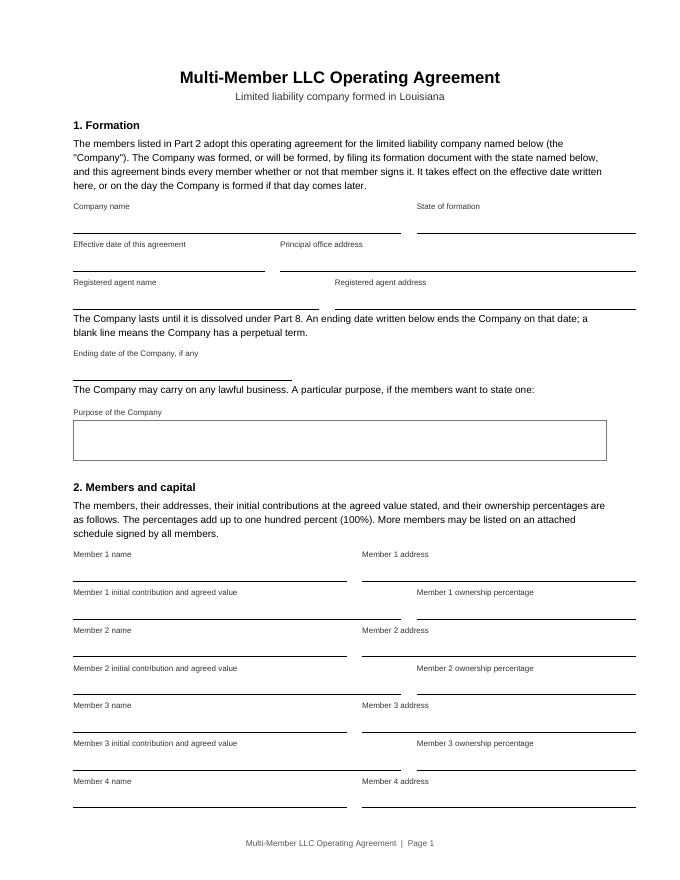
Members who sign nothing get the statute’s terms: equal shares of profits and of every distribution (R.S. 12:1323, 12:1324(B)), one vote apiece with a bare majority deciding even dissolution and a sale of the whole business (R.S. 12:1318(A), (B)), any member able to assign the interest (R.S. 12:1330(A)), and any member of a company not entered into for a term able to resign on thirty (30) days’ notice and collect the fair market value of the interest within a reasonable time (R.S. 12:1325(B), (C)). Limited liability does not depend on it: except as the chapter itself provides, no member, manager, employee or agent is liable in that capacity for a debt, obligation or liability of the company (R.S. 12:1320(B)). A company with one (1) owner, whose written agreement with the company is the operating agreement under R.S. 12:1301(A)(16), uses the single-member operating agreement in the LLC operating agreement section; the multi-member operating agreement walks through the eleven (11) parts this Louisiana version carries.
Frequently asked questions
Why does the document say a withdrawing member gets no payout?
Because R.S. 12:1325(C) would otherwise require one: a member who resigns is owed the fair market value of the interest within a reasonable time “if not otherwise provided in a written operating agreement”. Part 8 of the document provides otherwise, giving the remaining members a one hundred eighty (180) day option to buy the interest at fair value and nothing more.
Must the articles say the company is manager-managed?
Yes. R.S. 12:1311 reserves management to the members “except as otherwise provided in the articles of organization”, and R.S. 12:1312(A) is the provision that lets the articles hand the business to one or more managers. The manager-managed box in Part 4 of the document should match what the articles say, and a change takes an amendment to the articles under R.S. 12:1309.
Can a member be removed from the business?
Not by the other members alone. Chapter 22 names no expulsion power; a member leaves by withdrawal or resignation under R.S. 12:1325, by assigning the whole interest to an assignee the other members admit under R.S. 12:1332, or by death or an adjudication of incompetence under R.S. 12:1333(A). What the members can do is shape withdrawal in a written agreement, which R.S. 12:1325(B) lets them do by naming the times and events on which a member may leave.
How are the duties of a manager measured?
R.S. 12:1314(A) puts a manager, or a managing member, in a fiduciary relationship with the company and its members, with the diligence, care, judgment and skill of an ordinarily prudent person. Money damages, though, need gross negligence or worse, and the chapter defines gross negligence as reckless disregard or carelessness amounting to indifference to the company’s best interests (R.S. 12:1314(B), (C)); a written agreement may limit even that under R.S. 12:1315(A), short of R.S. 12:1315(B).