

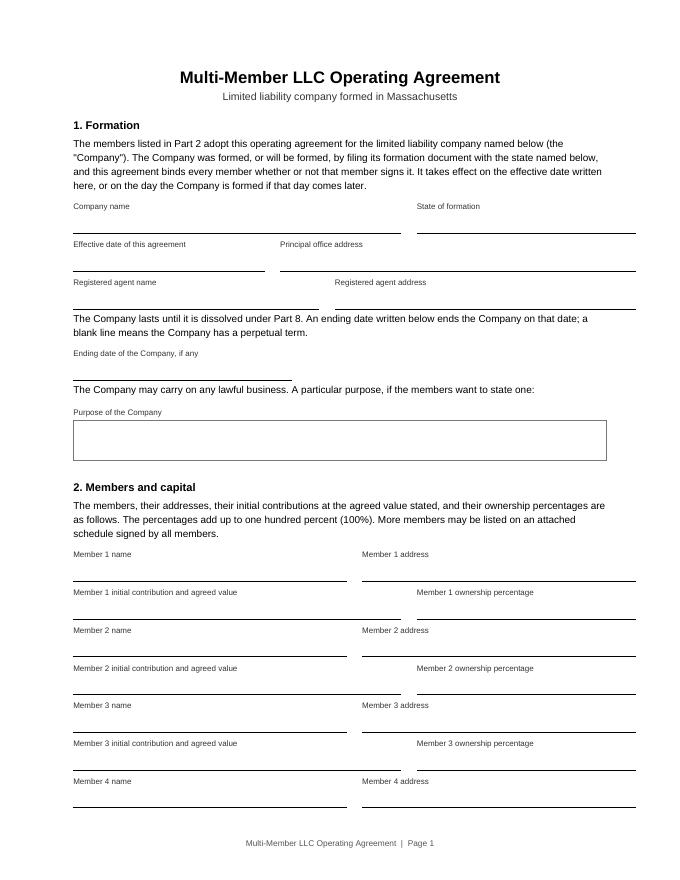
State Laws
Chapter 156C of the General Laws is the Massachusetts Limited Liability Company Act (§ 1). No section of chapter 156C (§§ 1 to 72, read 2026-11-02) requires the members to adopt an operating agreement. § 2(9) defines the term as “any written or oral agreement of the members as to the affairs of a limited liability company and the conduct of its business”, and that sentence is the whole definition. No section of chapter 156C (§§ 1 to 72, read 2026-11-02) lists in one place what an operating agreement may not do. Each default rule instead carries its own opening, most often “unless otherwise provided in the operating agreement” (§ 24(a) on management, § 42 on a member’s death) or “in the manner provided in the operating agreement” (§ 30 on distributions), and § 63(b) lets the agreement expand or restrict the duties and liabilities of members and managers.
Some defaults bend only to a written agreement, which is the strongest reason to use one. A person who takes an interest from the company after formation is admitted at the time a written operating agreement provides or, if the written operating agreement does not so provide, on the consent of all members (§ 20(b)(1)); a member’s promise to contribute is enforced as made “except as provided in a written operating agreement” (§ 28(a)); and any standards for indemnification, and any elimination or limit on personal liability for breach of duty, are set in the certificate of organization or a written operating agreement (§ 8(a), (b)). A few rules carry no opening clause. § 36 lets a member resign on not less than six (6) months’ written notice “regardless of whether an operating agreement provides that a member does not have the right to resign”, § 9 says what records the company “shall keep” (§ 9(a)(5) excepts what a written operating agreement already contains), and § 46(a)(1) puts creditors first on winding up, to the extent otherwise permitted by law.
The defaults the document replaces
| Rule | Massachusetts default | Section |
|---|---|---|
| Management | Vested in the members unless the agreement provides otherwise; where the company has at least one manager, then unless the agreement provides otherwise the manager manages and controls it and no member does | § 24(a), (b) |
| Weight of a vote | Where the agreement does not provide for voting rights, the decision of members who own more than fifty percent (50%) of the unreturned contributions controls; managers decide by a majority in number | § 21(d), § 26(d) |
| Ordinary decisions | Unless the agreement provides otherwise, with no manager each member may execute documents and act for the company; with a manager, each manager may and no member may | § 24(c) |
| Admitting a member | A person taking an interest from the company after formation: at the time provided in a written operating agreement or, if it does not so provide, on the consent of all members; an assignee as § 41 provides | § 20(b) |
| Amending the agreement | No section of chapter 156C (§§ 1 to 72, read 2026-11-02) sets a vote for amending the operating agreement, other than through a merger agreement approved under § 60, which may amend the surviving company’s operating agreement (§ 61(d)); § 21(a) lets the agreement provide for an amendment without the vote of any member or class, and § 21(d) makes the decision of members who own more than fifty percent (50%) of the unreturned contributions controlling where the agreement does not provide for the voting rights of members | § 21(a), (d) |
| Selling substantially all assets, merging | No section of chapter 156C (§§ 1 to 72, read 2026-11-02) names a vote for a sale of assets; a consolidation or merger needs members owning more than fifty percent (50%) of the unreturned contributions, unless a written operating agreement provides otherwise | § 60(a) |
| Sharing of distributions | In the manner the agreement provides; if it does not, by the agreed value, as stated in the company’s records, of each member’s contributions received and not returned; paid, except as §§ 32 and 46 provide, when the agreement specifies or, if it does not, as the members or managers determine | § 30, § 31 |
| Transfer of an interest | Assignable in whole or in part except as the agreement provides; the assignee may not take part in management except on the approval of all the other members or under a written-agreement procedure, and, unless the agreement provides otherwise, receives the profits, losses, distributions and allocations assigned, and a member who assigns the whole interest ceases to be a member | § 39(a), (b) |
| Withdrawal (resignation) | At the times and on the events the agreement specifies; the agreement may deny the right, yet a member may still resign on not less than six (6) months’ prior written notice to the company’s Massachusetts office and to each other member and manager, and a resignation that violates the agreement lets the company recover damages and offset them against distributions | § 36 |
| A member’s death | Unless the agreement provides otherwise, the executor, administrator, guardian, conservator or other legal representative may exercise all of the member’s rights to settle the estate or administer the property, including any power under the agreement of an assignee to become a member | § 42 |
| Vote to dissolve | The time or event the agreement specifies, the written consent of all members, or a decree of judicial dissolution; for a company formed before January 1, 1997, and except as provided in a written operating agreement, the death, insanity, retirement, resignation, expulsion, bankruptcy or dissolution of a member, or any other event that terminates a membership, also dissolves it unless all the remaining members consent to continue within ninety (90) days or a written operating agreement states a right to continue | § 43(1) to (5), § 44 |
| Order of payment on winding up | Creditors first, members and managers who are creditors included, to the extent otherwise permitted by law, other than liabilities for distributions to members under § 31 or § 32; then, unless the agreement provides otherwise, members and former members owed distributions under § 31 or § 32; then, unless the agreement provides otherwise, members first for the return of contributions and second in the proportions in which they share distributions | § 46(a) |
| Ceiling on distributions | §§ 30 to 35 state no balance-sheet or insolvency test; a member or manager who votes for or assents to a distribution that violates the operating agreement is personally liable to the company for the excess, and a proceeding is barred unless commenced within two (2) years after the distribution | § 35(a), (c) |
Part 5 of the document weighs votes by ownership percentage, a “financial interest” basis § 21(b) permits, and Part 3 pays distributions by the same percentages instead of by the agreed value of contributions. The ceiling in Part 3 is the document’s own rule, since no section of chapter 156C (§§ 1 to 72, read 2026-11-02) supplies one, and § 35 gives it force: whoever assents to a distribution the agreement forbids owes the company the amount over the line, with contribution from any member who took the money knowing it broke the agreement (§ 35(b)).
Forming the company
File the certificate of organization with the Secretary of the Commonwealth; keep the operating agreement at the Massachusetts office named in it.
One or more authorized persons execute a certificate of organization and file it in the office of the state secretary (§ 12(a)). § 12(a) lists nine (9) items, among them the company’s name, its office address in the commonwealth, the resident agent’s name, address and written consent, any fixed dissolution date, the name and address of each manager at formation, at least one other authorized signer if there are no managers, and the general character of the business. The company is formed at filing, or on a later date the certificate names, if there has been substantial compliance with the section (§ 12(b)). The fee is $500 (§ 12(d), read 2026-11-02), and whoever signs affirms the facts under the penalties of perjury (§ 15(c)).
Every company formed under the chapter also files an annual report with the state secretary carrying the same § 12(a) information, for a fee of $500 (§ 12(c), (d)). A company that has failed for two (2) consecutive years to file its annual reports may be administratively dissolved by the state secretary if, within ninety (90) days after written notice sent to its Massachusetts office, it does not correct the failure (§ 70(a)(1), (b)), and the certificate must be amended when managers are first designated or when the managers or authorized signatories change (§ 13(c)).
No section of chapter 156C (§§ 1 to 72, read 2026-11-02) calls for filing the operating agreement. § 5(1) requires an office in the commonwealth where the records in § 9 are kept, and § 9(a) names them: a current list of members and managers with addresses; the certificate and amendments; three (3) years of income tax returns and of financial statements; “copies of any then effective written operating agreements”; and, unless a written operating agreement covers them, a writing on contributions and agreed values, further contribution dates, distribution rights and dissolution events. Any member or manager may inspect and copy those records at reasonable request and at that person’s own expense during ordinary business hours (§ 9(b)). Part 6 of the document keeps the agreement, the certificate, the contribution record and six (6) years of returns at the company’s office in Massachusetts.
Signing
All four member blocks in Part 11 are signed; the manager signs the fifth when Part 4 is marked manager-managed.
Every member in Part 2 signs; § 2(9) calls the document the agreement “of the members”. Unless the operating agreement provides otherwise, § 15(b) lets any person enter into the operating agreement, or an amendment, through an agent, an attorney-in-fact included, and the authorization “need not be in writing, need not be sworn to, verified or acknowledged, and need not be filed in the office of the state secretary”, although a written one must be retained by the company. If a person required to execute the agreement refuses, anyone adversely affected may petition the superior court for an order (§ 16(b)). Neither § 2, § 9, § 15 nor § 16 mentions a notary or a witness. Electronic signing rests on 15 U.S.C. 7001(a)(2), under which a contract tied to a transaction in or affecting interstate or foreign commerce cannot lose its legal effect, validity or enforceability merely because an electronic signature or electronic record was used to form it.
Federal tax
Treasury Regulation § 301.7701-3(b)(1)(i) treats a domestic eligible entity with two (2) or more members as a partnership for federal income tax unless the entity elects otherwise. Part 6 of the document carries that default in its first check box; the second box is marked once the company has filed Form 8832 to be classified as a corporation, or Form 2553 to be taxed as an S corporation under section 1362(a). The partnership’s information return is Form 1065, and Form SS-4 is the application for an employer identification number.
Without an agreement
The chapter’s own defaults take over, section by section: members vote by unreturned contributions (§ 21(d)), profits, losses and distributions follow the agreed value of contributions (§§ 29, 30), a member may resign on six (6) months’ notice and claim the fair value of the interest (§§ 32, 36), and a new member needs the consent of all (§ 20(b)(1)). Limited liability does not hinge on any of it: except as the chapter provides, the debts of the company are solely the company’s, and no member or manager is personally liable for them, by indemnification, contribution, assessment or otherwise, solely by reason of being a member or acting as a manager (§ 22). The LLC operating agreement exists in a one-owner form as well, and the multi-member operating agreement is explained Part by Part.
Frequently asked questions
Does an oral operating agreement count in Massachusetts?
Yes. § 2(9) accepts “any written or oral agreement of the members”. However, an oral agreement cannot set the admission procedure of § 20(b)(1), the resignation payout of § 32, the cash-only rule of § 33 or the indemnification standards of § 8(a), each of which the chapter ties to a written operating agreement (§ 8(a) also accepts the certificate of organization).
Can the members stop a member from resigning?
Not completely. § 36 lets the agreement provide that a member has no right to resign, and then overrides it: on not less than six (6) months’ prior written notice to the company’s Massachusetts office and to each other member and manager, a member may resign anyway, and a resignation that violates the agreement lets the company recover damages and offset them against distributions. Part 8 of the document sets a shorter path, ninety (90) days’ notice, which § 36 allows since resignation is permitted “at the time or upon the happening of events specified in the operating agreement”.
What does a member’s estate get?
Unless the agreement provides otherwise, § 42 lets the executor, administrator, guardian, conservator or other legal representative exercise all of the member’s rights to settle the estate or administer the property, including any power the agreement gives an assignee to become a member. Part 8 of the Massachusetts document keeps that power for the legal representative while the remaining members decide whether to admit the holder or buy the interest at fair value.