

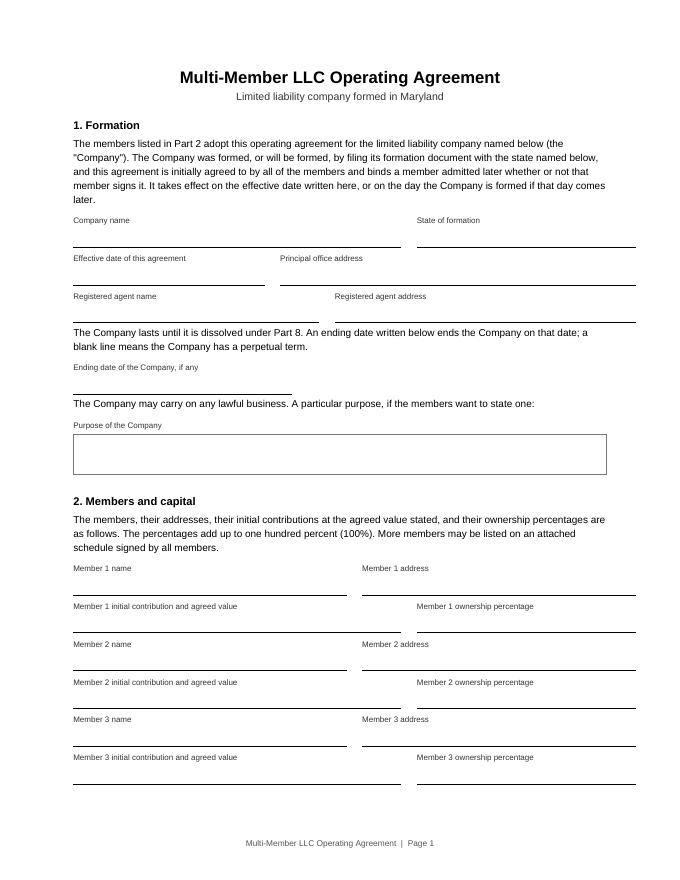
State Laws
Maryland’s limited liability company law is Title 4A of the Corporations and Associations Article. 4A-402(a) lets the members “enter into an operating agreement not inconsistent with the articles of organization to regulate or establish any aspect of the affairs of the limited liability company, the conduct of its business, or the relations of its members”, and lists nine (9) subjects it may cover, from management and the sharing of assets and earnings to assignment, admission, amendment and voting procedure. The initial operating agreement “shall be agreed to by all persons who are then members”, and unless the articles of organization specifically require otherwise it need not be in writing (4A-402(b)). A duly adopted agreement or amendment binds each person who is or becomes a member or an assignee whether or not that person has signed it (4A-402(d)(5)).
Unless the title provides otherwise, its policy “is to give the maximum effect to the principles of freedom of contract and to the enforceability of operating agreements” (4A-102(a)). Most of its defaults apply “unless otherwise agreed”, meaning unless the articles, the operating agreement or a unanimous consent say otherwise (4A-101(x)). Two formal rules survive any agreement: a unanimous consent the title requires must be in writing (4A-404), and an amendment adopted without unanimous consent, or after an economic interest has been assigned to a non-member, must be evidenced by a writing signed by an authorized person (4A-402(c)(3)(ii)).
The defaults the document replaces
| Rule | Maryland default | Section |
|---|---|---|
| Management | Except as the operating agreement provides, each member is an agent of the company and binds it by acts for apparently carrying on its business in the usual way, unless the articles of organization state that the authority of members to act solely by virtue of being members is limited; the operating agreement may grant exclusive authority to manage to persons who are not members | 4A-401(a), 4A-402(a)(1) |
| Weight of a vote | Members vote in proportion to their respective interests in the profits of the company as determined under 4A-503 | 4A-403(b)(1) |
| Ordinary decisions | Decisions concerning the affairs of the company require the consent of members holding at least a majority of the interests in profits | 4A-403(b)(2) |
| Acts needing two-thirds (2/3) | Disposing of all or substantially all of the business or property, approving a merger under 4A-702, or approving a conversion under 4A-1102 | 4A-403(d)(1) |
| Acts needing all members | A voluntary bankruptcy proceeding, an assignment for the benefit of creditors, altering the allocation of profit or loss, altering the allocation or computation of distributions, and any other act that would make it impossible to carry on the ordinary business | 4A-403(d)(2) |
| Amending the agreement | All of the members must agree, if the agreement does not provide its own method | 4A-402(c)(1) |
| Admitting a member | A person acquiring an interest from the company is admitted on compliance with the operating agreement or, if it does not so provide, on the unanimous consent of the members; an assignee only as 4A-604 provides, namely under the agreement’s admission terms or by unanimous consent | 4A-601(b), 4A-604(a) |
| Sharing of profits, losses and distributions | Profits and losses are allocated in proportion to the members’ capital contribution values; distributions go to the members in proportion to their right to share in profits; no member may demand a distribution in a form other than cash | 4A-503, 4A-504 |
| Transfer of an interest | Only an economic interest may be assigned, wholly or partly; the assignment does not dissolve the company or entitle the assignee to become a member or to exercise any right of a member; a member who assigns all of the economic interest ceases to be a member and forfeits the noneconomic interest | 4A-603(a), (b), (d) |
| Withdrawal | A member may withdraw before dissolution by giving the other members not less than six (6) months’ prior written notice; the agreement may forbid or limit withdrawal | 4A-605 |
| Payout on leaving | Within a reasonable time after a person ceases to be a member, the company may elect to pay that person or the successor in interest the fair value of the economic interest as of that date; if it does not, the person is an assignee of the unredeemed economic interest | 4A-606.1 |
| A member’s death | An individual ceases to be a member on death or on adjudication as incompetent; if the deceased was the last remaining member, the personal representative or guardian is automatically admitted as a new member unless, within ninety (90) days after learning of the death, the representative renounces in writing or designates a person who accepts | 4A-606(5), 4A-902(b)(2) |
| Vote to dissolve | The events specified in the articles or the agreement, the time specified by the unanimous consent of the members, a decree of judicial dissolution, or ninety (90) consecutive days with no members; the termination of a person’s membership does not by itself dissolve the company | 4A-902(a), (d) |
| Order of payment on winding up | To creditors, including members who are creditors, to the extent permitted by law; then to the members in proportion to their capital contribution values, adjusted by adding their shares of profits and deducting their shares of losses and all distributions previously received | 4A-906 |
| Ceiling on distributions | No section of Title 4A read on 2026-11-03 forbids a distribution on the ground of insolvency; a member who becomes entitled to a distribution has the status of, and the remedies of, a creditor of the company as to that distribution | 4A-505 |
Part 5 of the document counts votes by ownership percentage in place of profit shares, Part 3 allocates profits, losses and distributions by the same percentages, Part 8 shortens the six (6) months’ withdrawal notice to ninety (90) days, and Part 4 raises the two-thirds (2/3) threshold for a sale of substantially all assets or a merger to the written consent of every member. The ceiling in Part 3 is the document’s own term: a distribution is not made if the company could not then pay its debts as they come due or its liabilities would exceed the fair value of its assets.
Forming the company
File the articles of organization with the State Department of Assessments and Taxation (SDAT), online through Maryland Business Express or by mail; keep the operating agreement with the company’s records.
Any person may form the company by causing articles of organization to be executed and filed for record with the Department, and the company is formed when the Department accepts them or at a later time the articles specify (4A-202). The articles set forth the company’s name, the address of its principal office in Maryland and the name and address of its resident agent, and may add a statement that the members’ authority to act solely by virtue of being members is limited (4A-204(a)); any individual the founders authorize may execute them (4A-206(a)(1)). The processing fee is $100 under 1-203(b)(4)(i), and the Department’s SDAT charter document fee schedule, revised May 2024 and read 2026-11-03, lists $100 for domestic articles of organization and $50 more for expedited review.
Every business entity formed in Maryland files Form 1, the Business Entity Annual Report, each year; the Department’s annual report and forms page, read 2026-11-03, puts the 2026 reports on or before April 15, with a sixty (60) day extension to June 15 on an online request, and adds a personal property tax return for an entity with personal property in Maryland. The fee for a limited liability company’s annual report is $300 (1-203(b)(3)(ii)), waived for a year in which the entity shows that it complies with Title 12 of the Labor and Employment Article or otherwise provides an employer-offered savings arrangement that complies with federal law (1-203(b)(13)). After September 30 each year the Department certifies every Maryland limited liability company that has not filed the prior year’s report and proclaims its right to do business and to its name forfeited (4A-911(c), (d)); filing within sixty (60) days after the proclamation reinstates the company as of the forfeiture date (4A-912(b)), and later it needs articles of reinstatement (4A-915, 4A-917). Knowingly transacting business for a forfeited company is a misdemeanor with a fine of up to $500 (4A-919(a)).
No section of Title 4A read on 2026-11-03 calls for filing the operating agreement, and none lists records the company must keep; the act works through access instead. On written demand stating a purpose reasonably related to the membership interest, a member may inspect and copy information on the business and its finances, the articles and the operating agreement with amendments, and the members’ names and addresses (4A-406(a), (e)); any member may inspect the tax returns (4A-406(b)), and the agreement may set reasonable standards on access (4A-406(c)). Part 6 of the document keeps the agreement, the articles and the contribution record at the principal office with six (6) years of tax returns.
Signing
Each member named in Part 2 signs one of the four member blocks in Part 11; the manager signs the fifth block when Part 4 marks the company manager-managed.
The document has every member sign. The act requires the initial operating agreement to be agreed to by all persons who are then members (4A-402(b)(1)), does not require it to be written, and binds each member or assignee whether or not that person signed it (4A-402(d)(5)); the company itself need not execute it (4A-402(d)(4)). Neither a notary nor a witness is named in 4A-402; the title’s only acknowledgment rules concern filed documents, and even there a power of attorney for signing articles “need not be sworn to, verified, or acknowledged” (4A-206(b)(2), (c)). For a signature made on a screen, 15 U.S.C. 7001(a)(2) applies: a contract tied to interstate or foreign commerce keeps its legal effect, validity and enforceability even though it was formed with an electronic signature or record.
Federal tax
The IRS does not ask a Maryland company with two (2) or more members to choose: Treasury Regulation § 301.7701-3(b)(1)(i) puts it in the partnership column, and only an election moves it. Part 6 of the document carries one box for that default and one for an election, made on Form 8832 to be taxed as a corporation or on Form 2553 to be an S corporation under section 1362(a). The partnership’s own return is Form 1065; the employer identification number comes from Form SS-4.
Without an agreement
A company whose members agreed to nothing runs on the table above: profit shares decide votes and distributions, withdrawal takes six (6) months’ notice, and a sale of the business takes two-thirds (2/3). The members keep their shield either way: except as the title otherwise provides, no member is personally liable for the obligations of the company “solely by reason of being a member” (4A-301). A company with a single owner uses the single-member operating agreement in the LLC operating agreement section; the multi-member operating agreement explains the eleven (11) parts this Maryland version carries.
Frequently asked questions
Does a Maryland operating agreement have to be in writing?
No, unless the articles of organization specifically require it (4A-402(b)(2)). However, an amendment adopted by fewer than all the members, or made after an economic interest has gone to a non-member, must be evidenced by a signed writing (4A-402(c)(3)(ii)), and every unanimous consent the title calls for must be written (4A-404(1)).
How much notice must a member give to leave?
Unless otherwise agreed, not less than six (6) months’ prior written notice to the other members at their addresses on the company’s books (4A-605(a)); the agreement may forbid withdrawal or limit it (4A-605(b)). The document is stricter on timing and looser on the exit: Part 8 cuts the notice to ninety (90) days and leaves the remaining members a one hundred eighty (180) day window to buy at fair value, failing which the former member stays a transferee.
Does Maryland have managers?
No section of Title 4A uses the word “manager”; the agreement may grant exclusive authority to manage the company to persons who are not members (4A-402(a)(1)), and the articles may state that members have no authority to act solely by virtue of being members, after which anyone dealing with a member is presumed to know it (4A-401(a)(3)). A company that marks manager-managed in Part 4 may add that statement to its articles under 4A-204(a)(3).