

State Laws
Maine’s act is chapter 21 of Title 31, the “Maine Limited Liability Company Act” (§ 1501), in force since July 1, 2011 for every company then in existence, except as § 1693(2) and (3) provide (§ 1693(1)). Its policy is “to give maximum effect to the principles of freedom of contract and to the enforceability of limited liability company agreements” (§ 1507(1)). Except as § 1521(3) and § 1522 provide, the agreement governs relations among the members and between the members and the company (§ 1521(1)); to the extent it does not provide for such a matter, the chapter governs it (§ 1521(2)).
The limits are in § 1522(1), eight (8) items: the agreement may not vary the company’s separate existence, its capacity to sue or the governing law of § 1506; restrict the rights under the chapter of a person other than a member or transferee, except as § 1524(2) allows; vary the court’s power under § 1677; eliminate or limit a member’s liability for money damages for a bad faith violation of the implied covenant of good faith and fair dealing, which § 1522(2) reads into every agreement; waive the § 1553(1) rule that a contribution obligation be in writing; or vary the requirement to wind up under § 1597.
The defaults the document replaces
These defaults apply to the extent the agreement does not provide otherwise (§ 1521(2)); a part that cites § 1522(1) cannot be varied.
| Rule | Maine default | Section |
|---|---|---|
| Management | Unless the agreement provides otherwise (§ 1521(2)): the activities and affairs are under the direction, and subject to the oversight, of the members; the chapter sets out no separate manager-managed form; as to others, a person may bind the company only as § 1541 allows: to the extent the agreement authorizes it, the members authorize it under § 1556, or a filed statement of authority provides (§ 1542), and, with no statement of authority in effect, any manager, member, president or treasurer has the authority to bind it, or as other law provides | § 1556(1), § 1541(1) to (5) |
| Weight of a vote and ordinary decisions | Unless the agreement provides otherwise (§ 1502(17)): a matter in the ordinary course of activities may be decided by a majority of the members, meaning members who own more than fifty percent (50%) of the interests in profits, by class or group where there are classes; after dissolution, ordinary winding-up matters take the same majority | § 1556(2), (5), § 1502(17) |
| Matters that take every member | A merger or conversion takes the consent of all members (§ 1642(1), § 1646(1), § 1556(3)(A)); unless the agreement provides otherwise (§ 1521(2)): an amendment of the agreement; any other act outside the ordinary course; and any other matter the chapter reserves to all members, among them admitting a member after formation, where the agreement gives no other way, unless the admission follows a merger or conversion or comes within ninety (90) consecutive days after the company has no members through the holders of the last transferred interest (§ 1551(2)(A) to (D)); a member who would carry personal liability in the surviving or converted organization must consent in writing to a merger or conversion, and agreeing to an amendment clause with fewer than all members is not that consent (§ 1649) | § 1556(3), § 1642(1), § 1646(1), § 1551(2)(A), (C), § 1649 |
| Meetings and proxies | Unless the agreement provides otherwise (§ 1521(2)): any matter needing the members’ consent may be decided without a meeting, and a member may appoint a proxy or other agent by signing an appointing record, personally or through an agent; the chapter entitles no member to pay for services | § 1556(4), (6) |
| Contributions | A promise to contribute is not enforceable unless set forth in a writing signed by the member, a rule the agreement may not waive (§ 1522(1)(G)); unless the agreement provides otherwise (§ 1521(2)): a contribution may be cash, property, services rendered or a note; death or disability or other inability to perform personally does not excuse it, and if a member does not make a contribution required by an enforceable promise, the member or the member’s estate is obligated, at the company’s option, to contribute money equal to the value of the unmade portion; a compromise takes the consent of all members; notwithstanding it, a creditor who extended credit after an agreement or amendment reflecting the obligation, and before the amendment reflecting the compromise, may still enforce the original obligation to the extent the creditor reasonably relied on it, a right of a person other than a member or transferee that the agreement may not restrict (§ 1553(3), § 1522(1)(D)) | § 1552, § 1553(1) to (3), § 1522(1)(G) |
| Sharing of distributions | Unless the agreement provides otherwise (§ 1521(2)): distributions before dissolution are made on the basis of the agreed value, as stated in any written records of the company, of each person’s contributions received and not returned; a person has a right to one only if the company decides to make an interim distribution, and a member’s dissociation does not entitle the member to a distribution; no one may demand a distribution in any form other than money, though, except as § 1601(3) provides, the company may distribute an asset in kind if each person receives a percentage equal in value to that person’s share; a member or transferee entitled to a distribution has a creditor’s status and remedies for it | § 1554(1) to (4) |
| Ceiling on distributions | A company may not make a distribution to the extent that, after it, its liabilities (other than liabilities to members on account of their interests and liabilities whose recourse is limited to specific property) exceed the fair value of its assets, counting property that secures a liability of limited recourse only to the extent its fair value exceeds that liability; a recipient who knew the distribution broke that rule is liable to the company for the amount, one who did not know is not, and an action under the section is barred if not commenced within two (2) years after the distribution, and, subject to the exclusions below, that rule does not affect any obligation or liability under an agreement or other law for the amount of a distribution; reasonable compensation for present or past services and reasonable payments in the ordinary course of business under a bona fide retirement plan or other benefits program are not distributions; the section does not reach winding-up distributions under § 1601 | § 1555(1) to (5) |
| Transfer of an interest | Unless the agreement provides otherwise (§ 1521(2)): only the transferable interest is transferable, and it is personal property; a transfer is permissible, does not by itself dissociate the member or dissolve the company, and, subject to § 1574, gives the transferee no part in management and no access to records; the transferee receives the distributions the transferor would have received; the company need not give effect to the transfer until it has written notice; except as § 1582(4)(B) and (11) provide, the transferor keeps every other right and all duties of a member | § 1571, § 1572(1), (2), (4), (5) |
| Dissociation and what the member gets | Unless the agreement provides otherwise (§ 1521(2)): a person has the power to dissociate, and does so when the company has notice of the person’s express will, or on a later date the notice names; the dissociation is wrongful only if it breaches an express provision of the agreement or occurs before the company’s termination and the person dissociates by express will, is expelled by judicial determination, becomes a debtor in bankruptcy or makes a general assignment for the benefit of creditors, or, for a member that is not an individual, a trust other than a business trust or an estate, is dissociated for willfully dissolving or terminating, and a wrongful dissociation makes the person liable for damages (§ 1581(2), (3)); afterward the person has no right to take part in the activities, is entitled only to the distributions the person would have received as a member, and, if the company is not dissolved due to that dissociation, has no right on account of it to any payment for the interest | § 1581(1) to (3), § 1582(1), § 1583(1), (3) |
| A member’s death | Unless the agreement provides otherwise (§ 1521(2)): an individual member is dissociated on death, on the appointment of a guardian or general conservator, or on a judicial finding of incapacity (§ 1582(6)); the deceased member’s personal representative or other legal representative may, for purposes of settling the estate, exercise the rights of a current member under § 1558 (§ 1574), and a transferee’s lack of access to records is subject to it (§ 1572(1)(C)) | § 1582(6), § 1574, § 1572(1)(C) |
| Dissolution events | Unless the agreement provides otherwise (§ 1521(2)): an event or circumstance the agreement states; the consent of all the members; ninety (90) consecutive days with no members; a Superior Court order on a member’s application because carrying on in conformity with the agreement is not reasonably practicable, or because the members in control act illegally or fraudulently (where the court may order another remedy); or a Superior Court order on a transferable-interest holder’s application because the company has no members; a dissolution under the first three (3) events may be revoked before the certificate of cancellation by the vote the agreement names or, if it names none, the vote sufficient for dissolution, if no one entitled to vote has objected | § 1595(1), (2), § 1602(1) |
| Winding up order | The remaining members, or if none a person appointed by all holders of the interest last transferred by the last person to have been a member, may wind up, a right the agreement may not vary (§ 1522(1)(H)); the assets first pay, or adequately provide for, creditors, “including, to the extent permitted by law, members who are creditors” (§ 1601(1)); unless the agreement provides otherwise (§ 1521(2)), the surplus then returns the value of each unreturned contribution, pro rata if the surplus is short, and goes next to the owners of transferable interests in the proportions in which they shared distributions before dissolution (§ 1601(2), (3)) | § 1597(1), § 1522(1)(H), § 1601 |
| Records and inspection | Unless the agreement provides otherwise (§ 1521(2)): the chapter lists no required records and names no office for them; on ten (10) days’ notice in a record a member may inspect and copy, during regular business hours at a reasonable location the company specifies, any record the company maintains, to the extent the information is material to the member’s rights and duties under the agreement or the chapter; a dissociated member may, on thirty (30) days’ notice and in good faith, inspect the records for the period of membership that were then material to the person’s rights and duties; the company may charge reasonable copying costs, may add reasonable restrictions on top of any in the agreement, and may keep trade secrets confidential; a transferee has no rights under the section | § 1558(1) to (3), (5), (6) |
| Duties and personal liability | Except as the agreement sets forth under §§ 1521 and 1522: persons discharge their duties in good faith, with the diligence, care and skill of ordinarily prudent persons in like positions; no member or other person is personally liable for money damages for failing a duty unless found not to have acted honestly or in the reasonable belief that the action was in or not opposed to the best interests of the company or its members; a member not involved in management owes no fiduciary duty solely by being a member, and voting on managers or approving a sale, merger, dissolution, amendment, admission, borrowing or distribution is not involvement | § 1559(1) to (3) |
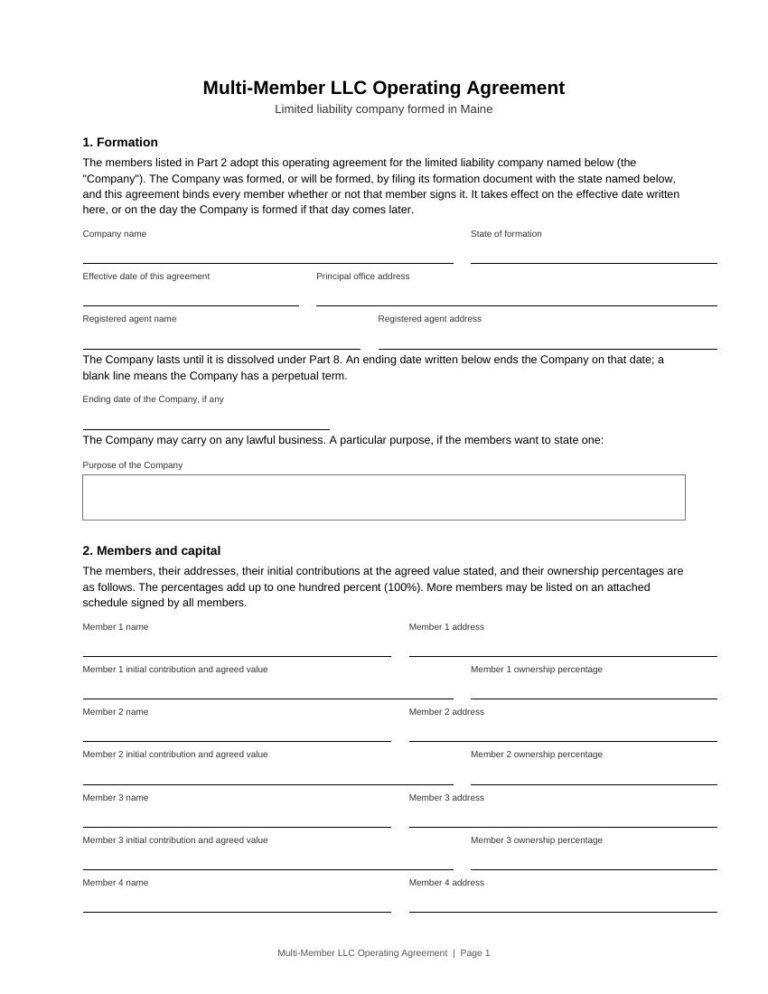
Part 5 of the document weighs each vote by ownership percentage where § 1502(17) counts profit interests, Part 3 shares profits, losses and every distribution by those percentages where § 1554(1) looks to the agreed value of contributions, and Part 4 lists the acts that take every member’s written consent, the merger, conversion and amendment of § 1556(3)(A) and (B) among them.
Forming the company
Mail form MLLC-6 with $175 to the Division of Corporations, UCC and Commissions in Augusta; keep the operating agreement with the company’s own records, since no section of chapter 21 requires it to be filed.
One or more authorized persons execute a certificate of formation and file it with the Secretary of State (§ 1531(1)(A)). It states the company’s name, which under § 1508(1) must, except in an assumed name filing under § 1510 or a foreign name registration under § 1511, contain “limited liability company”, “limited company”, L.L.C., LLC, L.C. or LC (L3C for a low-profit company), and the registered agent information of Title 5 § 105(1): a commercial registered agent’s name, or a noncommercial agent’s name and address, or an office or position and its business address. At least one (1) authorized person signs it (§ 1676(1)(A)), and the company is formed at the filing, or at a later date or time the certificate names, if there has been substantial compliance with § 1531 (§ 1531(2)).
§ 1680 sets the fees and makes no filing effective until its fee is paid: the certificate of formation $175, a name reservation $20, an amended certificate $50 and a certificate of cancellation $75. The Secretary of State’s Limited Liability Company Forms page, read 2026-11-05, prices form MLLC-6, the Certificate of Formation, at $175.00 and says the fillable forms are printed and mailed with the fee; filings were taking two (2) to seven (7) business days.
The annual report gives the name, the registered agent information, the principal office address, a brief statement of the business in Maine, and the name and address of at least one (1) member, manager or other authorized person (§ 1665(1)). The first is delivered between January 1 and June 1 of the year following the calendar year of formation, later ones in the same window each year (§ 1665(3)), with an $85 fee (§ 1680(6)). The Secretary of State’s Filing Requirement Reminders page gives the example of a company formed in 2025 reporting by June 1, 2026, takes the report through Annual Reports Online, and warns that the office mails no reminders. A report that misses June 1 adds the $50 late filing penalty (§ 1667(1), § 1680(10)) unless excused for excusable neglect under § 1667(3); a company that neither files nor pays is administratively dissolved under the § 1592 procedure (§ 1667(1)): the Secretary of State serves written notice, service is perfected five (5) days after mailing (§ 1592(8)), and the company is dissolved if the ground is still uncorrected sixty (60) days after the notice is issued and perfected (§ 1592(2)), and reinstatement within six (6) years costs $150, capped at $600 however many reports are missing (§ 1593(1), § 1680(17)).
No section of chapter 21 requires the operating agreement to be filed: the certificate of formation sets forth the name, the agent information and any other matters the members determine to include (§ 1531(1)(A)), a filed document must contain what Maine law requires and, unless otherwise provided by law, may not contain other information (§ 1673(1)), and the agreement may be entered into before, after or at the filing (§ 1531(1)(B)). Part 6 of the document keeps the records at the principal office and lists what is kept there.
Signing
Each member in Part 2 signs one of the four member blocks in Part 11; the manager signs the fifth if Part 4 marks the company manager-managed.
The document has every member sign. The chapter does not require it: a person admitted as a member becomes a party to and assents to the agreement, except as § 1553(1) provides (§ 1523(2)). Part 10 of the document has every member sign an amendment. Pen and ink are not required, because § 1502(24) counts an electronic symbol, sound or process attached to the record with the intent to adopt it as a signature. No notary, acknowledgment or witness is named for the agreement in §§ 1502, 1521, 1523, 1531 or 1676, nor in any other of the one hundred three (103) sections of chapter 21 as read on 2026-11-05: “notary” appears nowhere, “witness” once (§ 1600, expert witness fees in a court proceeding), and “acknowledgment” in three (3) sections (§§ 1643 and 1647, service of process on a foreign organization; § 1672(2), the Secretary of State’s acknowledgment of a filing date). 15 U.S.C. 7001(a)(2) bars denying a contract relating to a transaction in or affecting interstate or foreign commerce legal effect, validity or enforceability solely because an electronic signature or electronic record formed it; § 1691 says the chapter modifies, limits and supersedes that federal act, except for its consumer-consent rule in 7001(c), and does not authorize electronic delivery of the notices described in 15 U.S.C. 7003(b).
Federal tax
Except for an entity in existence before the regulation took effect (paragraph (b)(3)), Treasury Regulation § 301.7701-3(b)(1) makes a domestic eligible entity with two (2) or more members a partnership, and one with a single owner a disregarded entity, unless it elects otherwise. An election to be taxed as a corporation goes on Form 8832, and a company that wants S corporation status files Form 2553; Part 6 of the document carries one box for partnership treatment and one for corporation treatment. The employer identification number is applied for on Form SS-4.
Without an agreement
Members who adopt nothing run the company on the chapter’s defaults. Limited liability needs no agreement: a member is not liable solely by reason of being a member for a debt, obligation or liability of the company (§ 1544). A one-owner company, whose agreement is enforceable though only one person is party to it (§ 1502(15)), starts from the single-member operating agreement in the LLC operating agreement section; the multi-member operating agreement is the general eleven (11)-part document that this Maine version adapts in Part 8.
Frequently asked questions
When is a Maine LLC’s first annual report due?
Between January 1 and June 1 of the year after the calendar year in which the company was formed (§ 1665(3)). The fee is $85 and a late report adds $50 (§ 1680(6), (10); § 1667(3) excuses it for excusable neglect).
Does the certificate of formation say who manages the company?
Not unless the members add it, since § 1531(1)(A)(3) lets the certificate carry any other matters the members determine to include. A statement of authority filed under § 1542 for $50 may state the authority, or the limits on the authority, of named persons or of everyone holding a position, and is conclusive in favor of a person who gives value in reliance on it and does not know otherwise (§ 1542(1), (3), § 1680(15)), and the box in Part 4 of the document is the members’ own choice under § 1521(1).
Can the members cut their duties to one another?
In writing, yes, except in a low-profit limited liability company, where the § 1559 duties may not be restricted or eliminated (§ 1611(4)). § 1521(3)(A) lets a written agreement expand, restrict or eliminate a member’s duties, fiduciary duties included, and § 1521(3)(B) lets it limit or eliminate liability for breaching them; the implied covenant stays, and liability for a bad faith breach of it cannot be limited (§ 1522(1)(F), (2)). Part 4 of the document keeps good faith and Part 9 denies indemnification for bad faith.