

State Laws
Michigan’s act is 1993 PA 23, the Michigan Limited Liability Company Act, MCL 450.4101 to 450.5200 (§ 450.4101). No section read on 2026-11-02 orders the members to make an operating agreement, but MCL 450.4102(2)(r) settles what one is: “a written agreement by the member of a limited liability company that has 1 member, or between all of the members of a limited liability company that has more than 1 member, pertaining to the affairs of the limited liability company and the conduct of its business”, including any provision in the articles of organization on the same subjects. Two consequences follow. A spoken arrangement does not displace the act’s defaults, and when the articles and the agreement conflict, the articles control (MCL 450.4214).
No section read on 2026-11-02 lists the rules an operating agreement may not vary; the act marks many defaults with “unless otherwise provided in an operating agreement” or “except as provided in an operating agreement” (for example MCL 450.4302(2), 450.4505(1), 450.4506(1), 450.4808(1)(b), (c)), and the rules below carry no such words in the sections read. They include the insolvency test for distributions and the liability of a member or manager who assents to a prohibited one (450.4307(1)(a), 450.4308), a member’s right to inspect the records of 450.4213 on reasonable written request (450.4503(3)), the rule that only members, never managers, may authorize dissolution, a merger, a conversion or an amendment of the articles (450.4502(4)), and the four (4) kinds of manager liability that a provision limiting a manager’s monetary liability for breach of the 450.4404 duties cannot reach: a financial benefit the manager was not entitled to, liability under 450.4308, a knowing violation of law and an act before the provision took effect (450.4407). Whether the company is manager-managed is decided by the articles of organization, which must state that the business is to be managed by or under the authority of managers (450.4401, 450.4203(1)(d)); when the articles and the agreement conflict, the articles control (450.4214), so the box marked in Part 4 of the document has to match the articles on file.
The defaults the document replaces
| Rule | Michigan default | Section |
|---|---|---|
| Management | By the members, unless the articles of organization state that the business is to be managed by one or more managers; members who manage carry a manager’s duties, liabilities and indemnification rights | MCL 450.4401 |
| Weight of a vote | Where the agreement does not address voting, each member has one (1) vote, and an interest held by two or more persons counts as one member; a company in existence before July 1, 1997 that voted by its share of distributions keeps doing so until an agreement changes it | MCL 450.4502(1)(b), (2) |
| Ordinary decisions | A vote of a majority in interest of the members entitled to vote approves any matter submitted to the members, unless the act, the articles or the agreement require more; two or more managers each have one vote and act by a majority of all managers, unless the articles or the agreement provide otherwise | MCL 450.4502(8), 450.4405(1), (2) |
| Admitting a member | After formation, a person taking an interest from the company is admitted by complying with the agreement or, if it has no admission terms, on the unanimous vote of the members entitled to vote; an assignee as MCL 450.4506 provides | MCL 450.4501(2) |
| Amending the agreement | No section read on 2026-11-02 sets a separate vote; the act’s general rule is a majority in interest of the members entitled to vote, and an amendment to the articles may be authorized only by the members | MCL 450.4502(4)(c), (8) |
| Selling substantially all assets | Unless the agreement provides otherwise, the sale, exchange, lease or other transfer of all or substantially all of the assets outside the ordinary course may be authorized only by a vote of the members entitled to vote | MCL 450.4502(6) |
| Choosing or removing a manager | Selected by a vote of a majority in interest of the members entitled to vote; removable with or without cause unless the agreement allows removal only for cause, which then takes a meeting called for that purpose, reasonable advance notice of the allegations and an opportunity to be heard | MCL 450.4403 |
| Sharing of distributions | In the manner the agreement provides; if it does not, in equal shares to all members (a company in existence before July 1, 1997 that shared by contributions keeps doing so until an agreement changes it); where the agreement does not address a member’s right to a distribution before withdrawal or dissolution, any distribution to that member needs the unanimous approval of the members | MCL 450.4303(1), (2), 450.4304(2) |
| Transfer of an interest | Assignable in whole or in part except as the agreement provides; the assignment does not of itself let the assignee take part in management or become or exercise the rights of a member, and entitles the assignee to receive, to the extent assigned, only the distributions the assignor would be entitled to; an assignee becomes a member only on the unanimous vote of the members entitled to vote unless the agreement provides otherwise | MCL 450.4505(1), (2), 450.4506(1) |
| Withdrawal | A member may withdraw only as provided in an operating agreement; where the agreement permits withdrawal but is silent on an additional withdrawal distribution, the withdrawing member receives, within a reasonable time, the fair value of the interest as of the withdrawal date | MCL 450.4509(1), 450.4305 |
| A member’s death | No section read on 2026-11-02 makes death an event that ends membership; a membership interest is personal property that may be held in any manner personal property may be held, and the agreement may name events on which a person ceases to be a member; a member’s legal representative may apply to the circuit court to wind up the company for good cause (450.4805(1)) | MCL 450.4504(1), 450.4509(2), 450.4805(1) |
| Vote to dissolve | The unanimous vote of the members entitled to vote, a time set in the articles, a vote or event specified in the articles or the agreement, or a decree of judicial dissolution; only the members, not the managers, may authorize dissolution under 450.4801(c); before the company has commenced business, issued interests or incurred debts, a majority of the organizers may vote for dissolution | MCL 450.4801(a) to (e), 450.4502(4)(a) |
| Order of payment on winding up | Creditors first, members who are creditors included, other than liabilities for distributions under 450.4304 or 450.4305; then, except as the agreement provides, members and former members owed those distributions; then, except as the agreement provides, all remaining assets by shares of distributions under 450.4303; tax returns filed and tax paid before any of it | MCL 450.4808 |
| Ceiling on distributions | None after which the company could not pay its debts as they become due in the usual course of business, or its total assets would be less than its total liabilities plus, unless the agreement provides otherwise, the amount needed on dissolution to satisfy the preferential rights of members senior to the recipient | MCL 450.4307(1) |
Part 5 of the document votes by ownership percentage in place of one vote each, Part 3 shares profits and distributions by the same percentages in place of equal shares, and Part 8 writes the withdrawal right that 450.4509(1) says exists only if an agreement grants it. The ceiling has teeth: a member or manager who assents to a distribution that violates the agreement or 450.4307 is liable for the excess if the person did not comply with 450.4404, a knowing recipient is liable for what was received over the line, and a proceeding is barred two (2) years after the date the distribution’s effect is measured (MCL 450.4308(1), (3), (5)).
Forming the company
File the articles of organization with the Corporations Division of the Department of Licensing and Regulatory Affairs (LARA); keep the operating agreement at the registered office or principal place of business.
One or more organizers, who need not become members, form the company by filing executed articles of organization, and its existence begins on the articles’ effective date (MCL 450.4202(1), (2)). MCL 450.4203(1) requires five (5) statements: the name; the purposes, which may be stated as any activity for which a limited liability company may be formed under the act; the street address (and the mailing address, if different) of the initial registered office and the name of the initial resident agent; a statement that the business is to be managed by or under the authority of managers, if it is; and the maximum duration if other than perpetual. The filing fee is $50 under MCL 450.5101(1)(b), read 2026-11-02, and is waived when a majority of the initial membership interests will be held by veterans (450.5101(7), (8)). LARA’s Corporations Division lists form 700, Articles of Organization, on its limited liability company forms page.
Every company files an annual statement giving the name of its resident agent and the address of its registered office, not later than February 15 of each year; a company formed after September 30 skips the February 15 that immediately follows (MCL 450.4207(3)). The fee is $25 through September 30, 2027 and $15 after that (450.5101(1)(g)). If a company misses two (2) consecutive annual statements and does not file all the missing statements and fees within sixty (60) days after the administrator’s notice, it is not in good standing: its name becomes available to others and the administrator accepts no filing from it other than a certificate of restoration of good standing, although it remains in existence and may keep transacting business (450.4207a(2) to (4)). LARA’s annual filings page states the same September 30 exception and the same two-year consequence.
The operating agreement is a record the company keeps, not one it files. MCL 450.4213 lists six (6) kinds of records to keep at the registered office or principal place of business in Michigan: a current list of each member’s and manager’s name and address; the articles with amendments; three (3) years of tax returns and of financial statements; “copies of operating agreements”; and records from which a member can work out the members’ relative shares of distributions and voting rights. On reasonable written request and during ordinary business hours a member, or the member’s designated representative, inspects and copies any of them at the member’s expense where they are kept (450.4503(3)). Part 6 of the document holds those records at the registered office or principal place of business in Michigan with six (6) years of returns.
Signing
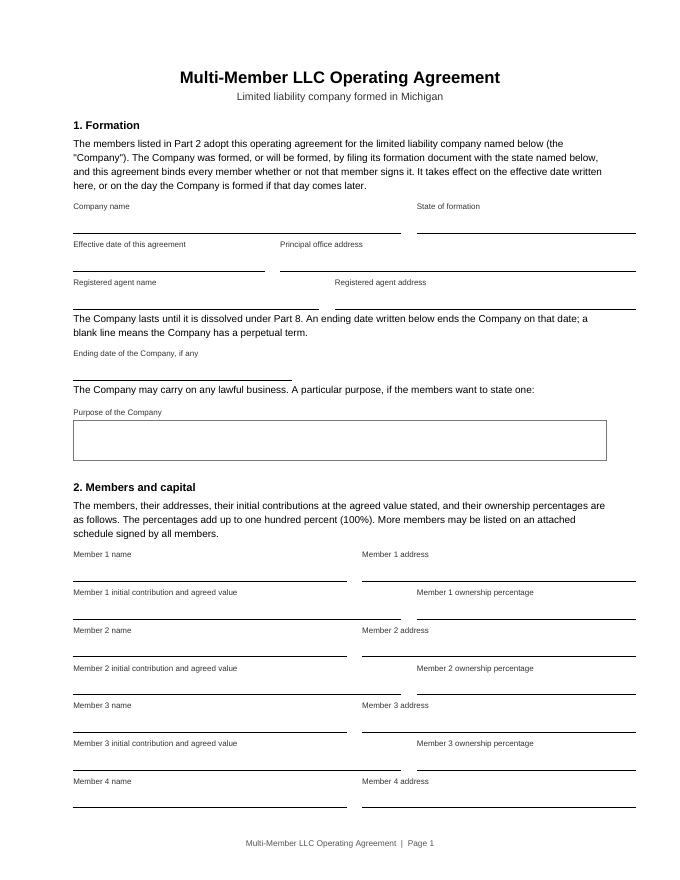
Each member block in Part 11 is signed; the manager signs the fifth block when Part 4 is marked manager-managed.
All four members named in Part 2 sign. MCL 450.4102(2)(r) defines an operating agreement as a written agreement “between all of the members”, and signing the initial operating agreement is also one of the ways a person is admitted as a member at formation when the agreement sets no other requirement (450.4501(1)(b)(i)). No notary or witness appears in MCL 450.4102, 450.4103, 450.4213 or 450.4501; 450.4103(3) says even a power of attorney used to sign a filed document need not be sworn to, verified, acknowledged or filed. Federal law covers an electronic signature: 15 U.S.C. 7001(a)(2) bars denying a contract about a transaction in or affecting interstate or foreign commerce its legal effect, validity or enforceability solely because an electronic signature or electronic record was used to form it.
Federal tax
A domestic eligible entity with two (2) or more members is classified as a partnership unless it elects otherwise (Treasury Regulation § 301.7701-3(b)(1)(i)). Part 6 of the document marks that default in its first box, and its second box after the company files Form 8832 to be taxed as a corporation or Form 2553 to elect S corporation treatment under section 1362(a). Form 1065 is the information return a partnership files, and a company applies for its employer identification number with Form SS-4.
Without an agreement
The act’s defaults run the company: one vote per member and equal shares of every distribution (a company in existence before July 1, 1997 that voted or shared by contributions keeps doing so until an agreement changes it; 450.4502(1)(b), (2), 450.4303(1)(b), (2)), unanimous approval before any member is paid an interim distribution (450.4304(2)), no right to withdraw (450.4509(1)), and unanimous votes to admit a member, to admit an assignee and to approve a merger (450.4501(2)(a), 450.4506(1), 450.4702(1)). The act’s default shield: unless otherwise provided by law or in an operating agreement, a person who is a member or manager is not liable for the acts, debts or obligations of the company (450.4501(4)). The LLC operating agreement also comes in a one-owner form, and the multi-member operating agreement is taken Part by Part.
Frequently asked questions
Can a member leave a Michigan LLC that has no agreement?
Not by withdrawing. MCL 450.4509(1) allows withdrawal “only as provided in an operating agreement”, so members who wrote nothing have no right to withdraw; a member may still assign the interest (450.4505(1), (4)). Part 8 of the document is that provision: ninety (90) days’ written notice, after which the member holds the interest as a transferee until the others admit the holder in writing or buy the interest at fair value within one hundred eighty (180) days.
What does “majority in interest” mean in Michigan?
MCL 450.4102(2)(n) defines it as a majority of the votes, as the operating agreement allocates them or as the act allocates them when the agreement is silent, held by members entitled to vote on the matter. With no agreement each member has one (1) vote (450.4502(1)(b); a company in existence before July 1, 1997 that voted by its share of distributions keeps doing so until an agreement changes it, 450.4502(2)), so it is a majority of the members; under Part 5 of the document it is a majority of the ownership percentages.
Does a manager owe the members a duty of care?
Yes. MCL 450.4404(1) requires a manager to act in good faith, with the care an ordinarily prudent person in a like position would exercise under similar circumstances, and in a manner the manager reasonably believes to be in the best interests of the company; the members of a member-managed company carry the same duties (450.4401(b)). An agreement may eliminate or limit a manager’s monetary liability for breaching that duty, within the four (4) exceptions of 450.4407.