

State Laws
North Carolina’s act is chapter 57D of the General Statutes (G.S. 57D-1-01). No section read on 2026-11-01 orders the owners to adopt an operating agreement, and G.S. 57D-1-03(23) defines one as any agreement about the LLC or an ownership interest that binds each interest owner, “in any form, including written, oral, or implied, or any combination thereof”. The same definition lets the agreement set its own form and folds the articles of organization into it. G.S. 57D-2-30(c) gives written terms the edge: an oral or implied term cannot override a written one against an outsider who reasonably relied on the writing. A person who becomes an interest owner is deemed to assent to the agreement (G.S. 57D-2-31(b)).
G.S. 57D-2-30(a) puts the chapter second: its provisions and the common law apply “only to the extent contrary or inconsistent provisions are not made in” the agreement, subject to subsections (b) through (e). That subsection holds five (5) numbered limits (its paragraphs (2) and (7) were recodified into paragraph (1)). The agreement may not vary the rules on filings with the Secretary of State and the courts, the annual report and articles of dissolution included ((b)(1)a); cut down the rights of non-parties ((b)(1)b); vary the sections in (b)(1)c, among them the nature and powers of the LLC (G.S. 57D-2-01, 57D-2-03), formation (G.S. 57D-2-20) and the dissolution events of G.S. 57D-6-01; diminish the wrongful-distribution rules of G.S. 57D-4-05 and 57D-4-06 ((b)(3)); diminish a member’s information rights under G.S. 57D-3-04(a) beyond what that section allows ((b)(4)); or remove the derivative action or the right to seek judicial dissolution without an alternative remedy ((b)(5), (6)).
The defaults the document replaces
| Rule | North Carolina default | Section |
|---|---|---|
| Management | Vested in the managers; all members are managers by virtue of being members unless the agreement says otherwise | G.S. 57D-3-20(a), (d) |
| Weight of a vote | Each manager has equal rights; a decision approved by a majority of the managers controls, and no meeting or notice is needed | G.S. 57D-3-20(b) |
| Ordinary decisions | Any manager may act for the LLC in the ordinary course, subject to the direction of a majority of the managers | G.S. 57D-3-20(c) |
| Admitting a member | A person acquiring an ownership interest from the LLC becomes a member on the unanimous approval of the members, or when the organizers identify the person as a member; an economic interest owner becomes one as G.S. 57D-5-04(a) or 57D-6-01(3) provides | G.S. 57D-3-03(2), 57D-3-01(a)(2), (3) |
| Amending the agreement | The approval of all members, to adopt or to amend | G.S. 57D-3-03(1) |
| Selling substantially all assets, converting, merging | The approval of all members | G.S. 57D-3-03(3), (5), (6) |
| Sharing of distributions | At the times and in the amounts the LLC decides, in proportion to the owners’ aggregate contribution amounts | G.S. 57D-4-03 |
| Transfer of an interest | An economic interest is transferable in whole or in part; the transfer does not entitle the transferee to become or exercise any rights of a member other than to receive the economic interest transferred; an economic interest owner may become a member only with that person’s approval, as the agreement provides, by the members’ approval under G.S. 57D-3-03(2), or in the manner G.S. 57D-6-01(3) permits | G.S. 57D-5-02, 57D-5-04(a) |
| Withdrawal | Except as the Chapter or other applicable law requires, no right to withdraw a capital interest or make the LLC buy or liquidate it; a person who abandons all rights of the ownership interest except the economic interest ceases to be a member | G.S. 57D-5-05, 57D-3-02(a)(4) |
| A member’s death | The person ceases to be a member; the estate, or the person through a designated agent or court-appointed guardian, becomes a special economic interest owner entitled to the economic interest, the member’s information rights and standing to seek judicial dissolution, unless the operating agreement expressly waives that standing | G.S. 57D-3-02(a)(2), (c) |
| Vote to dissolve | The approval of all members, apart from the events in Article 6; the 90th day with no member is one of those events, unless a member is admitted within the ninety (90) days | G.S. 57D-3-03(4), 57D-6-01(3) |
| Order of payment on winding up | Creditors first, including owners and managers who are creditors; the balance to the interest owners by contribution amounts | G.S. 57D-6-08 |
| Ceiling on distributions | None after which the LLC could not pay its debts as they become due, or its total liabilities would exceed the value of its assets | G.S. 57D-4-05(a) |
Part 4 of the document keeps the choice between member-managed and manager-managed, as G.S. 57D-3-20(d) permits; Part 5 counts votes by ownership percentage and lets holders of more than fifty percent (50%) decide ordinary matters, while the six (6) unanimous acts in Part 4 track G.S. 57D-3-03 and add borrowing outside the ordinary course. The ceiling in the last row cannot be lowered: G.S. 57D-4-06(a) makes a manager who approved a distribution over the line liable to the LLC for the excess if it is established that the manager failed the standard of G.S. 57D-3-21, with a proceeding barred unless commenced within two (2) years after the distribution, and G.S. 57D-2-30(b)(3) keeps that rule whatever the agreement says.
Forming the company
Deliver the articles of organization to the Secretary of State; keep the operating agreement at the principal office.
One or more persons form the LLC by delivering executed articles of organization to the Secretary of State; the LLC exists when the filed articles become effective, and the filing is conclusive proof that every condition of formation was met (G.S. 57D-2-20(a), (b)). G.S. 57D-2-21(a) lists five (5) contents: a name that satisfies G.S. 55D-20 and 55D-21; the name and address of each signer and whether that person signs as a member or an organizer; the registered office, its county and its agent; the principal office and county, if any; and the professional services of a professional limited liability company. The fee is $125 under G.S. 57D-1-22(a)(1), read 2026-11-01.
Every LLC except a professional one files an annual report (G.S. 57D-2-24(a)) giving its name, registered office and agent, the address and telephone number of its principal office, the names, titles and business addresses of its principal company officials, and a brief description of its business. The first report is due by April 15 of the year after the articles became effective, and one is due by each April 15 after that (G.S. 57D-2-24(b)); the fee is $200 (G.S. 57D-1-22(a)(28)). A report sent back for missing information is on time if corrected within thirty (30) days after the effective date of the notice (G.S. 57D-2-24(c)).
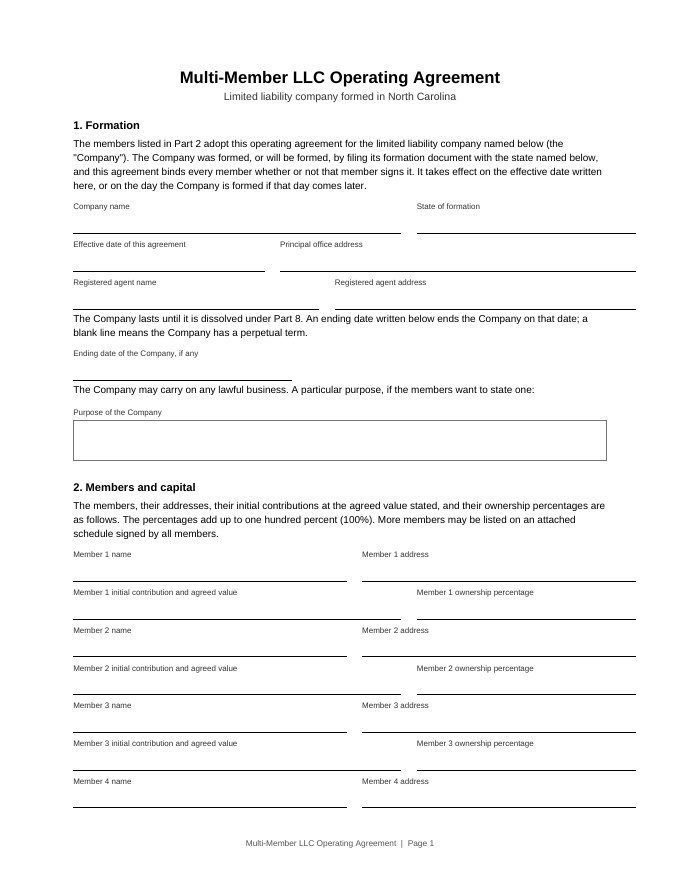
The operating agreement is not among the filings; the chapter asks instead that a member be able to see it. G.S. 57D-3-04(a)(1) entitles a member to inspect and copy the articles and “any other writing constituting all or part of the operating agreement” in effect during the four (4) preceding fiscal years, plus four years of tax returns or financial statements ((a)(2)). The member gives signed notice seven (7) days ahead stating what is wanted and why (G.S. 57D-3-04(d)) and inspects at the principal office or another location the LLC selects (G.S. 57D-3-04(e)), where Part 6 of the document keeps those records with six (6) years of returns.
Signing
Each of the four member blocks in Part 11 is signed; the manager signs the last block when the manager-managed box in Part 4 is marked.
Every member in Part 2 signs; adopting the agreement takes “the approval of all members” (G.S. 57D-3-03(1)); G.S. 57D-1-03(1) counts a vote at a meeting or any other assent given in the form the agreement sets for amendments. A member admitted later is bound without signing (G.S. 57D-2-31(b)). Nothing in G.S. 57D-1-03(23), 57D-2-30, 57D-2-31 or 57D-3-03 requires a notary or a witness. 15 U.S.C. 7001(a)(2) adds the federal rule for electronic signing: a contract in or affecting interstate or foreign commerce keeps its validity even though an electronic signature or record was used to form it.
Federal tax
Treasury Regulation § 301.7701-3(b)(1)(i) makes a domestic eligible entity with two (2) or more members a partnership for federal income tax unless it elects otherwise. Part 6 records that default in its first check box; the second box applies after the company files Form 8832 to be taxed as a corporation or Form 2553 to be taxed as an S corporation. Form 1065 is the partnership’s return, and Form SS-4 is how the company applies for an employer identification number.
Without an agreement
The chapter supplies what the agreement leaves out: G.S. 57D-2-30(a) applies its provisions and the common law wherever the agreement makes no contrary provision. Limited liability does not depend on the agreement, since G.S. 57D-3-30 says an interest owner, manager or other company official is not liable for the LLC’s obligations solely by reason of that position. The LLC operating agreement covers a company with one owner, and the multi-member operating agreement describes each part in turn.
Frequently asked questions
Does a handshake agreement count in North Carolina?
Yes. G.S. 57D-1-03(23) accepts an oral or implied agreement. However, G.S. 57D-2-30(c) stops an oral term from overriding a written one against an outsider who relied on the writing.
Can a member take back the money put in?
Not without the others. Except as the Chapter or other applicable law requires, G.S. 57D-5-05 says an interest owner may not withdraw, or compel the LLC to buy or liquidate, any part of a capital interest, and may not extinguish, abandon or diminish the obligations that go with the ownership interest. Part 8 of the document adds a way out: ninety (90) days’ notice makes the member a transferee, and the others may buy the interest at fair value within one hundred eighty (180) days.
What does the estate of a member who dies receive?
G.S. 57D-3-02(a)(2) ends membership at death, and G.S. 57D-3-02(c) makes the estate a special economic interest owner holding the economic interest, the information rights of G.S. 57D-3-04 and standing to seek judicial dissolution under G.S. 57D-6-02(2) unless the agreement expressly waives that standing. The estate is not a member (G.S. 57D-3-02(a)(2), 57D-1-03(32c)).