

State Laws
New Jersey’s act is the Revised Uniform Limited Liability Company Act, N.J.S. 42:2C-1 to 42:2C-94. No section read on 2026-11-02 orders the members to adopt an operating agreement or to put one in writing. N.J.S. 42:2C-2 defines the term as the agreement of all the members, a sole member included, “whether oral, in a record, implied, or in any combination thereof”, about the matters listed in 42:2C-11(a). The company is bound by the agreement whether or not it has itself assented, and a person who becomes a member is deemed to assent (42:2C-12(a), (b)).
42:2C-11(a) hands the agreement four (4) subjects: relations among the members and between them and the company, a manager’s rights and duties under the act, the company’s activities, and how the agreement is amended; 42:2C-11(b) applies the act to any matter in subsection (a) that the agreement does not provide for. Subsection (c) names eleven (11) things the agreement may not do, among them, subject to subsections (d) through (g), eliminate the duty of loyalty, the duty of care or any other fiduciary duty ((c)(4)) or the contractual obligation of good faith and fair dealing ((c)(5)); unreasonably restrict the duties and rights stated in 42:2C-40 ((c)(6)); or vary the requirement to wind up in 42:2C-49(a) and (b)(1) ((c)(8)). Subsection (g) lets it alter or eliminate the indemnification of 42:2C-38 and eliminate or limit a member’s or manager’s liability to the company and members for money damages, except for five (5) listed items, among them a breach of the duty of loyalty and a breach of a duty under 42:2C-36. The act “is to be liberally construed to give the maximum effect to the principle of freedom of contract” (42:2C-11(i)).
The defaults the document replaces
| Rule | New Jersey default | Section |
|---|---|---|
| Management | Member-managed, unless the agreement expressly says the company is or will be “manager-managed” or “managed by managers”, that management is or will be “vested in managers”, or uses words of similar import | N.J.S. 42:2C-37(a) |
| Weight of a vote | Each member has equal rights in the management and conduct of the company’s activities; in a manager-managed company each manager has equal rights | 42:2C-37(b)(2), (c)(2) |
| Ordinary decisions | A difference among members in the ordinary course may be decided by a majority of the members; among managers, by a majority of the managers | 42:2C-37(b)(3), (c)(3) |
| Acts outside the ordinary course | The consent of all members, in a member-managed and in a manager-managed company alike | 42:2C-37(b)(4), (c)(4)(c) |
| Admitting a member | After formation, as the agreement provides, through a merger, conversion or domestication, or with the consent of all the members; within ninety (90) consecutive days after the company ceases to have any member, a person the last member or that member’s legal representative designates and who consents | 42:2C-31(c) |
| Amending the agreement | The consent of all members | 42:2C-37(b)(5), (c)(4)(d) |
| Selling substantially all assets | In a manager-managed company, the consent of all members; in a member-managed company it is an act outside the ordinary course, which also takes all members | 42:2C-37(c)(4)(a), (b)(4) |
| Choosing or removing a manager | A majority of the members may choose a manager at any time and may remove one at any time without notice or cause | 42:2C-37(c)(5) |
| Sharing of distributions | In equal shares among members and dissociated members, except as needed to give effect to a transfer under 42:2C-42 or a charging order under 42:2C-43; a distribution before dissolution is owed only if the company decides to make one | 42:2C-34(a), (b) |
| Transfer of an interest | Permissible in whole or in part; it does not by itself dissociate the member or dissolve the company; subject to 42:2C-44 it does not entitle the transferee to take part in management or, except as 42:2C-42(c) provides, to have access to records or other information; the transferee has the right to receive the distributions the transferor would otherwise be entitled to | 42:2C-42(a), (b) |
| Withdrawal | A person may dissociate at any time, rightfully or wrongfully, by express will; the dissociation is wrongful if it breaches an express term of the agreement, and it does not entitle the person to a distribution | 42:2C-45(a), (b)(1), 42:2C-34(b) |
| A member’s death | The member is dissociated; the interest is then owned solely as a transferee, subject to 42:2C-44; the personal representative or other legal representative may exercise a transferee’s right under 42:2C-42(c) to an account from the date of dissolution and, for the purposes of settling the estate, the information rights of a current member under 42:2C-40 | 42:2C-46(f)(1), 42:2C-47(a)(3), 42:2C-44 |
| Vote to dissolve | The consent of all the members; also the passage of ninety (90) consecutive days during which the company has no members | 42:2C-48(a)(2), (3) |
| Order of payment on winding up | Creditors first, members who are creditors included; then the value of unreturned contributions; then equal shares among members and dissociated members, except as needed to give effect to a transfer under 42:2C-42, all paid in money; the surplus steps are subject to any order in effect under 42:2C-43, and if the surplus cannot cover unreturned contributions it is shared in proportion to their value | 42:2C-56(a) to (d) |
| Ceiling on distributions | None after which the company could not pay its debts as they become due in the ordinary course of its activities, or its total assets would be less than its total liabilities plus the amount needed on dissolution to satisfy the preferential rights of members whose rights rank above those receiving the distribution | 42:2C-35(a) |
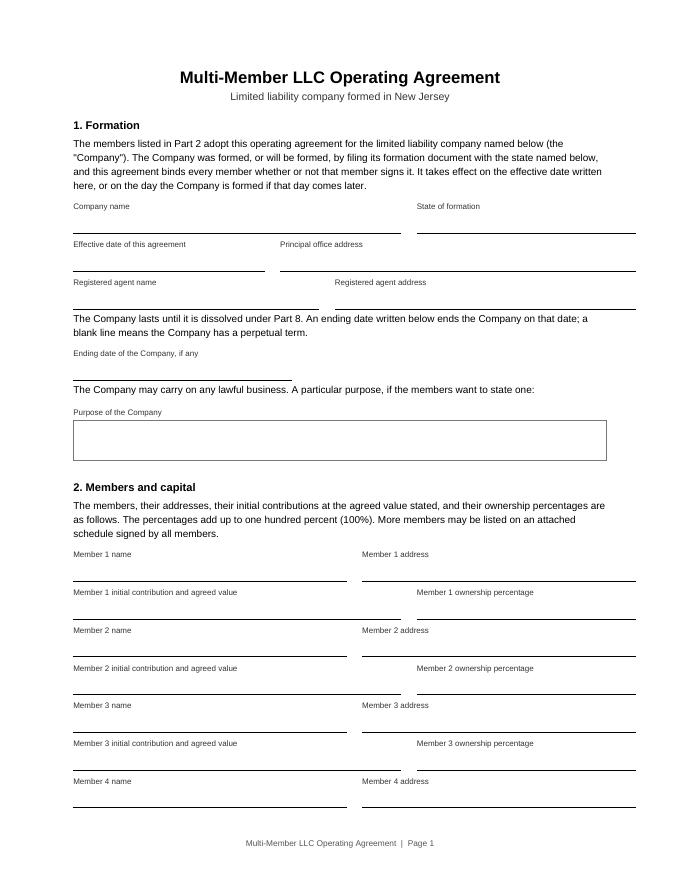
Part 5 weighs votes and Part 3 shares profits, losses and distributions by ownership percentage instead of per head, and Part 4 lists six (6) acts that take the written consent of all members, where 42:2C-37(b)(4) would otherwise reach any act outside the ordinary course. The ceiling stays put. Except as 42:2C-36(b) provides, a member of a member-managed company or a manager of a manager-managed company who consents to a distribution made in violation of 42:2C-35 and in consenting fails to comply with 42:2C-39 is personally liable to the company for the amount that exceeds what could have been distributed without the violation, and an action is barred two (2) years after the distribution (42:2C-36(a), (b), (e)). 42:2C-11(g)(3) keeps that liability outside what the agreement may limit.
Forming the company
Sign the certificate of formation and deliver it to the Division of Revenue with the $100 fee; the operating agreement stays with the company’s records.
One or more organizers form the company by signing a certificate of formation and delivering it to the filing office under 42:2C-2 (the Division of Revenue in the Department of the Treasury, or another State office the law designates) (42:2C-18(a)). The certificate states two (2) things: a name that complies with 42:2C-8, so it contains “limited liability company”, “L.L.C.” or “LLC”, and the street and mailing addresses of the initial registered office with the name of the initial agent for service of process at that office (42:2C-18(b)). The company is formed when the filing office has filed the certificate and the company has at least one member, unless the certificate states a delayed effective date (42:2C-18(d)). The fee is $100 under 42:2C-93(a)(4), and the Division’s Getting Registered page, last updated 07/01/26 and read 2026-11-02, states the same $100 for every for-profit entity.
Every limited liability company files an annual report stating its name and address, its registered agent’s name and address, and the names and addresses of its managing members or managers (42:2C-26(a)); the fee is $75 (42:2C-93(a)(6)). 42:2C-26 fixes no filing date. If no report is filed for two (2) consecutive years, the certificate of a domestic company is transferred to an inactive list; the company remains a limited liability company and its members’ and managers’ limited liability is not affected, but its name, subject to any other rights the company has to it, is available for use by any other limited liability company (42:2C-26(b)(1)). Under 42:2C-53 the filing office may place a company on the inactive list if it does not file annual reports for two (2) consecutive years or does not pay a fee within sixty (60) days after the due date; it sends notice first, and the company has sixty (60) days after service to correct each ground (42:2C-53(a) to (c)). A company on the inactive list continues in existence but, subject to 42:2C-54, may carry on only the activities needed to wind up (42:2C-53(d)); it may apply to the filing office for reinstatement (42:2C-54(a)), and a reinstatement filed two (2) or more years after placement requires a tax clearance certificate (42:2C-54(d)).
The operating agreement is not among those filings. The act keeps no list of records a company must hold; 42:2C-40 gives access instead. In a member-managed company a member may, on reasonable notice, inspect and copy during regular business hours, at a reasonable location the company specifies, any record the company maintains regarding its activities, financial condition and other circumstances, to the extent the information is material to the member’s rights and duties under the operating agreement or the act (42:2C-40(a)(1)); in a manager-managed company the company must, within ten (10) days after a demand in a record, inform the member in a record of what it will provide and when and where, and its reasons for declining any of it (42:2C-40(b)(2), (3)). Part 6 of the document holds the agreement, the certificate and the contribution record at the principal office alongside six (6) years of tax returns and three (3) years of financial statements.
Signing
Each member signs one of the four member blocks in Part 11; the manager signs the fifth block when Part 4 marks the company manager-managed.
Every member in Part 2 signs. The act defines the agreement as that of all the members (42:2C-2), the consent of all members is what amends it (42:2C-37(b)(5)), and a member admitted later is deemed to assent without signing (42:2C-12(b)). To “sign”, under 42:2C-2, includes attaching to the record an electronic symbol, sound or process with the present intent to adopt it. Nothing in 42:2C-2, 42:2C-11, 42:2C-12, 42:2C-18 or 42:2C-20 names a notary or a witness. The federal rule is 15 U.S.C. 7001(a)(2), which denies no contract in or affecting interstate or foreign commerce its legal effect, validity or enforceability on the ground that an electronic signature or record formed it.
Federal tax
For federal income tax, Treasury Regulation § 301.7701-3(b)(1)(i) puts a domestic eligible entity that has two (2) members or more in the partnership column until it elects otherwise, and 42:2C-92(a) makes New Jersey follow suit: a company with two or more members is a partnership for state taxation unless classified otherwise for federal income tax. Part 6 marks that default, or the election made on Form 8832 (corporation) or Form 2553 (S corporation). The partnership’s information return is Form 1065, and the company applies for its employer identification number on Form SS-4.
Without an agreement
42:2C-11(b) is the fallback: to the extent the agreement does not provide for a matter, “this act governs the matter”. A company with no agreement therefore pays distributions in equal shares, needs every member for any act outside the ordinary course, and lets a member leave at any time with no payout. 42:2C-30(a) still makes the company’s debts solely the company’s, and 42:2C-30(b) adds that a failure to observe formalities is not a ground for imposing liability on the members or managers. A company with one owner uses the single-member version of the LLC operating agreement; the multi-member operating agreement sets out the eleven (11) parts of the four-member document.
Frequently asked questions
Can a New Jersey LLC run on an oral operating agreement?
Yes. 42:2C-2 counts an agreement that is oral, in a record, implied or any combination of those. However, 42:2C-13(d)(2) lets a filed record prevail over the agreement as to outsiders who reasonably rely on the record.
Does a member who leaves get paid out?
Not by default. 42:2C-34(b) says a person’s dissociation does not entitle the person to a distribution, and 42:2C-47(a)(3) leaves the departing member holding the transferable interest solely as a transferee, subject to 42:2C-44 and Article 10 (sections 73 through 87). Part 8 of the document asks ninety (90) days’ notice of a withdrawal and gives the remaining members one hundred eighty (180) days to buy the interest at fair value.
Can a member be paid a salary?
The act does not entitle a member to remuneration for services performed for a member-managed company, apart from reasonable compensation for services in winding up (42:2C-37(f)); pay is for the members to agree. 42:2C-35(g) excludes reasonable compensation for services from the definition of a distribution, as Part 3 of the document does.